AI in Healthcare Staffing: How Agencies Are Improving Candidate Experience
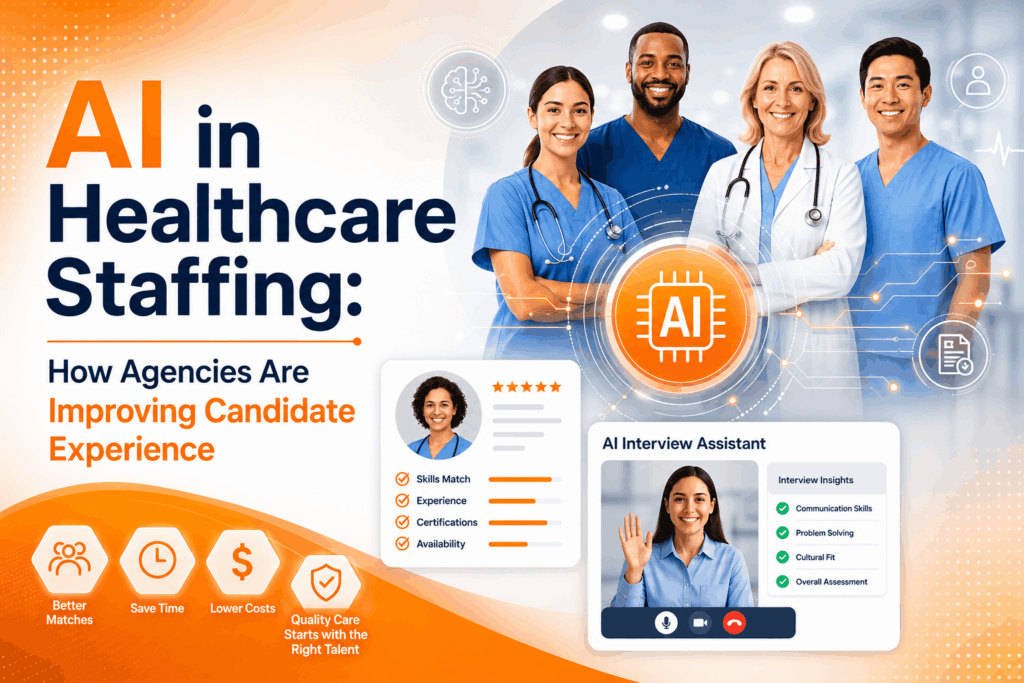
AI in healthcare staffing is defined as the use of artificial intelligence tools, such as chatbots, predictive analytics, and automated screening software, to match clinicians with open roles faster while improving communication throughout the hiring process. Healthcare staffing agencies use it to reduce time-to-hire and boost candidate satisfaction.
Key Takeaways: AI in Healthcare Staffing at a Glance
- AI in healthcare staffing cuts time-to-fill by automating resume screening, scheduling, and initial outreach.
- Healthcare staffing agency AI tools, including chatbots, now handle routine candidate questions around the clock.
- Hiring managers increasingly lean on staffing firms to help manage AI-related hiring challenges, per 2026 survey data.
- The U.S. faces a projected shortage of over 108,000 registered nurses by 2038, making candidate experience a key differentiator.
- AI recruitment automation improves communication consistency, reducing drop-off in traditional hiring pipelines.
- Predictive AI healthcare recruitment tools help agencies anticipate staffing gaps before they affect patient care.
What Is AI in Healthcare Staffing?
AI in healthcare staffing is the application of machine learning, natural language processing, and predictive analytics to recruit, screen, and place clinicians such as nurses, therapists, and allied health professionals. It automates repetitive tasks so recruiters can focus on relationship-building and complex placements.
Traditional staffing relies on manual resume review, phone screens, and spreadsheet tracking, a model that struggles against a growing shortage. According to the Health Resources and Services Administration (2025), the U.S. is projected to face a shortage of 108,960 registered nurses by 2038. AI in healthcare staffing closes this gap by compressing the time between application and offer, a shift explored further in The Rise of Predictive Analytics in Healthcare Workforce Planning.
How Does AI Differ From Traditional Healthcare Staffing Methods?
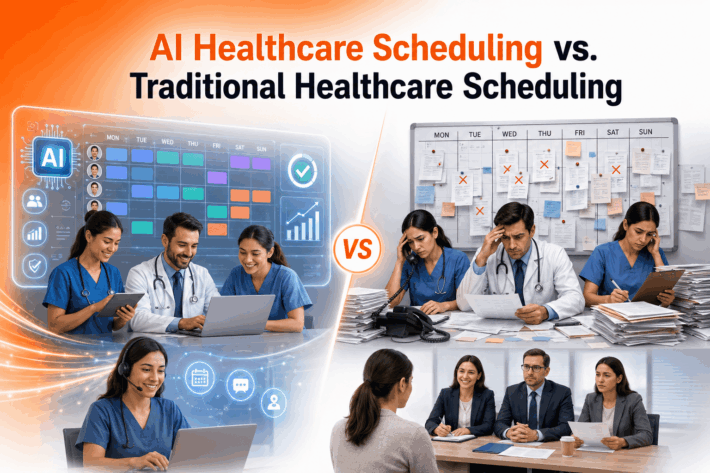
The difference between AI-powered and traditional healthcare staffing is speed, consistency, and data use. Traditional staffing relies on manual sourcing and delayed follow-up, while AI-driven staffing uses automated matching, real-time messaging, and predictive analytics to move candidates through the pipeline in days rather than weeks.
| Factor | Traditional Healthcare Staffing | AI-Powered Healthcare Staffing |
|---|---|---|
| Resume screening | Manual review, hours per batch | Automated scoring in seconds |
| Candidate communication | Phone/email, business hours only | Chatbots and SMS, available 24/7 |
| Time-to-fill | Weeks for specialized roles | Days, using predictive matching |
| Shortage forecasting | Reactive, based on current openings | Proactive, based on predictive models |
| Candidate follow-up consistency | Varies by recruiter workload | Standardized and automated |
How Healthcare Staffing Agency AI Improves the Candidate Experience
Healthcare staffing agency AI improves candidate experience by providing instant responses, personalized job matches, and transparent status updates throughout the hiring process. This reduces the uncertainty and long silences that historically frustrated nurses and allied health candidates during job searches.
When a travel nurse applies to three agencies at once, the one that replies first and keeps replying consistently usually wins the placement. AI recruitment automation makes that responsiveness possible at scale, even when recruiters manage hundreds of open requisitions.
What Are the Top Ways AI Improves Candidate Experience in Healthcare Staffing?
Here are the top ways AI improves candidate experience in healthcare staffing:
- Instant application acknowledgment. Chatbots confirm receipt of an application within seconds instead of days.
- 24/7 candidate support. AI assistants answer scheduling, credentialing, and pay-rate questions outside business hours.
- Smarter job matching. Machine learning matches clinician licenses, specialties, and location preferences to relevant openings automatically.
- Automated interview scheduling. AI coordinates calendars between recruiters, hiring managers, and candidates without email back-and-forth.
- Personalized communication. Natural language tools tailor outreach based on a candidate’s specialty, such as ICU, ER, or long-term care.
- Faster credentialing checks. AI cross-references licenses and certifications against compliance databases in real time.
This directly supports themes covered in AI and Nurse Burnout: How Smarter Staffing Supports Retention, which notes that reducing administrative friction for clinicians starts at the recruiting stage, before they are even hired.
How Does AI Recruitment Automation Speed Up Onboarding?
AI recruitment automation speeds up onboarding by digitizing credential verification, background checks, and compliance paperwork so new hires can start assignments faster. Automated workflows route documents to compliance staff instead of sitting in a shared inbox.
A single credentialing bottleneck can push a nurse’s start date back by a week or more, leaving a hospital unit understaffed. AI recruitment automation flags missing documents immediately and sends automated reminders, shortening the gap between offer acceptance and first shift.
Why AI Healthcare Recruitment Matters for Reducing Burnout and Turnover
AI healthcare recruitment matters for reducing burnout and turnover because it shortens the stressful gap between job search and placement, giving clinicians more certainty about schedules and assignments. Less administrative friction during hiring translates into a smoother transition into new roles.
Burnout is frequently tied to short-staffed units and last-minute scheduling. When AI in healthcare staffing helps agencies fill roles faster, it reduces strain on existing staff covering gaps. According to Robert Half (2026), 67% of hiring managers say they are more likely to seek support from a staffing firm to navigate AI-related hiring challenges.VIVA USA’s article, How to Measure the ROI of AI in Healthcare Staffing, ties AI adoption directly to retention metrics, not just fill rates.
What Role Does Predictive Staffing Play in Preventing Shortages?
Predictive staffing uses historical placement data, seasonal demand patterns, and regional workforce trends to forecast where clinician shortages will occur before they happen. Agencies use these forecasts to pre-recruit candidates for high-demand specialties and regions.
According to the U.S. Bureau of Labor Statistics (2025), healthcare occupations are projected to add about 1.9 million job openings annually through 2034. Agencies that use predictive AI healthcare recruitment tools can position candidate pipelines against that demand curve instead of scrambling once a hospital posts an urgent need. Related detail is available in AI Predictive Staffing: How Hospitals Prevent Workforce Shortages.
AI Candidate Experience in Action: A Real-World Example
A real-world example of AI candidate experience is a healthcare staffing agency that deployed a chatbot and automated matching system for inbound nurse applications, replacing slow manual follow-up with instant, consistent communication across every stage of the recruiting and hiring process.
This mid-size agency used the system for travel and per-diem nurse applications. Within the first quarter, average response time dropped from 48 hours to under 10 minutes, and candidates cited that responsiveness as a reason they accepted offers over competing agencies. The system also flagged incomplete license documentation immediately, cutting the credentialing cycle by several days, a pattern also described in The Rise of AI-Augmented Recruiters in IT Staffing.
What Results Can Healthcare Staffing Agencies Expect From AI Recruitment Automation?
Healthcare staffing agencies that adopt AI recruitment automation typically see faster response times, lower candidate drop-off rates, and shorter credentialing cycles within the first few months of implementation. Results vary by agency size, but the direction is consistent across reported case studies.
- Faster first response to applicants, often within minutes instead of days
- Reduced candidate drop-off during multi-step application processes
- Shorter time between offer acceptance and first shift
- More consistent communication across large candidate pools
Best Practices for Implementing AI in Healthcare Staffing
Implementing AI in healthcare staffing successfully requires pairing automation with human oversight, starting with high-volume repetitive tasks, auditing algorithms for bias, and training recruiters properly, especially for compliance-sensitive steps like credential verification where accuracy and state licensing rules matter most.
According to Deloitte (2026), 59% of organizations take a primarily technology-focused approach to AI adoption, yet that approach alone is 1.6 times more likely to fall short of expected returns. Agencies that pair automation with skilled recruiters see stronger adoption and candidate trust.
What Are the Top 5 Best Practices for Adopting AI in Healthcare Staffing?
Here are the top 5 best practices for adopting AI in healthcare staffing:
- Start with high-volume, repetitive tasks such as resume screening and initial outreach before automating complex decisions.
- Keep recruiters in the loop for final interviews and offer negotiations, where personal rapport matters most.
- Audit AI matching algorithms regularly to check for bias and ensure compliance with healthcare licensing requirements.
- Train staff on AI skills, a trend detailed in Why AI Skills Are Becoming Mandatory in AI-Powered Hiring, so recruiters can supervise and refine automated workflows.
- Measure candidate experience metrics, including response time and drop-off rate, before and after implementation to confirm ROI.
Conclusion: The Future of AI in Healthcare Staffing
AI in healthcare staffing is reshaping how agencies attract, communicate with, and place clinicians, directly improving candidate experience through faster responses, smarter matching, and automated credentialing. It also helps agencies stay ahead of a nursing shortage projected to exceed 108,000 RNs by 2038. Agencies that combine AI recruitment automation with skilled recruiters see stronger candidate trust and retention.
Ready to see how AI-driven staffing can improve your hiring outcomes? Contact VIVA USA today to learn how our healthcare staffing solutions connect qualified clinicians with the roles that need them most.