The Rise of Predictive Analytics in Healthcare Workforce Planning
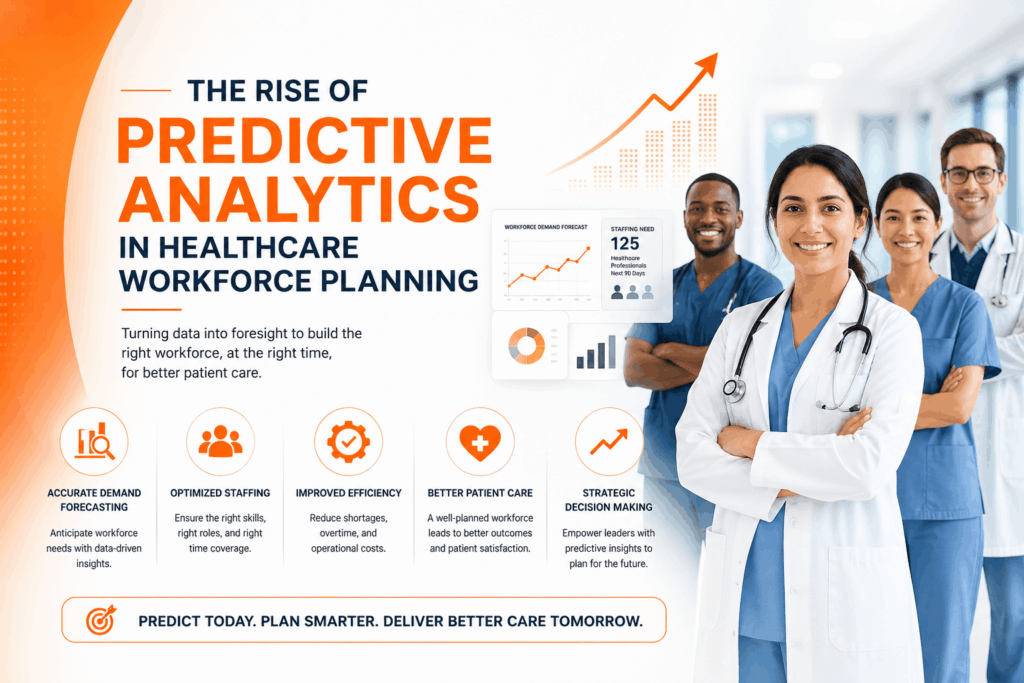
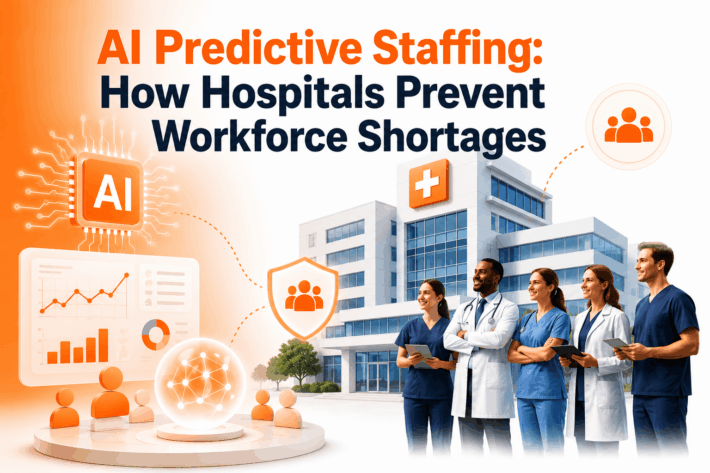
Predictive analytics in healthcare is the use of historical data, statistical algorithms, and machine learning to forecast future staffing needs, patient volumes, and workforce trends. Healthcare organizations apply these tools to reduce labor shortages, cut costs, and improve patient outcomes by making data-driven decisions about hiring, scheduling, and workforce deployment before gaps occur.
Key Takeaways
- Predictive analytics in healthcare helps organizations forecast staffing needs before shortages happen, not after.
- The U.S. is projected to face a shortage of up to 124,000 physicians by 2034, making data-driven workforce planning a strategic necessity.
- Hospitals using predictive workforce tools report up to a 20% reduction in agency staffing costs.
- AI-powered scheduling platforms like Kronos Workforce Dimensions and Oracle Health now integrate directly with predictive analytics dashboards.
- Healthcare staffing decisions driven by predictive models reduce nurse turnover by identifying at-risk employees before they resign.
- Organizations that invest in predictive analytics are better positioned to respond to seasonal surges, public health crises, and demographic shifts.
What Is Predictive Analytics in Healthcare Workforce Planning?
Predictive analytics in healthcare workforce planning is the application of data modeling tools to anticipate staffing shortfalls, turnover risk, and patient demand before they impact operations. Rather than reacting to a nursing shortage or an ER surge after it occurs, healthcare administrators use real-time data feeds, historical staffing patterns, and external labor market signals to plan proactively.
How Does Predictive Analytics Work in Healthcare Hiring?
Healthcare hiring powered by predictive analytics works by ingesting multiple data streams, including historical turnover rates, employee engagement scores, patient census data, and local labor market conditions, and running them through machine learning models to surface actionable forecasts. For example, a health system might identify that nurses in the ICU with fewer than two years of tenure and below-average engagement scores have an 82% probability of leaving within six months. Armed with that prediction, HR teams can intervene with targeted retention programs before a vacancy opens.
Platforms like Oracle Health, Workday Adaptive Planning, and SAP SuccessFactors now offer native predictive analytics modules designed specifically for healthcare workforce management.
What Are the Core Components of a Healthcare Predictive Analytics System?
A healthcare predictive analytics system typically includes the following components:
- Data ingestion layer — Pulls from EHR systems, HRIS platforms, payroll, and patient census tools
- Statistical modeling engine — Applies regression analysis, time-series forecasting, and machine learning algorithms
- Demand forecasting module — Predicts patient volumes by unit, shift, and season
- Supply modeling module — Maps available staff credentials, hours, and geographic distribution
- Risk scoring engine — Flags individual employees or roles with high turnover probability
- Decision dashboard — Presents forecasts in visual formats for operational leaders and HR teams
Why Predictive Analytics in Healthcare Is Now a Staffing Imperative
The U.S. healthcare labor market is under significant structural pressure. An aging population, a wave of retiring Baby Boomer clinicians, and post-pandemic burnout have converged to create one of the most acute healthcare staffing environments on record. Predictive analytics in healthcare shifts the workforce strategy from reactive to anticipatory.
- According to the Association of American Medical Colleges (2023), the United States could face a shortage of between 37,800 and 124,000 physicians by 2034, driven primarily by population aging and physician retirement.
- According to PR Newswire (2024), the global healthcare analytics market is projected to reach $96.9 billion by 2030, reflecting the scale of investment health systems are directing toward data-driven decision-making.
- According to Deloitte (2023), 76% of healthcare executives surveyed reported that workforce shortages represent their top operational risk, and 54% said they planned to increase investment in workforce analytics tools within 18 months.
- Registered nurse turnover rates reached 22.5% in 2023, costing the average hospital between $3.6 million and $6.5 million annually in replacement and agency costs.
- According to Forbes (2023), hospitals that deployed predictive scheduling and workforce analytics tools reduced their reliance on agency staffing by an average of 18% within the first 12 months of implementation.
What Is the Cost of Reactive Healthcare Staffing?
The cost of reactive healthcare staffing is measured in three ways: direct replacement costs, patient safety risk, and operational inefficiency. When a hospital scrambles to fill an open shift with a travel nurse, the average daily rate for a travel RN in 2024 ranges from $2,800 to $4,200, according to Staffing Industry Analysts. That is three to four times the cost of a permanently employed nurse. Predictive analytics allows staffing teams to replace expensive reactive fills with lower-cost proactive planning.
Which Healthcare Specialties Benefit Most from Predictive Workforce Tools?
The healthcare specialties that benefit most from predictive workforce tools include:
- Emergency medicine — Patient volumes are highly seasonal and surge-prone
- Critical care / ICU — Credentialing requirements make last-minute replacement extremely costly
- Surgical services — OR scheduling depends on precise staff-to-procedure matching
- Behavioral health — High burnout rates and chronic understaffing make retention modeling critical
- Home health and long-term care — Geographic dispersion makes route-optimized scheduling a high-value use case
Real-World Applications of Predictive Analytics in Healthcare Workforce Planning
The difference between theoretical capability and operational impact is visible in the case studies emerging from health systems that have adopted predictive analytics in healthcare at scale. The following examples illustrate how data-driven workforce strategies are being applied across different care settings.
How Did a Major Health System Use Predictive Analytics to Reduce Nurse Turnover?
Northwell Health, a 21-hospital system based in New York, implemented a predictive retention analytics platform developed with IBM Watson Health in 2022. The system analyzed over 200 variables per employee, including shift preference mismatches, commute distance changes, overtime accumulation, and manager tenure. Within 18 months, Northwell reported a 14% reduction in voluntary RN turnover and avoided an estimated $12 million in replacement costs.
The model flagged nurses at high attrition risk 90 to 120 days before they typically resigned, giving HR teams a meaningful intervention window. Retention strategies deployed in response included schedule flexibility programs, tuition reimbursement acceleration, and targeted manager coaching.
What Role Does AI Play in Healthcare Scheduling and Demand Forecasting?
AI plays three primary roles in healthcare scheduling and demand forecasting:
- Volume prediction — Machine learning models trained on years of patient admissions data can forecast ER volumes by day, shift, and season with 85-92% accuracy, according to a 2023 study in the Journal of the American Medical Informatics Association.
- Skill-mix optimization — AI platforms match the credentialing and competency profiles of available staff to forecasted patient acuity levels, reducing over-deployment of high-cost specialists.
- Fatigue risk modeling — Advanced systems flag scheduling patterns that correlate with clinician errors and burnout, allowing supervisors to intervene before patient safety is compromised.
How to Build a Predictive Analytics Strategy for Healthcare Workforce Planning
A predictive analytics strategy for healthcare workforce planning is built in four stages: data consolidation, model selection, integration, and governance. Most health systems already have the raw data required — the challenge lies in connecting disparate systems and ensuring data quality.
What Data Sources Are Needed for Healthcare Workforce Predictive Analytics?
The data sources required for healthcare workforce predictive analytics include:
| Data Source | What It Predicts |
|---|---|
| EHR / ADT patient census | Patient volumes by unit, shift, and season |
| HRIS / payroll records | Turnover patterns, tenure risk, absenteeism |
| Employee engagement surveys | Early attrition signals |
| Local labor market data (BLS) | External supply constraints and wage pressures |
| Credentialing and licensing records | Skill-mix gaps and compliance risk |
| Agency staffing usage logs | Over-reliance patterns and cost drivers |
What Are Common Barriers to Predictive Analytics Adoption in Healthcare?
The most common barriers to predictive analytics adoption in healthcare are data silos, budget constraints, and a shortage of analytics talent. Many health systems operate on legacy EHR platforms that do not natively integrate with modern analytics tools. Smaller community hospitals often lack dedicated data science teams. Staffing partners and healthcare-focused analytics vendors like Inovalon, Arcadia, and Health Catalyst offer managed solutions that reduce the internal capability requirements for predictive workforce modeling.
Conclusion
Predictive analytics in healthcare is transforming how health systems approach staffing, hiring, and workforce retention. The convergence of a physician and nursing shortage, rising labor costs, and increasingly capable AI tools has made data-driven workforce planning a clinical and financial priority. Organizations that implement predictive models gain the ability to anticipate shortfalls, protect staff wellbeing, and deliver better patient care.
The three core benefits are clear: proactive hiring reduces agency dependency, early attrition detection cuts turnover costs, and AI-driven scheduling improves patient safety. For healthcare organizations looking to build a smarter, more resilient workforce strategy, the time to act is now.
Help Center
Frequently asked questions
Quick answers to questions you may have. Can't find what you're looking for? Check out our full documentation.