Generative AI in Healthcare Staffing: Five Practical Use Cases
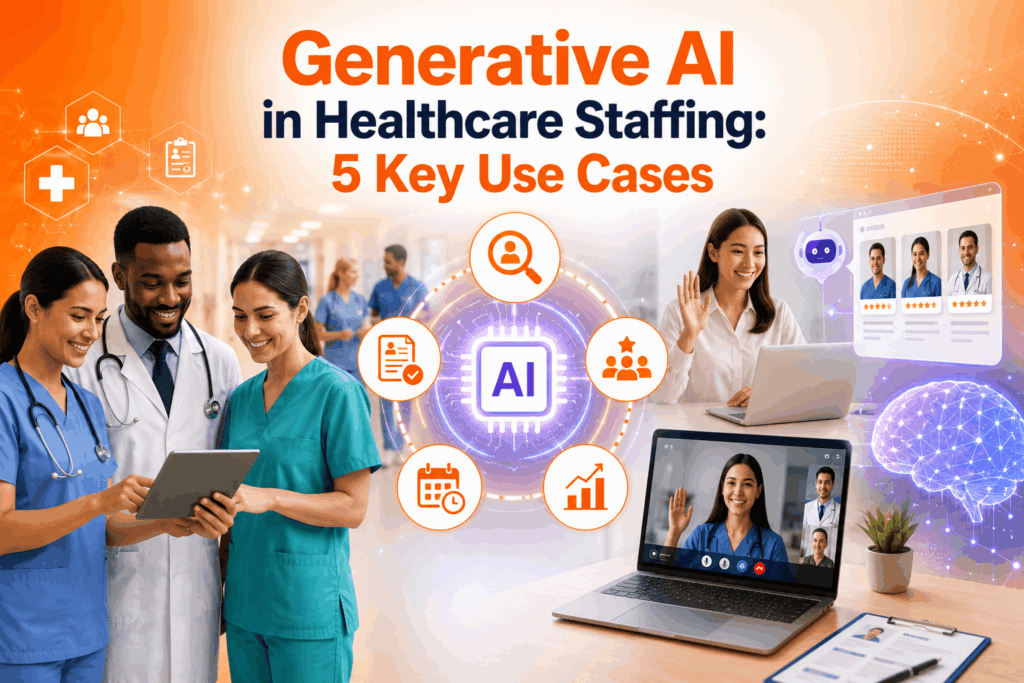
Generative AI in healthcare staffing is defined as using AI tools, including large language models and chatbots, to automate resume screening, candidate communication, job description writing, scheduling, and workforce forecasting. Staffing agencies and hospital HR teams use these tools to fill nursing and physician roles faster in 2026.
Key Takeaways: Generative AI Healthcare Recruitment at a Glance
This technology speeds up healthcare hiring by automating repetitive recruiting tasks such as screening and messaging, freeing recruiters to focus on relationship building, clinical vetting, and compliance review. The facts below highlight why healthcare employers are adopting these tools now.
- Generative AI screens resumes, drafts job postings, and personalizes candidate outreach in minutes, not hours.
- Robert Half (2026) reports 67% of hiring managers are more likely to use a staffing firm for AI-related hiring challenges.
- AMN Healthcare research (2026) found 81% of physicians now use AI, more than double the 2023 rate.
- Only 27% of talent professionals report using or experimenting with generative AI today, per LinkedIn (2025).
- The five use cases covered are screening, AI candidate communication, job descriptions, scheduling, and forecasting.
- GenAI in healthcare HR can reclaim 13% to 21% of nurses’ working hours annually.
Five Practical Use Cases of Generative AI in Healthcare Staffing
This technology supports recruiters across the entire hiring funnel, from sourcing to onboarding. Here are the top five ways healthcare staffing agencies and hospital HR departments use generative AI to reduce time-to-fill for hard-to-staff clinical and allied health roles nationwide.
How Does AI Automate Resume Screening for Healthcare Roles?
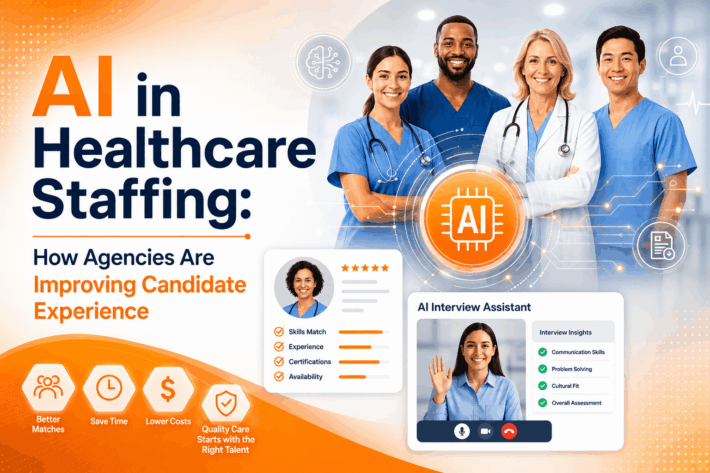
AI-powered applicant tracking systems use generative AI to read resumes, match licensure requirements, and rank candidates for roles such as RNs, LPNs, and radiology technologists, cutting screening time from hours to minutes while recruiters still review top matches before offers.
What Is AI Candidate Communication in Healthcare Recruitment?
AI candidate communication is defined as using chatbots, SMS bots, and generative AI email tools to answer candidate questions, send reminders, and follow up with applicants at any hour, keeping healthcare candidates engaged and reducing drop-off during lengthy credentialing steps.
How Does Generative AI Write Healthcare Job Descriptions?
Generative AI drafts job postings by pulling from a facility’s requirements, licensure rules, and past listings, then generates a compliant, SEO-friendly description in seconds for recruiters to edit, a real time-saver for agencies posting many listings weekly across nursing specialties.
Can Generative AI Handle Interview Scheduling for Clinical Staff?
Yes. Generative AI tools sync with recruiter and candidate calendars to propose interview times, send confirmations, and reschedule automatically when a healthcare candidate is on shift, removing days of back-and-forth email common in per diem and travel nursing schedules today.
How Does GenAI in Healthcare HR Forecast Workforce Demand?
GenAI in healthcare HR analyzes fill rates, patient volume, and shortage data to predict which specialties, such as ICU nursing, will need support next quarter, helping hospital HR teams pre-build pipelines before a staffing shortage becomes a patient care risk.
Generative AI Healthcare Recruitment Statistics and Trends for 2026
Generative AI healthcare recruitment adoption is accelerating in 2026, though most health systems remain in early stages of deployment. The statistics below, from Deloitte, Robert Half, LinkedIn, and AMN Healthcare, show the gap between AI access and full AI-driven hiring.
- According to Deloitte (2025), about 30% of health systems operate generative AI at scale in select areas, while only 2% have deployed it enterprise-wide.
- According to Staffing Industry Analysts, citing AMN Healthcare (2026), 81% of physicians now use AI tools, more than double the rate in 2023.
- According to Robert Half (2026), 67% of hiring managers are more likely to use a staffing firm for AI-related hiring challenges, and 89% say staffing firms are effective at it.
- According to LinkedIn (2025), only 27% of talent professionals are using or experimenting with generative AI, though 6 in 10 are optimistic about its impact on recruiting.
- According to Deloitte (2026), AI tool access expanded 50% in a year, yet 84% of organizations have not redesigned workflows around AI.
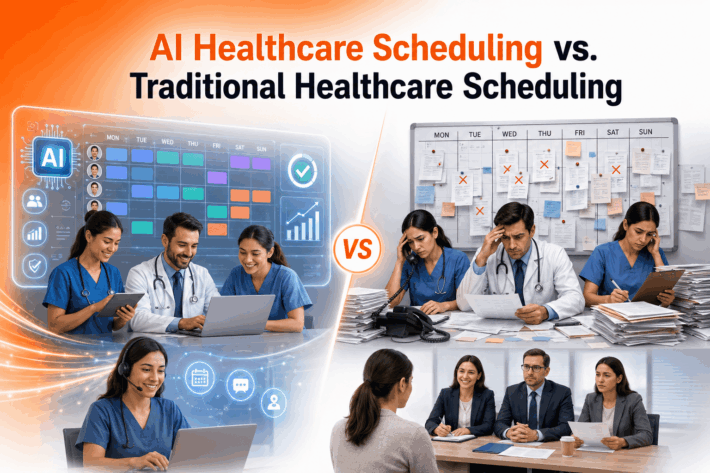
Generative AI vs. Traditional Healthcare Staffing: What Is the Difference?
The difference between generative AI healthcare recruitment and traditional healthcare staffing is speed and scale. Traditional staffing relies on manual review and one-to-one outreach, while generative AI automates repetitive steps so recruiters can focus on relationships and clinical vetting instead.
| Task | Traditional Healthcare Staffing | Generative AI Healthcare Recruitment |
|---|---|---|
| Resume screening | Manual review, hours per batch | Automated ranking in seconds |
| Candidate outreach | Calls and emails | AI candidate communication via chatbot and SMS |
| Job descriptions | Written from scratch | Drafted instantly, recruiter-edited |
| Interview scheduling | Manual back-and-forth email | Automated calendar matching |
| Workforce planning | Spreadsheet-based, reactive | Predictive, data-driven |
Which Healthcare Staffing Tasks Should Stay Human-Led?
Final candidate vetting, compliance verification, clinical reference checks, and offer negotiations should stay human-led even with generative AI support, since healthcare hiring involves licensure and patient safety requirements that still need a recruiter’s judgment, accountability, and direct relationship with each candidate.
Real-World Example: GenAI in Healthcare HR at a Regional Staffing Agency
A mid-size healthcare staffing agency filling ICU nursing and locum tenens roles can use generative AI to cut time-to-fill. A generative AI tool screens applications against licensure requirements, then an AI candidate communication bot texts qualified nurses within minutes, confirming shift preferences.
The recruiter reviews top matches, calls the strongest candidates, and finalizes paperwork by hand, blending generative AI for volume tasks with human judgment for accountability.
Conclusion
Generative AI in healthcare staffing helps agencies screen candidates faster, communicate around the clock, and forecast workforce needs before shortages hit patient care. The five use cases above (screening, AI candidate communication, job descriptions, scheduling, and forecasting) show how GenAI in healthcare HR complements experienced recruiters.
Ready to fill nursing, allied health, or physician roles faster? Contact VIVA USA to see how our staffing team combines generative AI with hands-on recruiting expertise to deliver qualified candidates quickly.