AI and Automation in Healthcare Staffing: Threat or Opportunity?

The healthcare industry in 2025 stands at a critical intersection. With chronic staffing shortages, rising patient demand, and escalating burnout rates among providers, healthcare organizations are increasingly exploring artificial intelligence (AI) and automation to optimize staffing and service delivery. But is this technology a threat to human jobs, or a much-needed ally in overcoming the current workforce crisis?
This article explains how AI is playing a bigger role in healthcare staffing and workforce management. It explores how technology can help close existing gaps and considers whether the benefits are strong enough to outweigh the risks.
The Healthcare Staffing Crisis in Context
Before evaluating the role of AI, it’s important to understand the depth of the staffing challenges that healthcare organizations face:
- According to the Bureau of Labor Statistics, the United States is projected to add over 1.9 million new healthcare jobs by 2031, many of which are already difficult to fill.
- The American Association of Colleges of Nursing reports that nursing schools turned away over 66,000 qualified applicants in 2023 due to faculty shortages.
- The National Library of Medicine projects a shortage of up to 124,180 physicians by 2027.
- Burnout is at an all-time high, with over 60% of clinicians reporting symptoms of emotional exhaustion and disengagement.
- A 2024 Statista survey revealed that 20 percent of U.S. healthcare workers reported serious intentions to leave the profession within the next two years.
With this context, healthcare leaders are turning to digital tools and intelligent systems to reduce inefficiencies, assist current staff, and streamline workforce operations.
How AI Can Be Used in Healthcare Staffing Today
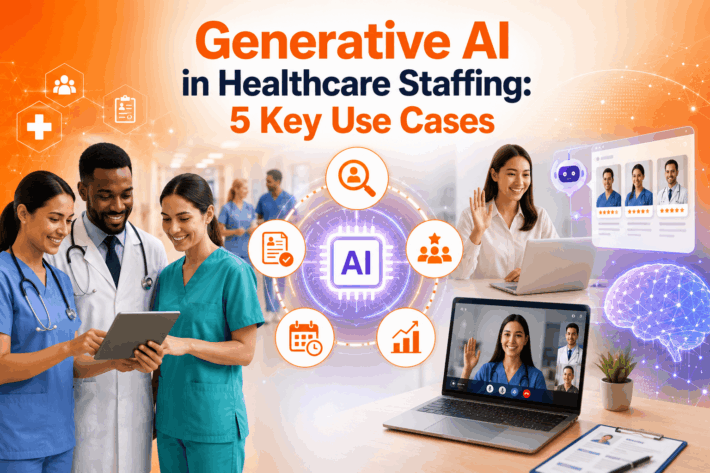
AI in healthcare staffing refers to the application of intelligent technologies to automate, predict, and optimize various workforce functions. Here are some practical ways AI is currently being used:
1. Candidate Screening and Recruitment
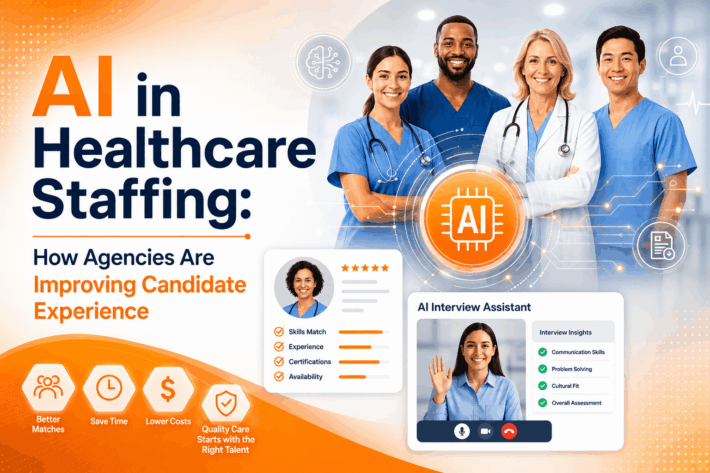
AI-powered Applicant Tracking Systems (ATS) can analyze resumes, assess qualifications, and rank candidates based on how well they match job descriptions. These tools reduce time-to-hire and allow recruiters to focus on high-value interactions.
2. Credential Verification and Onboarding
AI can automate license verification, background checks, and documentation review. This reduces delays and ensures compliance without manual bottlenecks.
3. Predictive Staffing and Demand Forecasting
Machine learning models analyze patient census data, seasonal trends, and historical patterns to predict staffing needs days or weeks in advance. This allows hospitals to plan proactively rather than reactively.
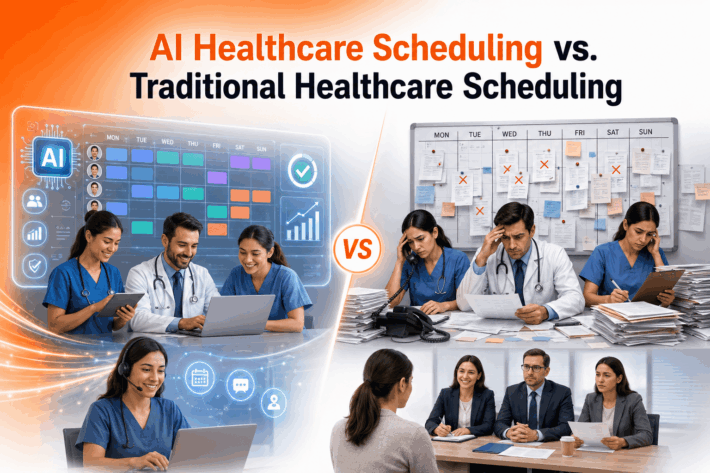
4. Scheduling Optimization
AI-powered scheduling tools can balance labor distribution, time-off requests, shift preferences, and compliance rules. This helps maintain adequate coverage without overworking staff.
5. Virtual Assistants and Chatbots
AI chatbots assist staff with scheduling queries, benefits navigation, and HR support. This saves time for human resource teams and empowers employees with quick answers.
How AI Helps Fill the Healthcare Talent Gap
One of the greatest strengths of AI is its ability to amplify human capacity rather than replace it. Here’s how AI is already helping healthcare systems bridge talent shortages:
1. Speeding Up the Hiring Process
By automating resume screening, background checks, and initial assessments, healthcare organizations can reduce the average time-to-fill from weeks to days. In an industry where, urgent hires are critical; this acceleration makes a real difference.
2. Enabling Smart Talent Matching
AI algorithms can match job seekers not only based on experience but also using behavioral analysis, cultural fit, and soft skill indicators. This leads to better hires who are more likely to stay and thrive.
3. Retaining Existing Staff
AI tools monitor staff workload, engagement scores, and stress indicators to flag burnout risks. Managers can receive alerts when intervention or schedule adjustments are needed, helping retain experienced workers.
4. Improving Care Delivery with Fewer Resources
AI-enabled clinical decision support systems can assist nurses and physicians in diagnostics, charting, and documentation. This allows them to focus more time on patient interaction and less on administrative work.
Reducing Burnout and Cognitive Load with AI
Burnout is not only a threat to healthcare quality but also to workforce stability. AI and automation can directly address this issue by offloading routine, repetitive, and mentally exhausting tasks.
1. Streamlining Administrative Burden
Clinicians spend an estimated 35 to 50 percent of their time on documentation. AI tools such as natural language processing (NLP) and ambient clinical intelligence record and transcribe physician-patient interactions in real time. This reduces the need for after-hours charting and lowers cognitive fatigue.
2. Enhancing Clinical Decision Making
AI can support diagnostic accuracy by analyzing patient history, labs, and imaging faster than humans alone. This not only saves time but also increases confidence among providers.
3. Intelligent Scheduling to Prevent Overwork
By monitoring patterns in shift assignments, call volume, and patient acuity, AI-driven scheduling systems can balance workloads and help prevent chronic overuse of key staff members.
4. Monitoring Wellness and Engagement
Some organizations now use AI to track email usage, tone, schedule density, and survey data to detect early signs of burnout or disengagement. These insights allow for targeted interventions such as wellness coaching, schedule adjustments, or managerial support.
Will AI Take Over Healthcare Jobs?
A common concern is whether AI will replace nurses, physicians, or allied health professionals. The evidence so far suggests otherwise. AI is best viewed as an augmentation tool rather than a replacement.
Roles Most Likely to Be Enhanced, Not Replaced:
- Nurses: AI supports care coordination and documentation, but hands-on clinical care still requires empathy and human judgment.
- Physicians: Clinical decision support tools help synthesize data but do not substitute for diagnostic reasoning.
- HR and Scheduling Staff: Automation can handle repetitive admin tasks, freeing up time for strategic workforce planning.
Jobs Where AI Creates New Demand:
- Healthcare Data Analysts
- Medical AI Trainers and Auditors
- Clinical Informatics Specialists
- Telehealth Coordinators
Instead of eliminating jobs, AI is likely to reshape roles and introduce new career pathways, especially for tech-savvy professionals interested in hybrid clinical-technical work.
Best Practices for Implementing AI in Healthcare Staffing
To maximize the benefits of AI while minimizing disruption, healthcare leaders should adopt thoughtful implementation strategies:
1. Involve Staff Early
Include frontline workers in AI pilot programs and gather their feedback. User input ensures tools are intuitive and helpful, not burdensome.
2. Focus on Interoperability
Ensure that AI tools integrate with existing EHRs, HR systems, and workforce platforms to avoid fragmentation.
3. Provide Adequate Training
Offer hands-on training, ongoing support, and digital literacy workshops to build confidence and user adoption.
4. Establish Clear Metrics
Track time savings, turnover reductions, scheduling efficiency, and burnout scores to evaluate ROI.
5. Maintain Ethical Standards
Use transparent algorithms and avoid bias in hiring and scheduling. Ensure that AI does not disproportionately impact certain roles or demographics.
Conclusion: Threat or Opportunity?
AI and automation are not a threat to healthcare staffing but a timely opportunity to alleviate strain, improve efficiency, and empower clinicians. By removing tedious tasks, anticipating workforce needs, and enabling smarter decision-making, AI supports rather than supplants human care.
For healthcare systems facing increasing demand and limited resources, the key question is not whether to adopt AI, but how to do it responsibly and effectively. Organizations that embrace AI as a collaborative partner will be better positioned to retain their workforce, fill critical roles, and deliver high-quality care in a sustainable way.
Investing in AI today is not about replacing people. It is about giving healthcare professionals the tools they need to thrive, not just survive, in a rapidly evolving healthcare environment.
Ready to bridge your workforce gaps with smarter staffing? Contact VIVA USA Inc to learn how our healthcare staffing solutions can transform your organization’s efficiency and employee experience.