What the Government Shutdown Means for Federal Contractors and Staffing in 2025–2026
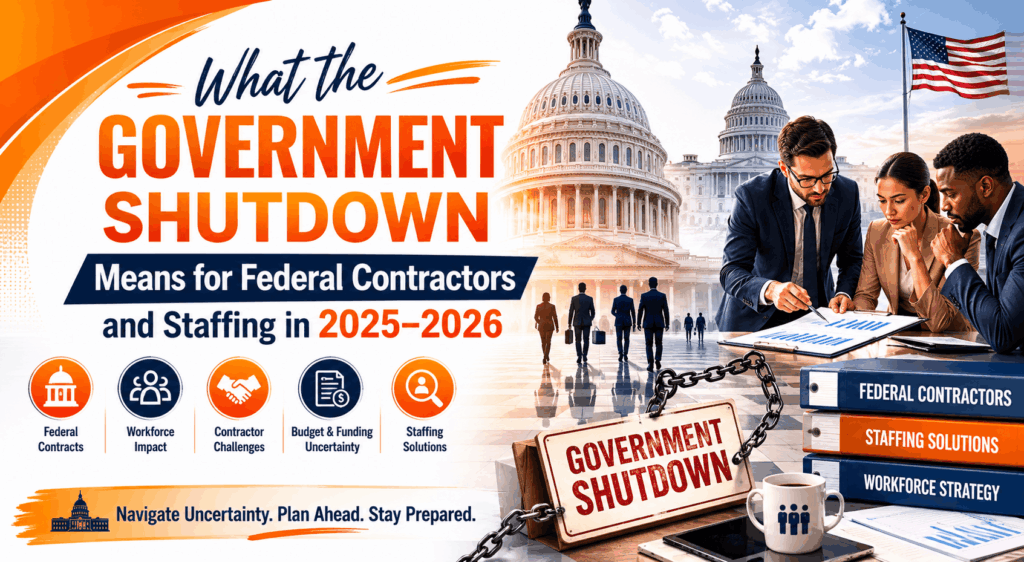
A government shutdown occurs when Congress fails to pass federal spending legislation, halting non-essential government operations. For federal contractors, a government shutdown triggers contract delays, workforce furloughs, and revenue disruptions. In 2025 and 2026, the government shutdown staffing impact could affect over 4 million contract workers and reshape how staffing agencies serve the federal sector.
Key Takeaways: Government Shutdown Impact on Federal Contractors
Here are the top facts about the government shutdown staffing impact that every federal contractor and staffing agency should know in 2025 and 2026.
- A government shutdown halts new federal contract awards and delays active contract payments, directly affecting contractor cash flow and project timelines.
- Approximately 4.1 million federal contract workers face potential work stoppages during a prolonged government shutdown, according to the Congressional Budget Office.
- Federal staffing agencies must implement government shutdown contingency planning to retain skilled talent and avoid costly re-recruitment cycles.
- The 2018–2019 government shutdown (35 days) cost the U.S. economy an estimated $11 billion, with $3 billion permanently lost, per the Congressional Budget Office.
- Proactive partnerships with government staffing agencies like VIVA USA help federal contractors maintain workforce readiness before, during, and after shutdowns.
How a Government Shutdown Affects Federal Contractors and Contract Workers
A government shutdown affects federal contractors by freezing new contract awards, delaying payments on active contracts, and halting project work that requires government oversight. Contractors who depend on federal agencies for approvals, facility access, or funding face immediate operational disruptions that can last weeks or months beyond the shutdown itself.
What Happens to Federal Contracts During a Government Shutdown?
Federal contract delays during a shutdown are defined as the suspension or postponement of government-funded work due to a lapse in federal appropriations. Contracting officers cannot issue new task orders, and ongoing contracts may receive stop-work orders depending on funding status and agency contingency plans.
The impact varies by contract type. Cost-reimbursement contracts typically halt because agencies cannot authorize new expenditures. Fixed-price contracts with available funding may continue, but only if the agency has obligated funds prior to the shutdown. Many IT services, consulting, and facilities management contracts experience full or partial work stoppages.
According to the Congressional Budget Office (2019), the 35-day government shutdown in 2018–2019 cost the U.S. economy approximately $11 billion, with $3 billion in permanent losses.
How Do Federal Employee Furloughs Affect Contractor Staffing?
Federal employee furlough staffing challenges arise when government employees who supervise or collaborate with contractors are sent home. Without government counterparts to approve deliverables, grant facility access, or provide technical direction, contract workers often cannot perform their assigned duties, even if their contracts have available funding.
According to the U.S. Office of Personnel Management (2024), approximately 800,000 federal employees were furloughed during the most recent extended shutdown scenario planning exercises.
Contract workers, unlike federal employees, do not receive back pay after a shutdown ends. This creates a significant retention risk for government staffing agencies, as skilled professionals may seek private-sector opportunities rather than wait for federal operations to resume.
Government Shutdown Staffing Impact: Risks for Agencies and Contractors
The government shutdown staffing impact extends beyond immediate work stoppages. Staffing agencies face talent attrition, delayed revenue cycles, and increased re-recruitment costs. Federal contractors must manage bench time, retain security-cleared personnel, and prepare for rapid ramp-up once operations resume.
What Are the Top Staffing Risks During a Government Shutdown?
Here are the top staffing risks that federal contractors and government staffing agencies face during a government shutdown:
- Talent attrition: Security-cleared professionals leave for private-sector roles, creating costly recruitment gaps.
- Revenue disruption: Contract payment delays strain cash flow for small and mid-size contractors.
- Re-onboarding costs: Replacing departed staff requires new background investigations, clearance processing, and training.
- Project timeline delays: Shutdown-related stoppages push deliverable deadlines by 2 to 4 times the shutdown duration.
- Subcontractor cascading effects: Prime contractor disruptions flow down to subcontractors and small businesses in the supply chain.
According to the Government Accountability Office (2019), federal agencies reported that shutdowns caused significant delays in procurement actions and increased administrative costs by 15% to 25% during recovery periods.
How Does a Government Shutdown Affect Federal Employees vs. Contractors?
The difference between federal employee furlough impacts and contractor impacts is significant. Federal employees receive back pay after a shutdown, while contract workers typically do not. Here is a comparison table:
| Impact Area | Federal Employees | Federal Contractors |
|---|---|---|
| Back Pay After Shutdown | Yes (guaranteed by law) | No (not guaranteed) |
| Job Security | Position retained during shutdown | Risk of contract termination |
| Health Benefits | Continue during furlough | May lapse depending on the employer |
| Security Clearance | Maintained | May lapse if investigation pauses |
| Return to Work Timeline | Immediately upon funding restoration | Depends on contract reactivation |
Government Shutdown Contingency Planning for Federal Contractors and Staffing Agencies
Government shutdown contingency planning is defined as the process of preparing operational, financial, and workforce strategies to minimize disruption during a lapse in federal appropriations. Effective contingency plans address cash flow management, employee retention, contract review, and rapid ramp-up procedures.
What Steps Should Federal Contractors Take Before a Government Shutdown?
Here are the top 6 steps federal contractors should take to prepare for a government shutdown:
- Review all active contracts: Identify which contracts have obligated funds and which will receive stop-work orders.
- Establish a cash reserve: Maintain 60 to 90 days of operating capital to cover payroll and overhead during payment freezes.
- Communicate with employees: Provide transparent updates to contract workers about shutdown scenarios, pay status, and return-to-work procedures.
- Partner with a staffing agency: Work with government staffing agencies like VIVA USA that specialize in federal workforce management and can mobilize talent quickly after a shutdown.
- Document all shutdown-related costs: Track expenses for potential equitable adjustment claims under FAR 52.249 (Termination for Convenience) provisions.
- Cross-train personnel: Ensure critical roles have backup coverage so operations can continue with reduced staff if needed.
Real-World Example: How a Federal IT Contractor Managed the 2018–2019 Shutdown
During the 35-day government shutdown in 2018–2019, a mid-size federal IT services contractor supporting the Department of Homeland Security faced a full stop-work order on three active task orders. The company retained 85% of its cleared workforce by offering temporary cross-training assignments on commercially funded projects and partnering with a government staffing agency to place employees on short-term private-sector engagements.
When operations resumed, the contractor ramped back to full capacity within two weeks, compared to the industry average of four to six weeks. This proactive contingency planning saved the company an estimated $1.2 million in re-recruitment and re-onboarding costs.
According to the Government Accountability Office (2023), federal contract spending reached $759 billion in fiscal year 2022, underscoring the massive economic scale at risk during any prolonged government shutdown.
According to the Congressional Research Service (2023), there have been 21 federal funding gaps since 1976, with four lasting longer than 10 business days.
Conclusion: Preparing for the Government Shutdown Staffing Impact in 2025–2026
The government shutdown remains one of the most disruptive risks facing federal contractors and staffing agencies heading into 2025 and 2026. Three critical takeaways stand out: first, federal contract delays during a shutdown extend well beyond the shutdown itself; second, contract workers face unique financial risks because they are not guaranteed back pay; and third, proactive government shutdown contingency planning with an experienced staffing partner can save significant time and money.
Ready to protect your federal workforce from shutdown disruptions? Contact VIVA USA today to learn how our government staffing solutions can help you build a resilient contingency plan, retain top talent, and ramp up quickly when operations resume. Visit viva-it.com or call us to speak with a federal staffing specialist.
FAQ
Frequently Asked Questions About Federal Contractors and the Government Shutdown
Below are 10 frequently asked questions about the government shutdown staffing impact, federal contract delays, and contingency planning for 2025 and 2026.