Offshore Staffing in the Age of AI: Collaboration, Automation and Human Expertise
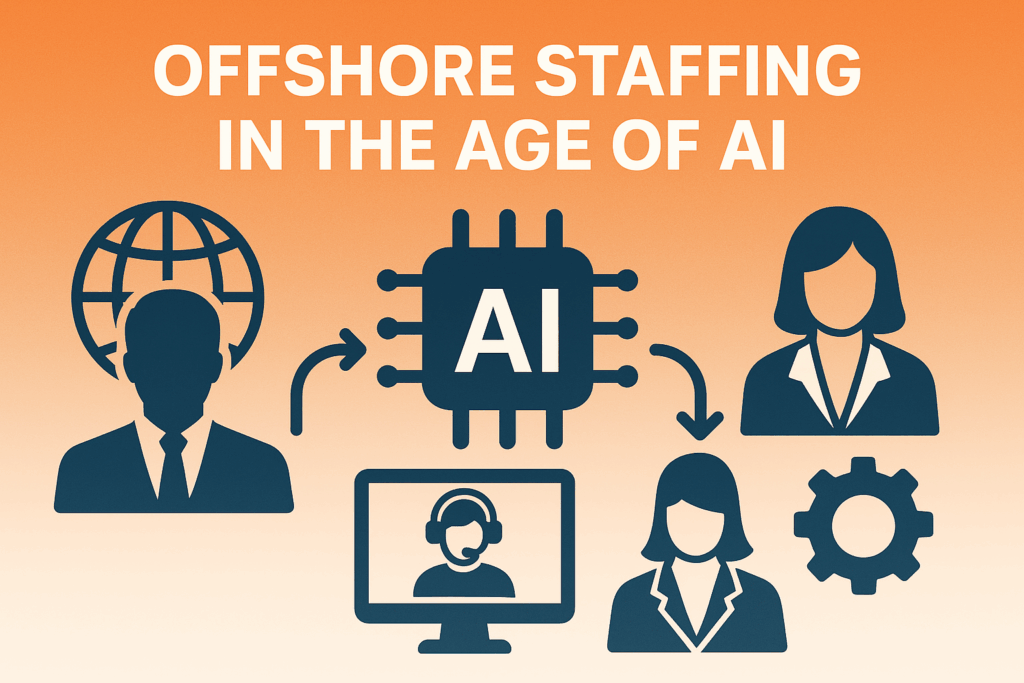
In today’s global business landscape, offshore staffing and remote staffing have evolved beyond cost cutting to become strategic engines of innovation, powered by the synergy of human expertise and artificial intelligence. This post explores how companies are blending collaboration, automation and talent to thrive in an AI driven staffing ecosystem.
Introduction
Offshore staffing in the age of AI allows companies to access global talent, automate repetitive tasks and retain the human insight that drives business value. Whether you are expanding a remote team or integrating AI into workforce strategy, the right mix of collaboration, automation and human expertise is key to staying competitive.
What Is Offshore Staffing and Why It Matters
Definition: Offshore staffing refers to hiring professionals located in different geographical regions, often abroad, to carry out business functions. This model is typically part of remote or near shore workforce strategies.
Why it matters now: With remote work widely accepted and AI tools advancing quickly, offshore staffing is no longer just about cost savings. It is increasingly about skills access, speed and scale.
Key Facts
- According to Deloitte’s 2024 Global Outsourcing Survey, 83 percent of surveyed organizations leverage AI in at least one outsourced service line.
- GitNux reports that 67 percent of staffing firms use AI to source candidates, and AI reduces time to hire by an average of 30 percent.
- The remote staffing sector grew by 28 percent in 2023.
- Fully remote job postings increased 16 percent in 2024 compared to 2023, according to Virtual Vocations.
Offshore Staffing and AI Automation: What Is Changing?
Concise answer: Offshore staffing enhanced by AI automation enables companies to use global talent pools, streamline hiring and onboarding, and focus human effort on strategic work. This creates faster, higher quality workforce delivery.
What AI brings to offshore staffing
- Automated candidate sourcing and screening using machine learning models that can scan global talent.
- Predictive analytics to forecast talent needs, assign workloads and schedule across time zones.
- Process automation for repetitive tasks such as data entry. Offshore human specialists can then focus on higher value work.
Benefits of combining offshore staffing with AI
- Speed and scalability: Access large talent pools globally while the AI handles volume tasks.
- Cost efficiency: Lower labor costs offshore paired with fewer recruitment delays.
- Specialized skill access: Offshore hubs provide niche skills, and AI helps match and manage them.
- Improved collaboration: With modern remote tools, asynchronous collaboration is easier across regions.
Example use case
A US based tech company partnered with an offshore staffing provider for software development teams in India and Latin America. They used AI tools to screen candidate profiles around the clock and schedule interviews, which cut hiring time by 40 percent. The human offshore engineers then focused on sprint work, integration and innovation.
Human Expertise Remains Critical in Offshore Staffing
Concise answer: Even in an age of growing automation, human expertise in cultural alignment, complex problem solving and relationship building remains essential for offshore staffing success.
Why humans still matter
- Cultural fit and communication: Offshore teams must align with client culture, language and norms, which AI cannot fully replace.
- Complex decision making: Strategic tasks, client facing roles and innovation require human judgment.
- Collaboration and team cohesion: Trust across geographies strengthens through human leadership and empathy.
- Governance and risk management: Oversight of vendor relationships, data security and compliance is a human responsibility.
Best practices for blending AI and human roles
- Define roles where AI handles high volume tasks and humans focus on strategy and culture.
- Provide 3 to 4 hours of overlap across time zones for real time interaction.
- Invest in remote team culture building through virtual meet ups, mentorship and occasional travel.
- Monitor performance analytics but use human interpretation to add context.
How Collaboration Works Across Offshore and Remote Teams
Concise answer: Effective offshore staffing in the AI era uses clear communication channels, defined workflows, overlapping time windows and collaborative platforms to ensure offshore, remote and on site teams work as one.
Key collaboration enablers
- Unified tools and platforms: Use shared communication tools, project management boards and dashboards with AI derived insights.
- Time zone overlap: Ensure 3 to 4 hours of daily overlap for meaningful collaboration.
- Regular check ins and rituals: Daily stand ups and weekly demos support cohesion.
- Cultural onboarding: Offshore hires should receive training on norms, communication practices and local context.
- Feedback loops: Use human managers and AI dashboards to monitor performance and identify training needs.
Collaboration table: On shore vs Offshore vs AI
| Role | Onshore Team | Offshore Team | AI and Automation Layer |
|---|---|---|---|
| Candidate Sourcing | Sets requirements and culture | Expands candidate pool | Screens, ranks, schedules |
| Onboarding | Introduces client context | Joins role remotely | Automates paperwork and compliance |
| Delivery | Defines scope and stakeholder input | Executes deliverables | Monitors productivity and flags risks |
| Quality Control | Reviews deliverables | Acts on feedback | Analyzes productivity data |
| Ongoing Training | Mentors and leads | Learns and adapts | Provides skills gap insights |
Automation in Offshore Staffing: What to Automate and What to Keep Human
Concise answer: Automate high volume and repetitive tasks such as resume screening, scheduling and basic support workflows. Retain human roles in expertise driven, high impact functions such as culture fit interviews, strategic planning and relationship management.
What to automate
- Resume parsing and candidate skill matching
- Interview scheduling
- Onboarding documentation and compliance checks
- Simple support workflows
- Initial performance metrics and alerts
What to keep human
- Technical interviews and assessments
- Culture fit and team fit interviews
- Strategic talent planning
- Client relationship management
- Interpretation of AI insights
Example
A staffing firm used AI chatbots to engage candidates 24 hours a day and reduced screening time by 60 percent. Human recruiters then handled final interviews and onboarding conversations to ensure candidates matched company culture.
Pitfalls to Avoid in AI Driven Offshore Staffing
Concise answer: Common pitfalls include over reliance on automation, ignoring cultural and time zone nuances, and failing to invest in onboarding or team integration.
Key pitfalls
- Treating offshore staffing as purely cost driven
- Neglecting time zone collaboration
- Using AI without human governance, which can cause bias and compliance issues
- Skipping human integration
- Failing to define clear boundaries between AI, offshore teams and client teams
Why Offshore Staffing in the Age of AI Is a Strategic Advantage
Concise answer: When done well, offshore staffing supported by AI delivers access to global skills, faster team build out, lower costs and stronger business agility.
Strategic advantages
- Global talent access
- Continuous delivery across time zones
- Flexible cost structures
- Faster time to market
- Increased capacity for innovation
Case in point
A global enterprise implemented an offshore staffing strategy with an AI powered recruitment pipeline. They reduced time to fill developer roles from 12 weeks to 4 weeks, increased project throughput by 22 percent and improved retention by focusing on team culture.
Key Takeaways
- Offshore staffing combined with AI automation enables fast and flexible workforce solutions.
- Human expertise is essential for culture, strategy and complex tasks.
- Collaboration tools and time zone planning are critical for team cohesion.
- Automate volume based processes and keep humans in strategic roles.
- Avoid pitfalls such as lack of oversight or ignoring culture and time zones.
- Offshore staffing in the AI era is a strategic advantage for scaling teams.
Conclusion
In the era of remote work, global talent access and AI enhanced staffing, organizations benefit significantly by combining offshore staffing, automation and human expertise. When these elements work together, businesses can build scalable, high performing teams that deliver consistent value.
VIVA USA Inc specializes in contingent staffing solutions that support rapid, flexible workforce expansion while maintaining quality and alignment with business goals. Neuhire focuses on offshore staffing, providing global talent pools, AI assisted sourcing and structured collaboration models designed for long term scalability.