How Federal Workforce Reductions Are Creating New Opportunities for Government Staffing Agencies
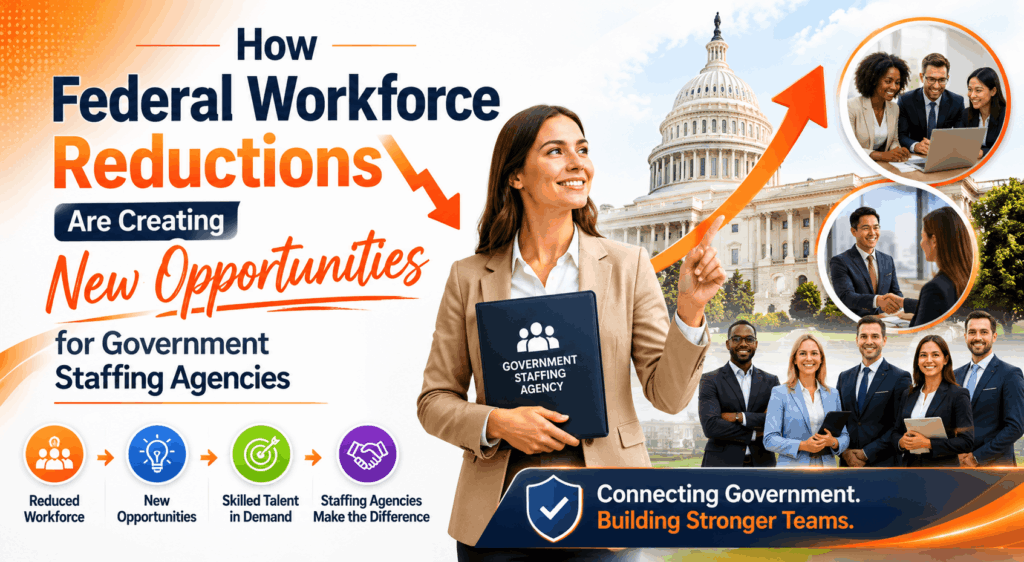
Federal workforce reductions are increasing demand for government staffing agencies because agencies still need to maintain essential services, fill skill gaps, and support mission-critical projects. As federal hiring slows and budgets tighten, federal contract staffing and public sector temporary staffing providers are becoming strategic partners for workforce continuity, specialized talent, and operational flexibility.
Key Takeaways / Quick Facts
- Federal workforce reductions are increasing reliance on government staffing agencies for contract-based talent acquisition.
- Federal hiring freezes are creating demand for temporary staffing, IT contractors, and outsourced project support.
- Government outsourcing opportunities are expanding in cybersecurity, healthcare, defense, and administrative operations.
- Federal contract staffing helps agencies reduce long-term payroll costs while maintaining service delivery.
- Public sector temporary staffing is growing because agencies need rapid hiring solutions without permanent headcount increases.
- Government staffing agencies with compliance expertise and cleared talent pools are gaining a competitive advantage.
According to the U.S. Bureau of Labor Statistics (2024), federal government employment declined by approximately 9,000 positions across multiple departments during restructuring efforts.
According to Deloitte (2024), 72% of public sector leaders are increasing investments in workforce flexibility and contract-based talent solutions.
According to Forbes (2023), organizations using contract staffing models reduced hiring costs by up to 30% during workforce restructuring periods.
According to Statista (2024), the U.S. staffing market generated more than $185 billion in revenue, with government and healthcare sectors contributing significantly to demand growth.
According to Staffing Industry Analysts (2026), 69% of employers reported difficulty finding skilled professionals for specialized roles, increasing dependence on staffing firms.
Why Federal Workforce Reductions Are Increasing Demand for Government Staffing Agencies
Federal workforce reductions are creating operational gaps that government staffing agencies can fill quickly and cost-effectively. Agencies facing hiring freezes or downsizing still require specialized talent, project continuity, and compliance expertise, making federal contract staffing an essential workforce strategy.
What Are Federal Workforce Reductions?
Federal workforce reductions are defined as decreases in permanent government employee headcount caused by budget constraints, hiring freezes, early retirement programs, or organizational restructuring. These reductions often impact administrative, IT, healthcare, and operational departments across federal agencies.
Recent workforce reduction initiatives have forced agencies to rethink traditional hiring strategies. Instead of increasing permanent staff, many departments are shifting toward flexible staffing arrangements that reduce overhead and improve scalability.
This transition is especially visible in sectors such as:
- Cybersecurity
- Healthcare administration
- Defense support
- Data analytics
- Procurement operations
- Federal IT modernization
Government staffing agencies are positioned to support these transitions because they already maintain talent pipelines with pre-screened candidates and compliance-ready professionals.
Why Agencies Prefer Federal Contract Staffing During Hiring Freezes
Federal hiring freeze staffing solutions allow agencies to maintain productivity without expanding permanent payroll obligations. Contract staffing enables departments to scale talent based on project timelines and funding availability.
Here are the top reasons agencies prefer contract staffing during workforce reductions:
- Faster hiring timelines
- Lower long-term employment costs
- Access to specialized talent
- Reduced administrative burden
- Greater workforce flexibility
- Easier project-based resource allocation
The difference between permanent federal hiring and federal contract staffing is flexibility. Permanent hiring involves lengthy approval and onboarding processes, while contract staffing allows agencies to deploy qualified professionals within days or weeks.
| Workforce Model | Permanent Federal Hiring | Federal Contract Staffing |
|---|---|---|
| Hiring Timeline | Several months | Days to weeks |
| Payroll Commitment | Long-term | Project-based |
| Scalability | Limited | Highly flexible |
| Specialized Skills Access | Slower | Immediate |
| Budget Flexibility | Restricted | More adaptable |
Government Staffing Agencies Are Benefiting From Expanding Government Outsourcing Opportunities
Government outsourcing opportunities are increasing because agencies must continue delivering services despite workforce limitations. Outsourcing allows federal departments to access specialized expertise, improve efficiency, and manage fluctuating workloads without increasing permanent staffing levels.
Which Industries Are Driving Public Sector Temporary Staffing Growth?
Public sector temporary staffing demand is strongest in industries facing skill shortages and operational modernization requirements. Agencies are prioritizing contract talent for high-demand and compliance-sensitive roles.
The fastest-growing sectors include:
- Federal IT and cybersecurity
- Veterans healthcare support
- Defense contracting
- Cloud infrastructure management
- Financial compliance
- Administrative processing
- Human resources support
Cybersecurity is one of the largest growth areas. Federal agencies continue facing talent shortages while increasing investments in digital modernization and threat protection.
According to the Cybersecurity and Infrastructure Security Agency (2024), the federal government continues to prioritize cybersecurity workforce expansion to address national security risks. https://www.cisa.gov/
Government staffing agencies with security-cleared professionals and technical recruiting expertise are therefore gaining a significant competitive advantage.
How Government Staffing Agencies Create Value During Workforce Reductions
Government staffing agencies create value by reducing hiring delays, improving workforce agility, and supplying highly specialized professionals who meet federal compliance standards.
Here are the top ways staffing firms support federal agencies:
- Rapid deployment of cleared talent
- Compliance with federal labor regulations
- Workforce continuity during hiring freezes
- Access to niche technical skills
- Scalable project staffing
- Reduced recruitment and onboarding costs
For example, agencies undergoing modernization projects often require cloud architects, cybersecurity analysts, and data engineers for limited durations. Hiring these professionals permanently may not align with long-term budgets. Staffing firms solve this challenge through contract-based workforce models.
This approach is especially important for agencies operating under continuing resolutions or uncertain annual appropriations.
Federal Contract Staffing Is Becoming a Long-Term Workforce Strategy
Federal contract staffing is no longer viewed as a temporary solution. Many agencies now use staffing partnerships as a long-term workforce strategy that supports operational resilience, cost optimization, and digital transformation.
Real-World Example of Federal Hiring Freeze Staffing Solutions
During recent federal hiring slowdowns, several healthcare and defense agencies expanded partnerships with government staffing agencies to maintain service delivery and technology operations.
One example involves Veterans Affairs healthcare facilities increasing reliance on contract healthcare professionals to address staffing shortages while maintaining patient care continuity. Contract staffing helped facilities manage fluctuating patient demand without permanent workforce expansion.
Similarly, federal IT modernization programs increasingly rely on contractors to support:
- Cloud migration
- Data management
- Cybersecurity operations
- AI implementation
- Systems integration
Government staffing agencies that specialize in federal contract staffing are uniquely positioned because they understand procurement rules, labor classifications, and security clearance requirements.
What Skills Are Most In Demand for Government Outsourcing Opportunities?
Government outsourcing opportunities are concentrated in high-skill and mission-critical areas where permanent talent shortages continue to grow.
The most in-demand contract roles include:
| High-Demand Role | Primary Sector |
|---|---|
| Cybersecurity Analyst | Federal IT |
| Cloud Engineer | Digital Modernization |
| Healthcare Administrator | Veterans Healthcare |
| Procurement Specialist | Federal Operations |
| Data Analyst | Intelligence & Research |
| Project Manager | Infrastructure & Defense |
| Compliance Officer | Financial Oversight |
According to the Partnership for Public Service (2024), federal agencies continue struggling to compete with private-sector salaries for technical talent.
This challenge increases the importance of staffing agencies that can source and deploy experienced professionals quickly.
How Government Staffing Agencies Can Capitalize on Federal Workforce Reductions
Government staffing agencies can capitalize on federal workforce reductions by developing specialized recruiting capabilities, compliance expertise, and long-term public sector partnerships.
Best Practices for Winning Federal Contract Staffing Opportunities
Federal contract staffing success depends on compliance readiness, industry specialization, and workforce quality. Agencies that invest in government-specific recruiting strategies gain stronger competitive positioning.
Here are the top ways staffing firms can improve federal contract success:
- Build security-cleared talent pipelines
- Specialize in high-demand sectors
- Maintain federal compliance expertise
- Develop rapid-response recruiting teams
- Invest in AI-driven workforce analytics
- Strengthen partnerships with prime contractors
Staffing agencies should also monitor federal procurement trends and workforce planning initiatives to identify emerging outsourcing opportunities.
Why Public Sector Temporary Staffing Will Continue Growing
Public sector temporary staffing will continue growing because federal agencies need flexible workforce models that adapt to economic uncertainty, digital transformation, and budget pressures.
Several long-term trends support this growth:
- Aging federal workforce retirement rates
- Increased cybersecurity threats
- AI and cloud modernization initiatives
- Budget optimization pressures
- Persistent technical skill shortages
The difference between traditional workforce expansion and modern staffing strategies is agility. Public agencies increasingly prioritize scalable talent solutions over fixed employment models.
This trend creates sustained opportunities for government staffing agencies that can deliver specialized talent quickly and compliantly.
Conclusion
Federal workforce reductions are reshaping how agencies manage talent, operations, and modernization initiatives. Government staffing agencies are benefiting from rising demand for federal contract staffing, public sector temporary staffing, and government outsourcing opportunities. Agencies increasingly need flexible workforce models, specialized expertise, and rapid hiring support.
VIVA USA helps federal organizations address workforce challenges with scalable staffing solutions, compliance expertise, and access to highly skilled professionals. Contact VIVA USA today to discuss customized government staffing solutions or download our federal workforce strategy guide.