Why AI Skills Are Becoming Mandatory in AI-Powered Hiring?
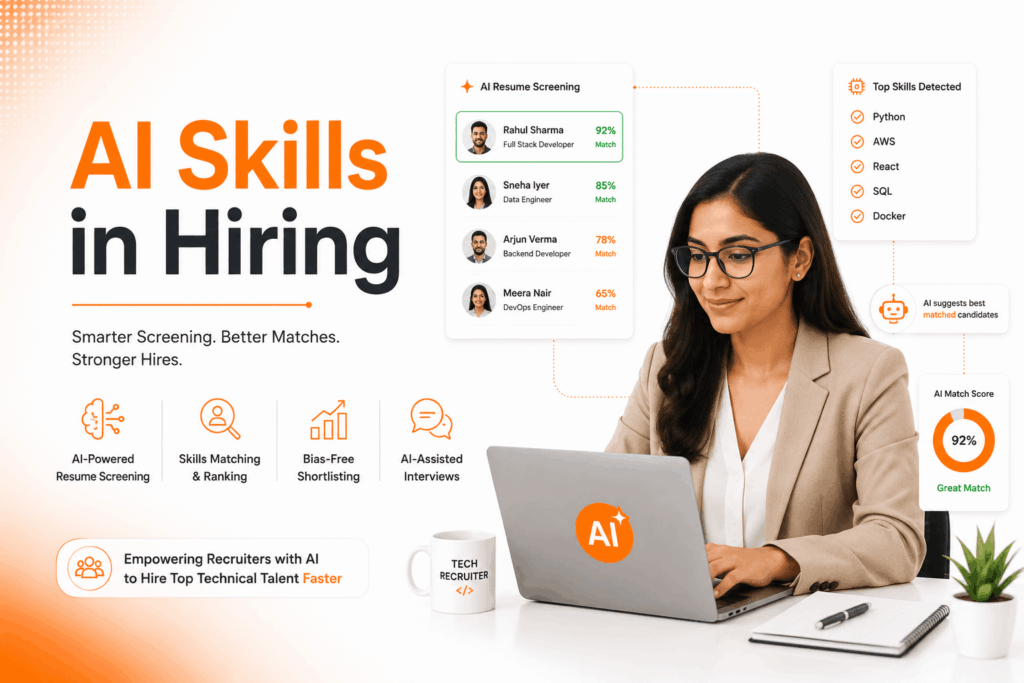
AI skills are now a baseline requirement in tech hiring. AI-powered hiring processes favor candidates who understand machine learning, natural language processing, and data systems. As companies adopt AI-driven recruitment tools and AI-based workflows, professionals without AI competency are increasingly filtered out before the first interview.
- 77% of employers say AI skills are now essential or very important in tech candidates (Zapier Survey, 2024).
- AI-driven recruitment tools are used by 65% of Fortune 500 companies to screen resumes and rank applicants (Workday, 2025).
- Roles requiring AI or machine learning expertise grew by 74% over the past four years (Great Learning, 2023).
- The global AI talent shortage is projected to reach 85 million unfilled tech jobs by 2030 (Korn Ferry, 2023).
- Tech professionals with AI certifications earn 20-35% higher salaries than peers without them (Robert Half Technology, 2024).
How AI-Powered Hiring Is Redefining Candidate Expectations
AI-powered hiring is defined as the use of artificial intelligence tools, including applicant tracking systems, resume parsers, and predictive analytics platforms, to source, evaluate, and select job candidates. In 2024, companies using AI-powered hiring tools such as HireVue, Eightfold AI, and Workday expect applicants to have working knowledge of these same technologies.
The shift is not subtle. Hiring managers at companies like Microsoft, Google, and Amazon now list AI fluency alongside programming languages in job descriptions for roles ranging from software engineering to product management. A candidate who cannot speak to large language models, prompt engineering, or AI-assisted code review is at a structural disadvantage.
This creates a feedback loop: organizations deploy AI-powered hiring tools, those tools prioritize AI-literate candidates, and the market responds by treating AI skills as table stakes rather than differentiators.
Why AI Skills Matter More Than Traditional Certifications in 2024 and Beyond
Traditional certifications in project management, cloud infrastructure, or software development are no longer sufficient to stand out in AI-driven recruitment pipelines. According to the LinkedIn 2024 Workforce Report, the half-life of technical skills has dropped to approximately 2.5 years, meaning credentials earned in 2021 may already signal outdated knowledge.
By contrast, AI skills signal adaptability, a trait that AI talent acquisition specialists now rank above domain expertise in many engineering and data roles. Candidates who demonstrate hands-on experience with tools like TensorFlow, PyTorch, OpenAI APIs, or Microsoft Azure AI Services are advancing past initial screening at significantly higher rates.
Which AI Skills Are Most In Demand for Tech Hiring in 2025
Here are the top AI skills that consistently appear in AI-powered hiring pipelines across enterprise and mid-market tech employers:
- Machine learning model development and deployment (Python, scikit-learn, PyTorch)
- Natural language processing and large language model (LLM) integration
- AI-assisted software development using tools like GitHub Copilot or Amazon CodeWhisperer
- Data pipeline architecture for AI systems (Apache Spark, Databricks, Snowflake)
- Prompt engineering and retrieval-augmented generation (RAG) systems
- AI governance, responsible AI frameworks, and explainability tools
How AI Is Changing Tech Recruitment: A Data-Driven Overview
AI is changing tech recruitment by automating candidate screening, improving job-match accuracy, and reducing time-to-hire by up to 40%. Platforms using AI-driven recruitment include Greenhouse, Lever, iCIMS, and SAP SuccessFactors. These tools score resumes against live job requirements, flag skill gaps, and rank applicants before a human recruiter ever opens a profile.
The implications for job seekers are significant. A 2023 Deloitte study found that 65% of Fortune 500 companies use AI-driven recruitment software, and that candidates whose resumes did not reflect AI-related keywords were deprioritized in automated ranking. This means AI skills are not just valued in interviews; they are a prerequisite for reaching the interview stage.
- According to Workday (2025), 65% of Fortune 500 companies use AI-driven recruitment tools to evaluate and rank candidates before human review.
- According to Robert Half Technology (2024), tech professionals with verified AI skills and certifications earn 20-35% higher base salaries than peers in comparable roles without AI credentials.
- According to the Great Learning (2023), roles requiring AI or machine learning expertise grew by 74% over the past four years, with no sign of deceleration through 2027.
- According to Forbes (2024), the global demand for AI talent is growing three times faster than the available supply, creating a structural talent gap that will persist through the end of the decade.
The difference between traditional tech recruitment and AI-driven recruitment is significant:
| Factor | Traditional Recruitment | AI-Driven Recruitment |
|---|---|---|
| Resume Screening | Manual review by HR; 6-10 seconds per resume | Automated keyword scoring; 100s of resumes per minute |
| Skill Prioritization | Degrees and years of experience | AI certifications, project portfolios, and tool proficiency |
| Bias Mitigation | Prone to unconscious bias | Algorithm-based scoring (though bias can persist in training data) |
| Time-to-Hire | 30-60 days average | 14-21 days with AI screening tools |
| Candidate Ranking | Recruiter judgment | Predictive fit score based on 50+ data points |
How AI Is Transforming IT Staffing: A Real-World Case Study
AI is transforming IT staffing by enabling staffing agencies and internal talent teams to match candidates to roles with greater precision, speed, and measurable outcomes. The adoption of AI talent acquisition platforms has moved from experimental to operational across enterprise IT departments in industries including finance, healthcare, and logistics.
Real-World Example: How a Fortune 500 Financial Firm Used AI Talent Acquisition to Cut Hiring Time in Half
In 2023, a major U.S. financial services company partnered with Eightfold AI to overhaul its IT staffing pipeline. The firm processed over 120,000 applications annually for roles in cloud architecture, cybersecurity, and data engineering. Manual screening could not keep pace with demand, and time-to-hire exceeded 47 days.
After deploying Eightfold’s AI talent acquisition platform, the firm reduced time-to-hire to 22 days, increased qualified candidate pass-through rates by 31%, and identified 18% more internal candidates eligible for role transitions. Critically, the platform flagged AI skill gaps in existing employees, prompting the firm to invest in upskilling programs targeting Python, TensorFlow, and cloud-based ML deployment.
The result: a self-reinforcing cycle in which AI-powered hiring identified AI skill deficits, which then drove targeted reskilling, which improved the firm’s ability to fill future AI-adjacent roles internally. This is the operational reality of how AI is transforming IT staffing at scale.
Steps Tech Professionals Can Take to Succeed in AI-Driven Recruitment
Here are the top steps to position yourself for AI-powered hiring success:
- Earn a recognized AI certification such as the AWS Certified Machine Learning Specialty, Google Professional ML Engineer, or Microsoft Certified: Azure AI Engineer Associate.
- Build a GitHub portfolio demonstrating real AI project experience, including model training, deployment pipelines, and prompt engineering examples.
- Optimize your LinkedIn profile with AI-specific keywords, tool names, and quantified project outcomes to rank higher in AI talent acquisition searches.
- Tailor your resume to include specific AI tools (PyTorch, Hugging Face, LangChain) rather than generic references to ‘AI experience.’
- Engage with a specialized IT staffing partner such as VIVA, which maintains active relationships with employers using AI-driven recruitment platforms and can match your profile to roles before they are publicly listed.
Conclusion: AI Skills Are No Longer Optional in Tech Hiring
AI skills have moved from competitive advantage to baseline requirement across the tech industry. Three realities define the current landscape: AI-powered hiring platforms now control the first stage of candidate evaluation, AI-driven recruitment tools systematically favor applicants with documented AI competencies, and AI talent acquisition specialists at leading firms are calibrating offers based on AI skill depth.
For tech professionals, the path forward is clear: build verifiable AI skills, optimize your profile for AI-powered hiring systems, and partner with a staffing specialist who understands how AI is transforming IT staffing from the inside out.
Help Center
Frequently asked questions
Quick answers to questions you may have. Can't find what you're looking for? Check out our full documentation.
AI is transforming IT staffing agencies by enabling faster, more accurate candidate-to-role matching. Agencies using AI-driven recruitment platforms can analyze thousands of candidate profiles against real-time job requirements in minutes, reducing time-to-fill by 30-45%. VIVA USA uses AI-augmented staffing intelligence to match IT professionals with employers before roles go to market.
Partnering with a specialized IT staffing agency gives candidates a direct channel into employers before roles are publicly listed, bypassing the AI-powered hiring filters entirely at the first stage. Agencies like VIVA USA maintain active relationships with enterprise employers and have visibility into which AI skills are being weighted in current hiring cycles. A staffing consultant can help you align your resume language, portfolio, and certification profile with the specific criteria that AI-driven recruitment platforms at target companies are scoring against, significantly improving your pass-through rate from automated screening to human review.