Top 7 Most In-Demand IT Roles in 2026 (and the Skills Employers Want Most)
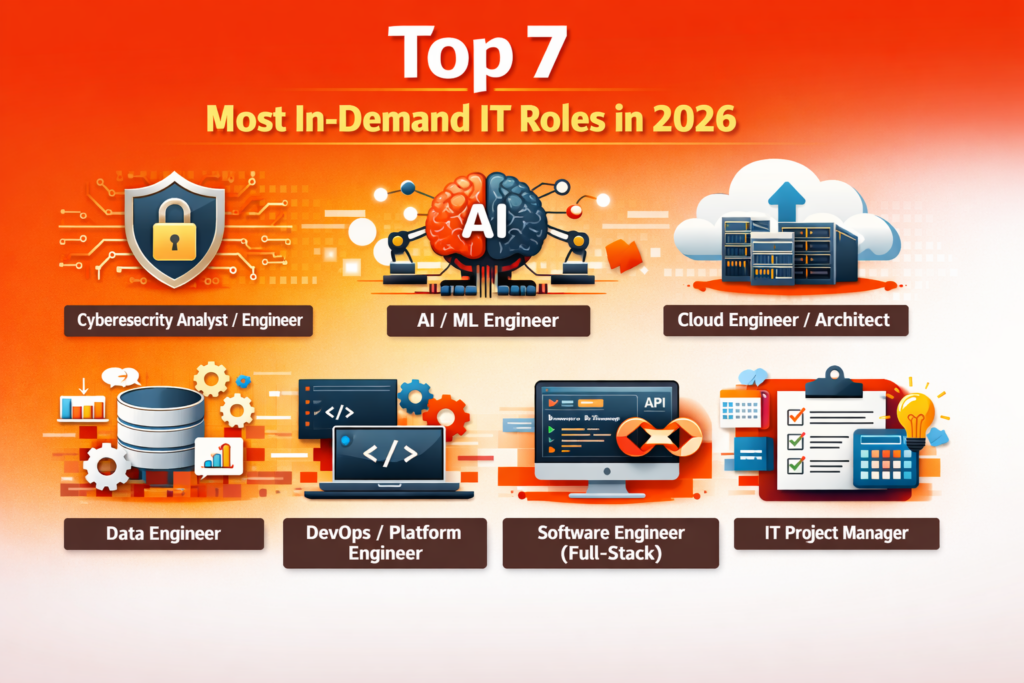
The most in-demand IT roles in 2026 are those that help organizations secure systems, deploy AI responsibly, modernize cloud environments, and scale data-driven products. Across industries, hiring demand is strongest for cybersecurity, AI/ML, cloud, data engineering, DevOps, and platform roles because these positions directly impact revenue, risk reduction, and speed-to-market.
Quick Facts: Top IT Roles 2026
Here are the top IT roles for 2026 based on hiring priorities, technology investment trends, and long-term job growth outlook:
- Cybersecurity Analyst / Engineer
- AI / Machine Learning Engineer
- Cloud Engineer / Cloud Architect
- Data Engineer
- DevOps Engineer / Platform Engineer
- Software Engineer (Full-Stack + API)
- IT Project Manager / Product Owner (Tech)
These roles consistently show up in tech hiring research and workforce projections because they support the most critical outcomes: secure operations, scalable infrastructure, and AI-ready innovation.
Why These Are the Most In-Demand Tech Jobs in 2026
In-demand tech jobs in 2026 are being shaped by three forces:
- Cyber risk is increasing, and security talent is still scarce.
- Generative AI adoption is accelerating, creating new needs for AI engineering, governance, and scalable data pipelines.
- Cloud and modernization projects continue, forcing companies to rebuild legacy infrastructure for performance and compliance.
Robert Half identified top tech priorities including security, AI/ML, cloud initiatives, tech modernization, and software development, all of which directly map to the roles in this list.
5 Recent IT Hiring Statistics
Below are recent, snippet-friendly stats from the last 2–3 years that reflect why these roles are trending.
- Cybersecurity job growth is far above average
According to the U.S. Bureau of Labor Statistics (Occupational Outlook Handbook), May 2025 update, employment for Information Security Analysts is projected to grow 29% from 2024 to 2034, with about 16,000 openings per year. - The cybersecurity workforce gap remains massive
According to ISC2, on October 31, 2023, the global cybersecurity workforce reached 5.5 million, but the talent gap is still around 4 million professionals. - Tech leaders are prioritizing AI, security, cloud, and software development
According to Robert Half, 2024, the top priorities for tech teams include systems and information security, AI/ML/automation, cloud initiatives, modernization, and software development. - Generative AI is scaling in real enterprise environments
According to Deloitte (State of Generative AI in the Enterprise), 2024, the survey was fielded to 2,773 director-to-C-suite respondents across multiple industries and countries, showing broad enterprise engagement with GenAI initiatives. - AI/ML operations roles are becoming especially hard to hire
According to Business Insider, January 2026, Cisco’s HR leadership highlighted that AI and ML Ops roles are difficult to fill due to limited qualified talent and strong demand.
Top 7 Highest-Priority IT Roles for 2026 (With Skills + Salary Drivers)
1) Cybersecurity Analyst / Cybersecurity Engineer (Top IT roles 2026)
Cybersecurity analysts and engineers protect systems, networks, and applications from attacks, breaches, and data loss. They’re among the most in-demand tech jobs in 2026 because security is now a business requirement, not an IT add-on.
What does a Cybersecurity Engineer do?
A Cybersecurity Engineer designs and implements security controls to prevent breaches, detect threats, and respond to incidents. In 2026, demand is high because companies must protect cloud infrastructure, sensitive customer data, and AI systems while meeting compliance requirements and minimizing operational downtime.
Core skills employers want in 2026
- SIEM tools (Splunk, Sentinel)
- Incident response and threat hunting
- Zero Trust architecture
- Vulnerability management
- IAM (Okta, Azure AD)
- Cloud security (AWS/Azure/GCP)
Mini case example
A mid-sized healthcare provider migrating to the cloud may need a cybersecurity engineer to implement:
- MFA and least privilege access
- encrypted backups and ransomware recovery plans
- compliance controls aligned to HIPAA frameworks
That single hire can reduce breach risk and limit business disruption.
2) AI / Machine Learning Engineer (In-demand tech jobs 2026)
AI is no longer just experimentation. In 2026, companies want practical AI roles that ship real products and integrate with business systems.
What does an AI/ML Engineer do?
An AI/ML Engineer builds and deploys machine learning models that automate decisions, personalize experiences, and generate insights. In 2026, these roles are highly in demand because organizations need AI talent to create production-grade solutions, integrate AI into workflows, and keep models accurate, explainable, and secure at scale.
Core skills employers want in 2026
- Python, PyTorch, TensorFlow
- Model deployment (APIs, containers)
- LLM applications (RAG pipelines, prompt design, evaluation)
- Feature engineering and experimentation
- Model monitoring and retraining
Why this role is “highest paying IT jobs 2026” material
AI engineers often impact revenue directly, such as reducing churn, increasing conversion rates, and accelerating customer support resolution time.
3) Cloud Engineer / Cloud Architect (Future of IT careers)
Cloud adoption continues, but the focus in 2026 is different: it’s about cost control, security, and performance, not just migrating servers.
What does a Cloud Architect do?
A Cloud Architect designs scalable, secure cloud infrastructure and ensures systems are reliable, compliant, and cost-efficient. In 2026, demand remains high because companies are modernizing legacy environments, optimizing cloud spend, and building cloud foundations that support AI workloads, data pipelines, and enterprise security controls.
Core skills employers want in 2026
- AWS, Azure, or GCP (deep expertise in one)
- Infrastructure as Code (Terraform, CloudFormation)
- Network design and identity controls
- FinOps and cloud cost governance
- Resilience planning (DR, multi-region strategy)
Real-world hiring signal
Robert Half lists cloud initiatives among the top priority areas for tech teams, which directly supports the demand for cloud roles.
4) Data Engineer (Top IT roles 2026 for AI-ready companies)
AI success depends on data quality, speed, and governance. Data engineers are becoming the backbone of modern enterprise systems.
What does a Data Engineer do?
A Data Engineer builds the pipelines and infrastructure that move, transform, and organize data for analytics and AI systems. In 2026, these roles are in high demand because businesses need trusted, well-structured datasets to power machine learning, real-time reporting, and automated decision-making across cloud platforms.
Core skills employers want in 2026
- SQL + Python
- ETL/ELT tools (dbt, Airflow)
- Data lakes and lakehouse systems
- Streaming pipelines (Kafka)
- Data governance and quality checks
Mini case example
A retail organization launching personalization may require a data engineer to unify:
- online behavior + purchase history
- product catalog metadata
- real-time inventory feeds
Without clean pipelines, AI recommendations fail, and revenue opportunities are lost.
5) DevOps Engineer / Platform Engineer (In-demand tech jobs 2026)
DevOps is evolving into platform engineering: building “internal platforms” that help developers ship faster and safer.
What does a DevOps/Platform Engineer do?
A DevOps or Platform Engineer creates automation and infrastructure that improves deployment speed, system reliability, and security. In 2026, demand is rising because teams need faster release cycles, scalable cloud environments, and built-in compliance controls, especially for AI-enabled applications and always-on digital services.
Core skills employers want in 2026
- Kubernetes and containerization
- CI/CD (GitHub Actions, Jenkins)
- Observability (Grafana, Prometheus)
- SRE practices (SLAs, error budgets)
- Secrets management
Why it’s a “future of IT careers” role
Platform engineers reduce friction across engineering teams and make modernization sustainable.
6) Software Engineer (Full-Stack + API) (Highest paying IT jobs 2026)
Even with AI tools, companies still need strong engineers who can build secure systems and scalable applications.
What does a Full-Stack Software Engineer do?
A Full-Stack Software Engineer builds both front-end interfaces and back-end systems, delivering end-to-end functionality through APIs and integrated services. In 2026, demand remains high because organizations must modernize applications, improve customer experiences, and integrate AI features while maintaining performance, security, and maintainability.
Core skills employers want in 2026
- Java, C#, Python, JavaScript/TypeScript
- API development (REST, GraphQL)
- Microservices architecture
- Secure coding practices
- Testing automation
Example: AI-powered product features
Software engineers often partner with AI teams to deliver:
- AI search
- intelligent chat interfaces
- workflow automation
They make AI usable for real customers.
7) IT Project Manager / Technical Product Owner (Top IT roles 2026 for execution)
Companies don’t just need great technology; they need delivery leadership.
What does an IT Project Manager do?
An IT Project Manager plans and coordinates technology initiatives across teams, timelines, budgets, and stakeholders. In 2026, demand is strong because modernization, cybersecurity, and AI deployment require structured execution, risk management, and clear communication to keep projects on track and aligned with business goals.
Core skills employers want in 2026
- Agile delivery (Scrum, Kanban)
- Scope and risk management
- Stakeholder alignment
- Vendor and MSP coordination
- Technical fluency in cloud, security, and data
Mini case example
A Fortune 500 cloud migration with compliance constraints often fails without strong project leadership that can coordinate:
- security approvals
- infrastructure changes
- app modernization
- rollout and support plans
Comparison Table: Top IT Roles 2026 by Focus Area
| Role | Primary Business Value | Fastest-Growing Skill Focus |
|---|---|---|
| Cybersecurity Analyst/Engineer | Risk reduction + compliance | Cloud security + Zero Trust |
| AI/ML Engineer | Automation + revenue impact | LLM apps + model deployment |
| Cloud Engineer/Architect | Scalability + cost control | IaC + FinOps |
| Data Engineer | Data trust + AI readiness | Lakehouse + streaming |
| DevOps/Platform Engineer | Speed + reliability | Kubernetes + observability |
| Software Engineer | Product delivery | APIs + secure development |
| IT Project Manager | Execution + alignment | Agile + technical delivery |
Conclusion: The Future of IT Careers Is Built on AI, Cloud, and Security
The top IT roles in 2026 reflect a clear shift: companies are investing in security resilience, AI delivery, cloud optimization, and high-performing engineering teams. Whether you’re hiring for growth or stability, these seven roles offer the best mix of demand, salary potential, and long-term relevance.
Hire Faster with VIVA USA
If your organization needs help hiring for the top IT roles in 2026, VIVA USA can support your team with flexible contingent staffing models, reduce time to hire, and specialized talent pipelines across IT, engineering, and digital transformation. Contact VIVA USA to build your 2026 tech workforce strategy today.