Cost of Vacancy in Healthcare: Why Slow Hiring Hurts More Than You Think
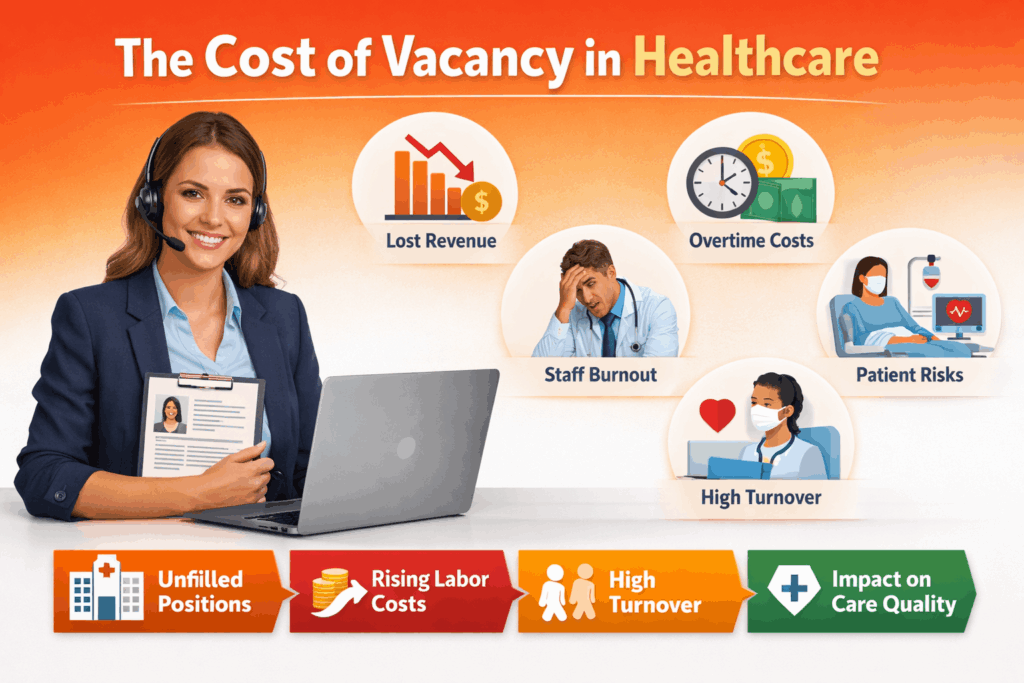
The cost of vacancy in healthcare goes far beyond an empty position. Every unfilled nursing, physician, or allied health role increases overtime costs, reduces patient access, strains staff morale, and can impact patient outcomes. Slow healthcare time-to-fill directly affects revenue, compliance, and care quality, making healthcare staffing speed a critical operational priority.
What Is the Cost of Vacancy in Healthcare?
The cost of vacancy in healthcare refers to the total financial and operational impact of leaving clinical or non-clinical healthcare positions unfilled. It includes direct revenue loss, overtime pay, contract labor premiums, burnout-related turnover, and potential declines in patient satisfaction and quality metrics.
In simple terms, every day a healthcare role remains open, the organization loses money and efficiency.
Recent Healthcare Staffing Statistics You Should Know
Understanding the scope of the issue starts with data. Here are recent statistics that highlight why vacancy in healthcare is so costly:
- Nursing Workforce Shortage: According to the National Center for Health Workforce Analysis, 2023, the United States could face a shortage of over 108,960 full-time registered nurses.
- Hospital Workforce Challenges: According to the American Hospital Association, 2024, hospitals are projected to experience a shortage of up to 3.2 million healthcare workers by 2026 across clinical and support roles.
- Turnover Costs for Nurses: According to NSI Nursing Solutions, 2024, the average cost of turnover for a bedside registered nurse is $61,110, and the average hospital loses between $4.4 million and $6.9 million annually due to nurse turnover.
- Healthcare Labor Expenses: According to Kaufman Hall, 2023, labor expenses per patient day increased by more than 20 percent compared to pre-pandemic levels.
- Physician Shortage Projections: According to the Association of American Medical Colleges, 2024, the United States could face a shortage of up to 86,000 physicians by 2036.
These numbers confirm a simple truth: slow healthcare hiring is not just inconvenient. It is expensive and escalating.
How Slow Healthcare Time-to-Fill Impacts Revenue
Healthcare time-to-fill refers to the average number of days it takes to fill an open position from job posting to candidate acceptance. In healthcare, extended time-to-fill directly reduces revenue potential.
1. Lost Billable Services
When clinical roles remain vacant:
- Fewer patient appointments are scheduled
- Surgical blocks go unused
- Emergency departments experience bottlenecks
- Specialty services face delays
For example, if a physician generates $2 million annually in billable services, a three-month vacancy could represent a potential revenue gap of $500,000.
2. Reduced Patient Throughput
Vacancies slow down admissions, procedures, and discharge planning. This leads to:
- Longer wait times
- Decreased patient satisfaction scores
- Lower reimbursement under value-based care models
In competitive healthcare markets, this can drive patients to alternative providers.
The Hidden Costs of Vacancy in Healthcare
Beyond lost revenue, the hidden costs of vacancy in healthcare can be even more damaging.
Increased Overtime and Premium Pay
To compensate for staffing shortages, organizations rely on:
- Overtime pay
- Travel nurses
- Locum tenens physicians
- Agency staffing contracts
Temporary labor often costs significantly more than permanent staff salaries. Premium contract rates can be double or triple base hourly wages.
Burnout and Secondary Turnover
Chronic understaffing increases workload and stress. This leads to:
- Higher burnout rates
- Increased absenteeism
- More voluntary resignations
When one vacancy triggers additional departures, the organization enters a costly turnover cycle.
According to NSI Nursing Solutions, 2024, the average hospital RN turnover rate remains above 18 percent, compounding staffing instability.
How Vacancy in Healthcare Impacts Patient Outcomes
Unfilled roles affect more than finances. They directly impact patient safety and quality metrics.
Higher Patient-to-Nurse Ratios
Research consistently shows that higher patient-to-nurse ratios correlate with:
- Increased medication errors
- Higher infection rates
- Longer hospital stays
Compliance and Accreditation Risks
Staffing shortages can compromise compliance with:
- Joint Commission standards
- CMS staffing requirements
- State nurse-to-patient ratio laws
Non-compliance can lead to penalties, reimbursement reductions, or reputational damage.
Why Healthcare Time-to-Fill Is Longer Than Other Industries
Healthcare hiring cycles are uniquely complex.
Key Factors Driving Longer Time-to-Fill
- Licensing and credential verification
- Background checks and compliance screening
- Specialty skill requirements
- Competitive talent market
- Geographic workforce shortages
According to industry benchmarks, healthcare roles often take 45 to 90 days to fill, depending on specialization and location.
In rural or high-demand specialties, physician time-to-fill can exceed six months.
Quick Facts: The Real Cost of Healthcare Vacancies
- The average RN turnover cost exceeds $61,000 per nurse.
- Hospitals can lose millions annually due to nurse turnover alone.
- Labor costs have risen more than 20 percent compared to pre-pandemic levels.
- Physician shortages may reach 86,000 by 2036.
- Extended time-to-fill directly reduces patient throughput and revenue.
These figures show that healthcare staffing delays are a strategic risk, not just an HR challenge.
Case Example: The Financial Impact of a 90-Day RN Vacancy
Consider a mid-sized hospital with:
- 250 beds
- Average RN salary of $85,000
- 90-day vacancy in a critical care unit
Direct Financial Impact
- Overtime premiums: Estimated $15,000 to $25,000
- Agency nurse contracts: Potentially $30,000 to $45,000
- Reduced admissions due to limited staffing capacity
Indirect Impact
- Increased burnout among remaining staff
- Higher turnover probability
- Lower patient satisfaction scores
The total cost can easily exceed $75,000 for a single prolonged vacancy.
Multiply this by multiple departments, and the annual financial impact becomes substantial.
How Strategic Healthcare Staffing Reduces Vacancy Costs
Proactive healthcare staffing strategies significantly reduce healthcare time-to-fill and associated costs.
1. Talent Pipeline Development
Building relationships with:
- Nursing schools
- Residency programs
- Allied health training institutions
ensures a steady inflow of qualified candidates.
2. MSP and VMS Integration
Managed Service Provider and Vendor Management System models centralize contingent staffing, enabling:
- Faster requisition processing
- Vendor performance tracking
- Reduced markups
3. AI-Powered Candidate Matching
Modern healthcare staffing firms use AI-driven sourcing to:
- Identify qualified candidates faster
- Match skills to compliance requirements
- Shorten screening cycles
This reduces time-to-fill without sacrificing quality.
Comparison: Cost of Vacancy vs Cost of Strategic Staffing
| Factor | Prolonged Vacancy | Strategic Healthcare Staffing |
|---|---|---|
| Revenue Impact | Lost patient volume | Maintained throughput |
| Labor Costs | High overtime and agency rates | Predictable staffing costs |
| Staff Morale | Burnout and turnover | Stable workload |
| Patient Outcomes | Increased risk | Improved quality metrics |
| Compliance Risk | Higher | Lower |
Investing in strategic healthcare staffing reduces total operational risk.
How to Calculate the Cost of Vacancy in Healthcare
Use this simple formula:
Cost of Vacancy = (Daily Revenue Impact + Overtime Costs + Agency Premiums) × Days Vacant + Turnover Risk Costs
For example:
- $5,000 daily revenue impact
- $1,000 daily overtime
- 60-day vacancy
Total Estimated Cost: $360,000
This calculation often surprises healthcare administrators who underestimate vacancy impact.
Key Takeaways
- The cost of vacancy in healthcare includes lost revenue, overtime, turnover, and patient outcome risks.
- Healthcare time-to-fill directly affects operational stability.
- Nurse turnover alone costs hospitals millions annually.
- Labor expenses remain elevated compared to pre-pandemic levels.
- Strategic healthcare staffing reduces financial and clinical risk.
Conclusion: Why Faster Healthcare Hiring Is a Strategic Imperative
Vacancy in healthcare is not just a staffing issue. It is a financial, operational, and patient safety risk. Slow healthcare time-to-fill increases labor costs, reduces revenue, strains teams, and impacts care quality. Healthcare organizations that treat staffing as a strategic priority rather than a reactive process consistently outperform competitors in both financial stability and patient outcomes. If your organization is struggling with extended vacancies or rising labor costs, it may be time to rethink your healthcare staffing strategy. Contact VIVA USA today to learn how our flexible contingent staffing models, MSP solutions, and AI-powered sourcing can reduce healthcare time-to-fill and protect your bottom line.