Hiring Funnel Optimization: Where Most Companies Lose Top Candidates
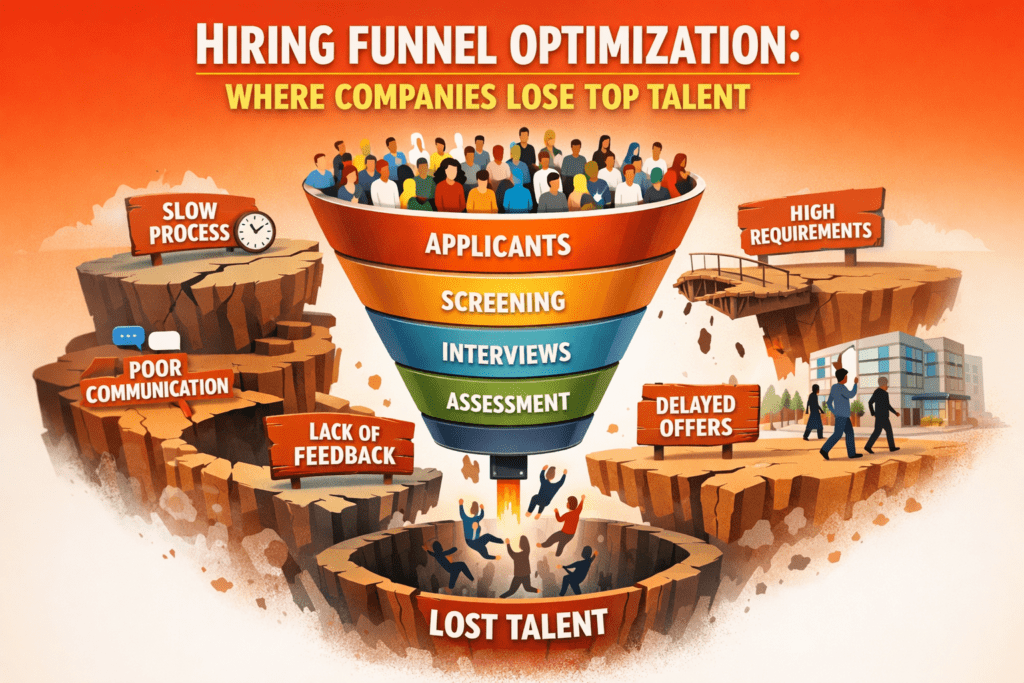
Hiring funnel optimization is the strategic process of analyzing and refining each stage of the recruitment journey to reduce candidate drop-off and improve the quality and efficiency of hires. Many companies experience significant candidate loss due to inefficiencies in their hiring funnel, often at predictable stages that can be identified and improved through data-driven strategies.
The Leaky Bucket: Understanding Candidate Drop-Off in the Hiring Process
A “leaky bucket” aptly describes a hiring funnel that loses a high percentage of candidates before an offer is made or accepted. This phenomenon is a critical concern for businesses, as it directly impacts time to hire, cost per hire, and ultimately, the quality of talent acquired. Identifying where candidates drop off in the hiring process is the first step toward a more robust recruitment strategy.
Research from SHRM indicates that the average cost per hire is approximately $4,700, making every lost candidate a potential financial setback. Optimizing your hiring funnel can significantly reduce these costs and improve your overall recruitment ROI.
Decoding the Stages: What are the Hiring Funnel Stages?
The hiring funnel typically comprises several distinct stages, each serving a unique purpose in evaluating and attracting candidates. Understanding these stages is fundamental to effective recruitment funnel optimization.
The key stages of a typical hiring funnel include:
- Awareness/Attraction: This initial stage focuses on making potential candidates aware of your company and available positions. It involves employer branding, job postings, and outreach efforts.
- Application: Candidates express interest by submitting their resumes and cover letters, often through an Applicant Tracking System (ATS).
- Screening/Assessment: Recruiters or hiring managers review applications, conduct initial phone screens, and may use assessments to narrow down the pool.
- Interviewing: Selected candidates undergo one or more rounds of interviews with various team members.
- Offer: A formal job offer is extended to the chosen candidate.
- Onboarding: The final stage where the accepted candidate transitions into an employee, though technically outside the hiring decision funnel, it impacts retention.
Let’s delve into where most companies falter within these stages.
Stage 1: Awareness & Attraction Pitfalls
This is the very top of your recruitment funnel, where you aim to capture the attention of potential talent. Many companies struggle here due to a lack of strong employer branding or poorly crafted job descriptions.
Where candidates drop off:
- Weak Employer Brand: If your company’s reputation is unclear or negative, or if you simply don’t have a compelling story to tell, top talent may never even consider applying.
- Poorly Written Job Descriptions: Vague, lengthy, or overly demanding job descriptions deter qualified candidates. Candidates want to understand the role, responsibilities, and company culture clearly.
- Limited Sourcing Channels: Relying on only one or two job boards means missing out on a vast pool of passive candidates who might be perfect for the role.
How to optimize this stage:
- Develop a strong employer value proposition (EVP): Clearly articulate what makes your company a great place to work.
- Craft compelling and concise job descriptions: Highlight key responsibilities, required skills, and the impact of the role. Use inclusive language.
- Diversify your sourcing strategies: Utilize social media, professional networks, university partnerships, and referral programs.
Stage 2: The Application Process Bottleneck
The application stage is often a major point of friction, leading to significant candidate drop-off. Complex or lengthy application forms frustrate candidates and signal a potentially inefficient organization.
Where candidates drop off:
- Lengthy and Complex Application Forms: Requiring excessive information or multiple steps upfront discourages applicants, especially those applying on mobile devices.
- Lack of Transparency: Not providing an estimated timeline for the hiring process can leave candidates feeling uncertain and lead them to pursue other opportunities.
- Poor Mobile Experience: With many candidates applying via smartphones, a non-mobile-friendly application system is a huge barrier.
How to optimize this stage:
- Simplify the application process: Aim for a streamlined, intuitive application that can be completed quickly, ideally under 10 minutes.
- Provide clear expectations: Inform applicants about the next steps and estimated timelines.
- Ensure mobile optimization: Test your application portal on various mobile devices to guarantee a seamless experience.
A study by CareerBuilder revealed that 60% of job seekers have quit an online application due to its length or complexity. This statistic highlights the critical need for recruitment funnel optimization at the application stage.
Stage 3: Screening & Assessment Hurdles
Once applications are received, the screening and assessment phase determines who moves forward. Ineffective screening methods or a lack of timely communication can cause candidates to disengage.
Where candidates drop off:
- Slow Response Times: Delaying communication after an application is submitted can lead to candidates accepting other offers.
- Irrelevant Assessments: Requiring candidates to complete assessments that don’t directly relate to the job’s core competencies can be perceived as a waste of time.
- Lack of Feedback for Rejected Candidates: Candidates appreciate knowing why they weren’t selected, even if it’s a generic response. No communication at all can damage your employer brand.
How to optimize this stage:
- Automate initial screening where possible: Use AI-powered tools to quickly identify qualified candidates based on keywords and criteria.
- Implement relevant and efficient assessments: Ensure any tests or tasks accurately reflect the job requirements and are not overly time-consuming.
- Provide timely and polite communication: Even automated rejection emails are better than silence.
Stage 4: Interviewing Stage Attrition
Interviews are a two-way street; candidates are evaluating your company as much as you are evaluating them. A disorganized or negative interview experience is a common reason for candidate withdrawal.
Where candidates drop off:
- Poor Interviewer Training: Interviewers who are unprepared, ask illegal questions, or project a negative impression can alienate top talent.
- Lack of Communication or Follow-Up: Candidates expect regular updates after interviews. Prolonged silence suggests disinterest or disorganization.
- Inconsistent Interview Experience: Different interviewers asking disparate questions or having varying expectations can create confusion and frustration for candidates.
- Logistical Challenges: Difficult scheduling, last-minute changes, or technical issues with virtual interviews can reflect poorly on the company.
How to optimize the recruitment funnel optimization in the interviewing stage:
- Train all interviewers: Ensure they understand best practices, legal guidelines, and your company’s values.
- Establish a structured interview process: Use consistent questions and evaluation criteria across all candidates for a role.
- Maintain prompt and clear communication: Provide updates on the timeline and next steps.
- Prioritize candidate experience: Make scheduling easy, be punctual, and create a welcoming environment.
A survey by Talent Board found that 52% of candidates say that a poor candidate experience would make them take their business elsewhere. This underscores the financial and reputational impact of a suboptimal interview process.
Stage 5: Offer & Negotiation Fumbles
Even after extending an offer, companies can lose candidates due to uncompetitive offers, a slow negotiation process, or a lack of persuasive selling.
Where candidates drop off:
- Uncompetitive Compensation and Benefits: If your offer doesn’t align with market rates or candidate expectations, they will likely decline.
- Slow Offer Process: Delays in extending an offer or responding to counter-offers can lead candidates to accept other positions.
- Lack of “Sell”: Failing to reiterate the unique value proposition of the role and the company can result in candidates feeling less enthusiastic about the offer.
How to optimize this stage:
- Conduct thorough market research: Ensure your compensation and benefits packages are competitive.
- Streamline the offer approval process: Aim for quick turnaround times on offers and negotiations.
- Personalize the offer presentation: Reiterate why the candidate is a great fit and highlight the benefits of joining your team.
Key Takeaways for Hiring Funnel Optimization
- Candidate Experience is Paramount: A positive experience at every touchpoint reduces drop-off.
- Data-Driven Decisions: Track metrics at each stage to identify bottlenecks and areas for improvement.
- Communication is Key: Timely, clear, and consistent communication keeps candidates engaged.
- Employer Branding Matters: A strong brand attracts better talent from the outset.
- Efficiency and Simplicity: Streamline processes to reduce friction for candidates and recruiters.
Quick Facts about Candidate Drop-Off:
- 60% of job seekers have abandoned an online application due to its length or complexity. (CareerBuilder, 2018)
- 52% of candidates would take their business elsewhere after a poor candidate experience. (Talent Board, 2021)
- The average cost per hire is $4,700. (SHRM, 2022)
Conclusion
Optimizing your hiring funnel is not a one-time task but an ongoing commitment to refining your recruitment strategy. By understanding where candidates drop off and implementing targeted improvements at each stage, companies can significantly enhance their ability to attract, engage, and secure top talent. Focusing on candidate experience, streamlining processes, and leveraging data are essential for a robust and efficient hiring funnel.
Is your hiring funnel a leaky bucket? Contact VIVA USA today to discover how our expert staffing solutions can help you optimize your recruitment process and secure the talent you need to thrive.