How to Reduce Candidate Drop-Off Rates with Better Technology
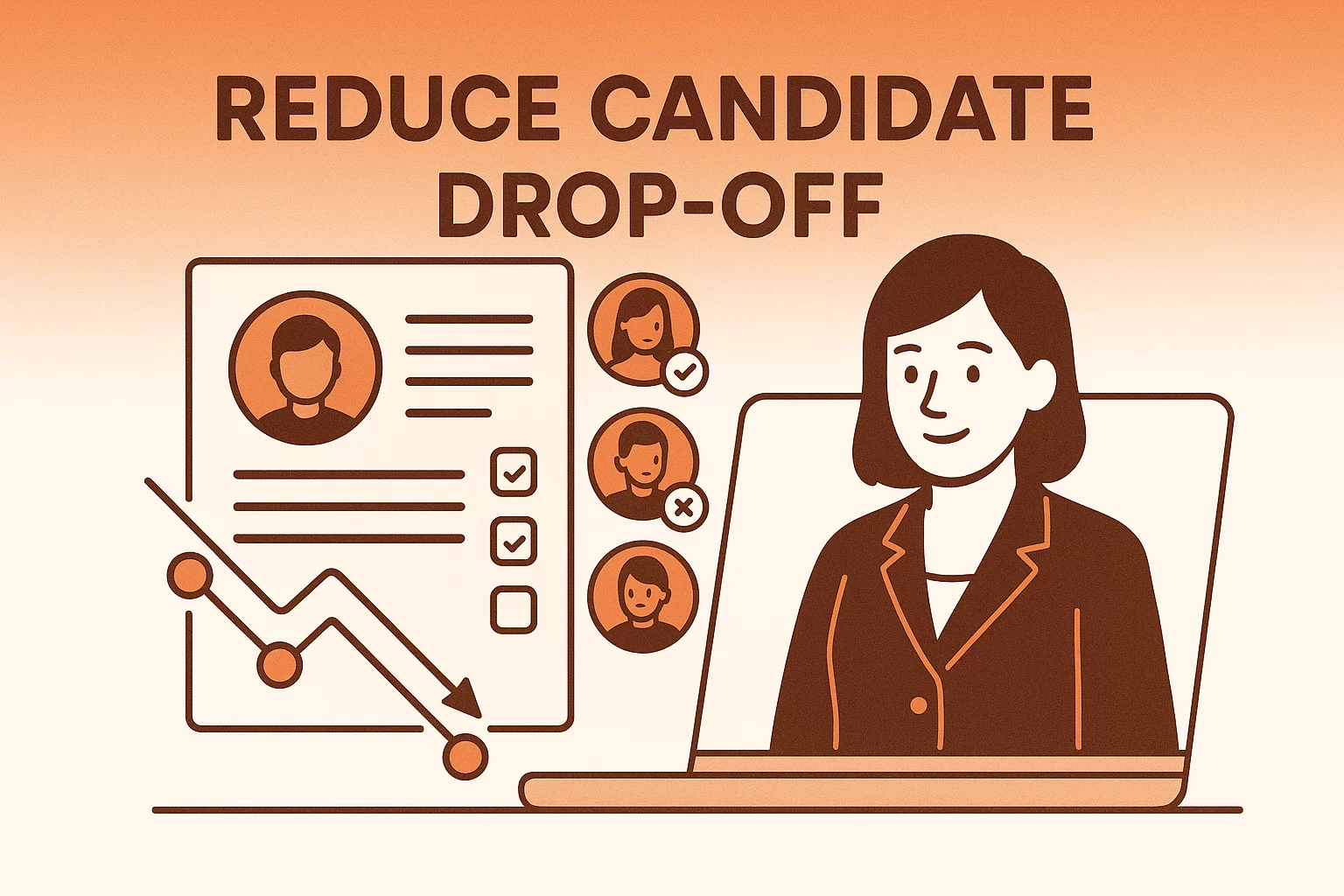
In today’s competitive hiring landscape, candidate drop-off is a silent revenue leak in your recruitment funnel. The good news: with better technology and smarter automation, you can slash drop-off, boost engagement, and hire faster. In this post, we’ll show exactly how to reduce candidate drop off using tools and strategies that encourage completion, clarity, and connection.
Reduce candidate drop-off by simplifying and engaging at every step. The key is to remove friction, maintain transparent communication, and leverage technology to guide candidates forward, not leave them behind. This blog outlines actionable tactics using candidate engagement tools to retain more applicants.
Why Candidates Drop Off (And What the Data Shows)
Understanding why candidates disengage helps you target the right fixes. Here are key stats:
- SmartRecruiters reports that 72% of candidates say the smoothness of the interview process influences whether they accept a job. (smartrecruiters.com)
- Fasthire (2024) finds up to 75% candidate drop-off across recruitment funnels in many organizations. (fasthire.io)
- TalentPool (2025) notes that 28% of candidates admit to ghosting mid process in recruiting. (thetalentpool.ai)
These numbers spotlight the urgent need for candidate engagement tools, streamlined workflows, and feedback loops.
How to Reduce Candidate Drop-Off with Technology
Below are focused strategies (and tool types) that directly address drop-off, structured so many answers are snippet friendly.
1. Use an Intelligent Applicant Tracking System (ATS) with Drop-Off Analytics
An advanced ATS tracks drop-off by funnel stage, logs candidate disengagement points, and surfaces metrics (for example form abandonment). You can quickly spot where most applicants leave, such as the screening form, assessment, or scheduling phase, and correct that stage.
Why It Matters:
- Moves you from guesswork to evidence: see exactly where candidates exit.
- Enables prioritization: focus on the zone with the highest attrition.
- Supports A/B testing of process tweaks with measurable feedback.
Example Tools: Greenhouse, Lever, Workable, SmartRecruiters (most have modules or integrations for analytics).
2. Simplify & Optimize the Application Form
Reduce candidate drop-off by cutting form fields, using progressive profiling, auto filling data, and making the application fully mobile friendly. These measures lower friction and encourage completion.
Best Practices:
- Ask minimal, essential fields (other details can come later).
- Pre populate from resume or LinkedIn parsing.
- Employ multi-step “wizard” forms rather than one long page.
- Ensure full mobile responsiveness since many drop-offs occur on mobile.
- Use save as draft functionality so candidates can return later.
Case Example: A mid sized tech firm switched from a 15 field single page to a 5 step progressive form, and they saw a 30% increase in completion rates within two months.
3. Deploy Conversational & Chatbot Tools
Conversational tools (chatbots, SMS, live chat) guide candidates through the application process, answer FAQs in real time, and prompt them to complete actions. This reduces hesitation and dropout.
Practical Uses:
- Interactive pre screening via chat (for example “Are you willing to relocate?”).
- Real time support: “I can help you with your resume upload.”
- Nudges and reminders via SMS or chat: “You started the form, want to finish?”
- Q&A bots to clarify role, benefits, next step timelines.
Why It Works:
These tools lower uncertainty, reduce waiting for responses, and treat candidates like humans, not passive form fillers. Some platforms show increased completion by 15–25% when integrated.
4. Automate Scheduling, Reminders & Feedback
Integrate automated interview scheduling, reminder emails or texts, and status feedback to keep candidates engaged and reduce drop-off caused by slow or disjointed communication.
Implementation Tips:
- Let candidates self pick interview slots from your calendar.
- Use reminders (24h, 1h prior) via email or SMS.
- If you cannot respond right away, send auto status updates (“We received your application, next steps in 3 days”).
- Even rejections should be prompt and personalized.
5. Integrate Assessment & Testing Platforms Smoothly
When assessments or tests are required, embed or link them seamlessly inside your application flow. This reduces add-on friction that makes candidates abandon mid process.
Tips for Integration:
- Use in platform assessments (not redirecting to third sites).
- Keep assessments short (under 20 minutes).
- Give clear instructions and progress indicators.
- Allow pausing and resuming.
- Provide immediate feedback or results if possible.
6. Provide Transparent & Timely Communication
Transparent, frequent communication (on status, timelines, next steps) builds trust and minimizes drop-off. Candidates feel respected and informed, not left in limbo.
Communication Strategy:
- Use drip emails: confirmation → screen → interview → decision.
- Give date ranges, not vague “soon.”
- Use SMS or push notifications for updates.
- Ask for and act on candidate experience feedback.
7. Monitor, Analyze & Iterate with A/B Testing
Continuously test versions, for example form length, button copy, layout, using A/B experimentation. Track impact on drop-off and refine. A data driven loop ensures you improve over time.
Steps:
- Identify a stage with high drop-off.
- Create two variants (A vs B).
- Route traffic and measure difference in completion.
- Retain the better version and test again elsewhere.
Bonus: Use candidate surveys or exit surveys asking “Why did you stop?” to inform your hypotheses.
Comparison Table: Before vs After Better Technology
| Process Aspect | Before (Legacy) | After (With Candidate Engagement Tools and Automation) |
|---|---|---|
| Form Complexity | Long, static, many fields | Dynamic, minimal, progressive or step based |
| Mobile Experience | Poor or non optimized | Fully responsive, mobile first design |
| Communication | Manual, delayed, opaque | Automated, timely, transparent status updates |
| Scheduling | Back and forth emails | Self service calendar booking with reminders |
| Assessments | Redirect to external pages, lengthy | Embedded, short, resumable |
| Analytics & Visibility | Blindspots, manual reports | Real time dashboards, drop-off analytics, A/B testing |
| Candidate Experience | Candidates feel ignored or lost | Candidates feel guided, empowered, and respected |
Implementation Checklist
- Audit your current drop-off points (via ATS and analytics).
- Choose an ATS or engagement platform with built-in analytics and integrations.
- Redesign your application forms for minimal friction and mobile.
- Add conversational tools (chatbot, SMS nudges).
- Automate scheduling and reminders.
- Embed assessments smartly.
- Build transparent candidate communication workflows.
- Run A/B tests and collect feedback.
- Review metrics monthly and adapt continuously.
Conclusion
Reducing candidate drop-off is not magic, it is systematic. By layering candidate engagement tools, automation, clear communication, seamless assessments, and smart analytics, your recruitment funnel becomes more efficient, humane, and effective.
If you would like expert guidance designing or integrating recruiting technology that reduces drop-off and accelerates hiring, contact VIVA. We help you build high converting, candidate-centric hiring workflows today.