How to Measure Hiring Success Beyond Offer Acceptance
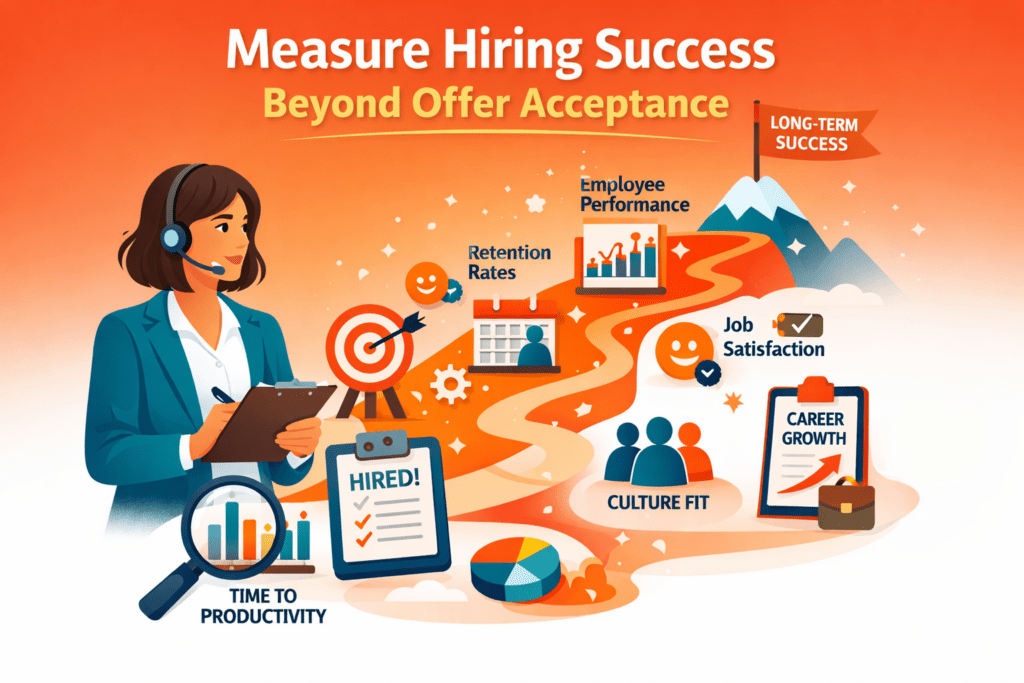
Measuring hiring success does not end when a candidate signs a contract. To truly measure hiring success, organizations must track long-term performance, cultural integration, and retention. The most effective hiring success metrics evaluate the return on investment (ROI) of a new hire through data points like quality of hire, time to productivity, and first-year retention rates.
Quick Facts: Essential Recruitment Success Metrics
- Quality of Hire: The primary indicator of whether a recruit adds value to the organization.
- Time to Productivity: Measures how long it takes for a new employee to contribute fully.
- First-Year Attrition: Tracks the percentage of hires who leave within 12 months.
- Hiring Manager Satisfaction: A qualitative score reflecting the alignment between HR and business needs.
- The “Hidden” Cost of Failure: A bad hire can cost up to 30% of the employee’s first-year earnings in lost productivity and turnover expenses.
Why You Must Measure Hiring Success Beyond the Offer
While the offer acceptance rate tells you how attractive your employer brand is, it does not tell you if you hired the right person. True recruitment success metrics shift the focus from the “transaction” of hiring to the “impact” of the employee.
According to Robert Half, 2024, 91% of hiring managers admit it is challenging to find skilled professionals, which often leads to “panic hiring.” However, rushing the process to secure an acceptance often leads to long-term financial loss. As noted by VIVA USA in previous post, the true cost of a bad hire extends far beyond the initial salary, encompassing recruitment fees, training hours, and the negative impact on team morale.
What is the most important metric for hiring success?
The most critical metric is Quality of Hire. This multi-dimensional metric combines performance reviews, ramp-up time, and retention data to determine if a new hire is meeting the strategic goals of the company. It serves as the ultimate validator of your entire recruitment funnel and sourcing strategy.
Recent Statistics on Hiring and Performance
To build a data-driven recruitment strategy, consider these recent benchmarks:
- Retention and Attrition: Research from Robert Half, 2024, indicates that hiring a new employee can cost significantly more than their annual salary when accounting for disruption, making first-year retention a vital financial metric.
- Productivity Gains: According to Deloitte’s 2024 Global Human Capital Trends, organizations that prioritize “human performance” and employee development see higher engagement levels and faster ramp-up times for new staff.
- Hiring Accuracy: A 2023 Statista report on global recruitment found that over 50% of companies are now using AI-driven analytics to improve the accuracy of their quality of hire assessments.
- The Ripple Effect: According to Forbes, 2024, a single bad hire can lower the productivity of an entire team by 15% due to the increased burden placed on high-performing employees to cover for the skills gap.
Key Hiring Success Metrics to Track
To optimize your talent acquisition strategy, you should look at a blend of quantitative and qualitative data that begins after the onboarding process is complete.
1. Quality of Hire (QoH)
Quality of Hire is the “North Star” of hiring success metrics. It is often calculated by averaging several variables over the hire’s first six to twelve months.
- Performance Ratings: Assessment of the hire’s output against KPIs.
- Culture Fit: How well the individual aligns with company values.
- Longevity: Whether the hire stays long enough to provide a return on the initial investment.
2. Time to Productivity (Ramp-Up Time)
This metric tracks the duration between a new hire’s start date and the point where they are contributing at a “fully functional” level. If your ramp-up time is too long, it may indicate a flaw in your onboarding process or a mismatch in the candidate’s technical skills during the screening phase.
3. First-Year Attrition Rate
If a high percentage of your hires leave within the first year, your recruitment process is likely failing to screen for cultural fit or realistic job previews. High attrition is an expensive red flag. Specialized recruiting partners can help mitigate this by ensuring candidates are vetted for both technical skills and long-term organizational alignment.
4. Hiring Manager Satisfaction
Send a survey to hiring managers 90 to 120 days after a new hire starts. Ask them:
- Does the hire meet the technical requirements of the role?
- How well has the hire integrated with the team?
- Was the recruitment process efficient and collaborative?
How to Calculate the ROI of Your Recruitment Success Metrics
Measuring the financial impact of your hires helps secure budget for future talent initiatives and demonstrates the value of specialized recruiting.
| Metric | How to Measure | Business Impact |
|---|---|---|
| Cost per Hire | Total Recruiting Costs / Total Hires | Budget Efficiency |
| Revenue per Employee | Total Revenue / Total Number of Employees | Workforce Productivity |
| New Hire Retention | (Hires still employed after 1 yr / Total hires) × 100 | Stability & Cost Savings |
Using these recruitment success metrics allows you to identify which sourcing channels deliver the highest quality candidates. For instance, if specialized recruiting agencies consistently produce hires with higher performance ratings than general job boards, the ROI justifies the higher upfront cost.
The True Cost of a Bad Hire
A common mistake in measuring success is ignoring the “negative ROI” of a poor recruitment choice. Beyond the salary, companies must account for:
- Recruitment Costs: Advertising, internal HR time, and external fees.
- Training Costs: The time senior staff spends mentoring a hire who eventually leaves.
- Operational Disruption: The loss of momentum on critical projects.
By focusing on long-term hiring success metrics, companies avoid the cycle of “hire-and-replace” that drains corporate resources. Specialized recruiting mitigates these risks by providing access to a vetted pool of talent that has already been assessed for technical proficiency.
Best Practices for Improving Your Hiring Success
- Standardize Interviews: Use structured interviews to ensure every candidate is evaluated against the same criteria. This reduces bias and improves the reliability of your quality metrics.
- Invest in Onboarding: Recruitment does not end at the signature. A strong onboarding program can improve retention by over 80% according to industry reports.
- Audit Your Sourcing Channels: If your most expensive job board has the lowest “Quality of Hire” score, it is time to reallocate that budget to more effective channels like employee referrals or specialized staffing partners.
- Leverage AI and Data: Modern Applicant Tracking Systems (ATS) can automate the collection of these metrics, providing real-time dashboards for HR leaders to make informed decisions.
Conclusion
Moving beyond offer acceptance is the only way to ensure your recruitment strategy is actually driving business growth. By focusing on hiring success metrics like Quality of Hire and Time to Productivity, you can transform your HR department from a cost center into a strategic partner.
Tracking these metrics requires a consistent, data-driven approach and the right talent partners. If you are looking to improve your quality of hire and avoid the steep costs associated with recruitment errors, partnering with a specialized firm can provide the necessary expertise.
Are you ready to elevate your talent acquisition strategy? Contact VIVA USA today for staffing solutions that focus on long-term hiring success and high-quality talent integration.