The Cost of a Bad Tech Hire: How to Calculate the Real ROI of Specialized Recruiting
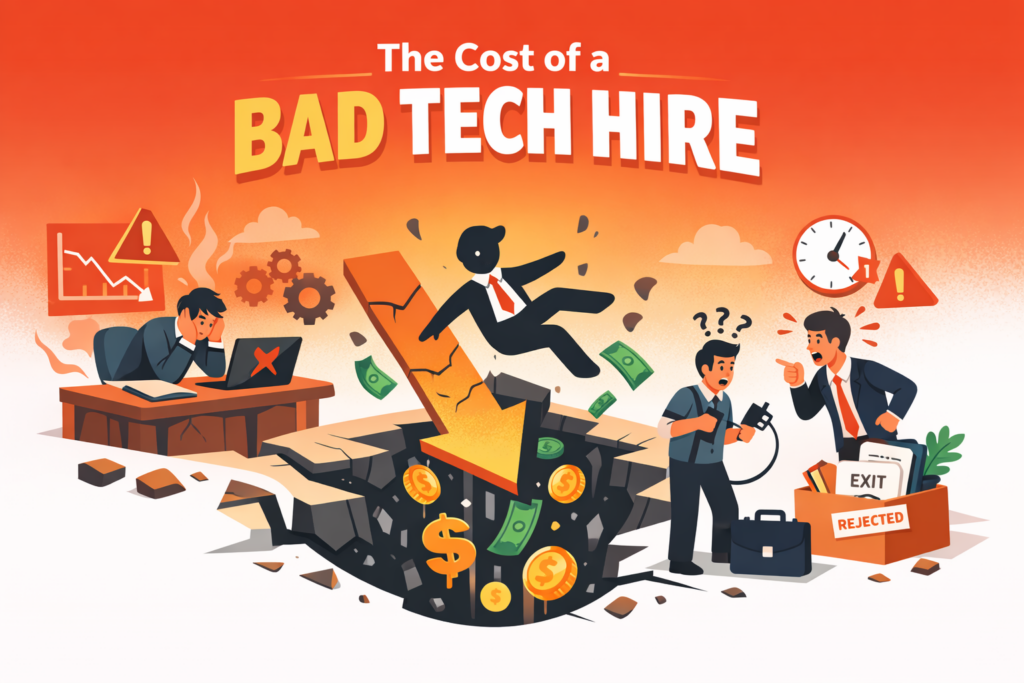
Hiring the wrong technical talent is a multi-billion dollar problem for modern enterprises. A bad tech hire costs an average of 30% of the employee’s first-year earnings, but in specialized fields like software engineering or cybersecurity, this figure can skyrocket to 150% or even 200% of their annual salary due to lost productivity, project delays, and recruitment rework. Utilizing specialized recruiting is the primary method for mitigating these risks and ensuring a positive return on investment (ROI).
Quick Facts: The Impact of Hiring Mistakes
- Direct Financial Loss: The average cost of a bad hire is at least $15,000, but often exceeds $240,000 for senior technical roles.
- Retention Boost: Effective onboarding and specialized matching can increase new hire retention by up to 82%.
- Time Loss: It typically takes six months or more for a business to break even on the investment of a new hire.
- Team Productivity: Over 75% of employers report that turnover increases workloads and lowers morale for the remaining staff.
What is the cost of a bad tech hire?
The cost of a bad tech hire refers to the total financial and operational loss incurred when an employee is underqualified, culturally mismatched, or leaves the company prematurely. This includes direct expenses like salary and recruitment fees, plus indirect costs such as damaged team morale, delayed product releases, and the price of restarting the search.
Recent Statistics on Tech Recruitment
To understand the gravity of hiring errors, consider these data points from leading industry reports:
- 30% of Annual Earnings: According to the U.S. Department of Labor (2025), the average cost of a bad hire is at least 30% of the employee’s first-year earnings.
- $240,000 Per Mistake: A study highlighted by SHRM and CareerBuilder (2024) indicates that the total cost of a bad hire can reach up to $240,000 when accounting for recruitment, compensation, and lost productivity.
- 82% Retention Improvement: According to Glassdoor (2025), organizations with a strong, specialized onboarding and matching process improve new hire retention by 82%.
- 30% Morale Reduction: According to the Forbes Human Resources Council (2024), a bad hire can lead to a 30% reduction in team morale, which often triggers further attrition among top performers.
How to Calculate Technology Staffing ROI
Calculating the technology staffing ROI requires looking beyond the initial placement fee. You must weigh the total investment against the value the new hire produces over time.
The Standard Recruitment ROI Formula
The simplest way to express the return on your hiring investment is:
ROI = (Total Value of Hire – Total Cost of Hire)/(Total Cost of Hire)*100
Breaking Down the “Total Cost of Hire”
To get an accurate number, you must sum these four categories:
- Hiring Costs: Job board ads, background checks, and the hourly rate of everyone involved in the interview process.
- Onboarding & Training: The cost of software licenses, hardware, and the mentor’s time spent on training.
- Compensation: Total salary and benefits paid during the tenure of the employee.
- Exit & Replacement: Severance pay, administrative time for offboarding, and the cost of starting a new search.
The Hidden ROI of Specialized Recruiting
Many companies avoid specialized staffing agencies because of the upfront fee. However, the ROI of specialized recruiting is found in the reduction of “soft” costs that internal HR teams often overlook.
1. Reduced Time-to-Fill
In tech, every day a seat stays vacant is a day of lost revenue. A specialized recruiter has a pre-vetted pipeline of niche talent (e.g., DevOps, AI Engineers, Cloud Architects). Reducing your time-to-fill by just 14 days can save thousands in project lag.
2. Higher Quality of Hire
Generalist recruiters may not understand the difference between a Java developer and a JavaScript developer. Specialized firms use technical assessments to ensure candidates possess the specific skills required. This drastically reduces the likelihood of a “skill gap” hire.
3. Lower Attrition Rates
Specialized recruiters focus on cultural and technical alignment. As noted by Glassdoor, a strong match improves new hire retention significantly. When an employee stays for three years instead of six months, the ROI on that initial recruiting fee becomes exponential.
Comparing Internal vs. Specialized Tech Recruiting ROI
| Metric | Internal Generalist Team | Specialized Recruiting Partner |
|---|---|---|
| Sourcing Speed | Slow (Posting and Praying) | Fast (Passive Talent Network) |
| Technical Screening | Basic/Surface Level | Deep Technical Assessment |
| Cost Per Hire | Lower Upfront | Higher Upfront |
| Risk of Bad Hire | Higher (High Volume focus) | Lower (Quality/Fit focus) |
| Overall ROI | Variable | Consistently Higher Long-term |
Steps to Maximize Your Tech Recruiting ROI
To ensure you are getting the most out of your hiring budget, follow these three strategic steps:
Define Success Metrics Early
Before hiring, determine what the “break-even point” looks like. For a software engineer, this might be when they ship their first major feature independently. Having clear KPIs allows you to measure the value of the hire more accurately.
Implement Structured Technical Interviews
Avoid “gut feeling” hires. According to Forbes (2024), unstructured interviews lead to biased decisions. Using a standardized rubric for every candidate reduces bias and ensures that you are measuring for the skills that actually drive profit.
Leverage Temporary-to-Permanent Models
This “try before you buy” approach is one of the safest ways to protect your tech recruiting ROI. It allows you to evaluate a candidate’s real-world performance for 3 to 6 months before committing to a full-time salary and benefits package.
Case Study: The Cost of a $120,000 Software Engineer Mis-Hire
If a company hires a Senior Software Engineer at a $120,000 salary and they leave after four months, the financial damage is not just $40,000 (four months of salary).
The real breakdown looks like this:
- Recruitment & Ads: $5,000
- Interviewing Time (Team): $3,000
- Salary & Benefits (4 months): $52,000
- Lost Productivity (Team): $15,000
- Replacement Search: $10,000
- Total Loss: $85,000
In this scenario, a $20,000 fee for a specialized recruiter who guarantees a successful hire would have saved the company $65,000 in sunk costs.
Conclusion
The cost of a bad tech hire is a silent profit killer. While the invoice for a specialized recruiting partner might seem like a large expenditure, the ROI of specialized recruiting is proven through faster fills, higher quality talent, and significantly lower turnover. By calculating the real impact of every hiring decision, leadership can move from “filling seats” to “building value.”
Are you ready to stop losing money on turnover and start building a high-performance team? Contact VIVA USA today for specialized technology staffing solutions that deliver a measurable return on your investment.