MSP vs. VMS: What’s the Difference and Which Contingent Workforce Management Solution is Right for You?
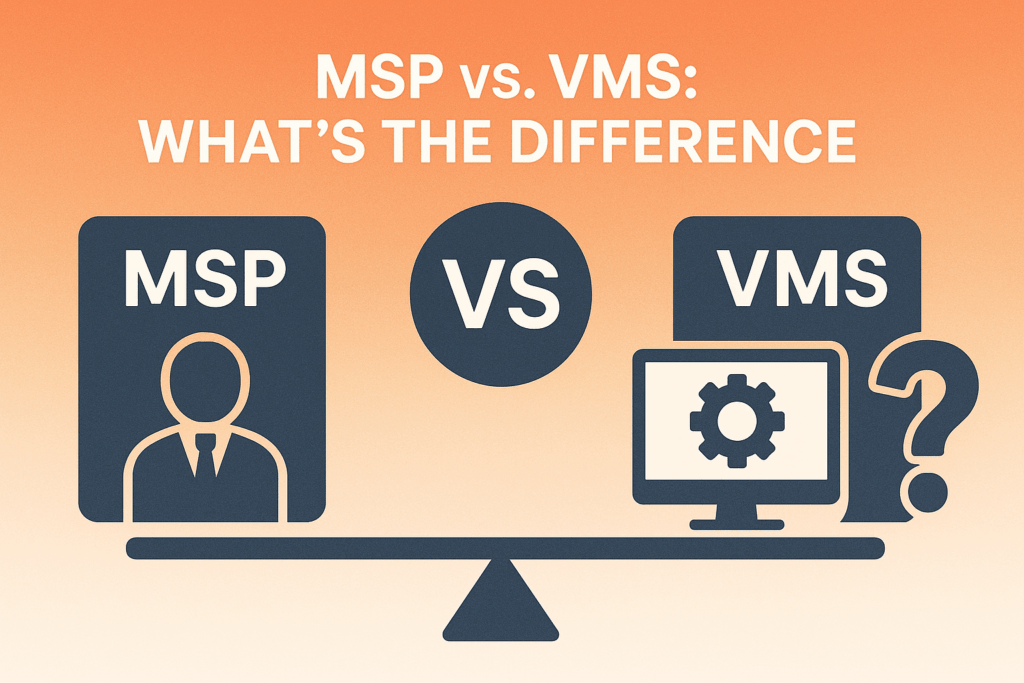
When looking to optimize your contingent workforce management solutions, you will inevitably encounter the terms MSP vs VMS. While often discussed together, a Managed Service Provider (MSP) and a Vendor Management System (VMS) are fundamentally different: the MSP is a service a team of people providing strategic oversight and management and the VMS is a technology platform a software tool used to automate and track contingent labor processes. For large enterprises, choosing the right combination of these two is critical for controlling costs, ensuring compliance, and gaining full visibility over their non-employee workforce.
Key Takeaways: MSP and VMS Difference in a Snapshot
The core difference between a Managed Service Provider (MSP) and a Vendor Management System (VMS) lies in the nature of the solution.
- Managed Service Provider (MSP): A third-party service that takes over the end-to-end management of your entire contingent workforce program, acting as a strategic partner.
- Vendor Management System (VMS): A cloud-based software solution that automates and centralizes the transactional and administrative aspects of contingent workforce procurement and management.
- Relationship: The most effective contingent workforce programs typically use an MSP service that leverages a VMS technology platform to execute their strategy.
The Rise of Contingent Labor: Essential Statistics
The global trend toward flexible staffing makes robust contingent workforce management solutions non-negotiable for modern enterprises. These statistics highlight the market size and importance of this segment:
- Market Growth Projection: The global contingent workforce management market size was $209.44 billion in 2023 and is projected to reach $557.92 billion by 2032, expanding at a CAGR of 10.5%. This growth underscores the increasing need for sophisticated solutions like MSP and VMS.
- SIA Industry Size: The overall Workforce Solutions Ecosystem was an estimated $2.3 trillion global market in 2023. This massive scale indicates the significant investment being made in all forms of staffing and workforce management.
- Intent to Increase Usage: 54% of companies plan to increase their use of global contingent talent in the coming years. This demonstrates a clear strategic shift toward a more flexible labor model that requires strong oversight.
- Cost Control with Technology: VMS solutions for healthcare have been shown to deliver average cost reductions of 10-25% in temporary labor spend. This illustrates the measurable financial impact of implementing a VMS technology platform.
What is a Managed Service Provider (MSP)?
A Managed Service Provider (MSP) is an outsourced team of experts responsible for running an organization’s entire non-employee workforce program. Think of an MSP as your strategic consultant and operations manager for all things related to temporary labor.
The Role and Responsibilities of an MSP
The primary function of an MSP is to provide end-to-end management of the contingent labor lifecycle, from requisition to off-boarding and payment. They bring deep industry expertise, best practices, and a human touch to the complexities of external talent acquisition.
An MSP’s core responsibilities include:
- Vendor Management: The MSP manages relationships with a network of staffing suppliers, negotiating contracts, setting performance standards, and consolidating billing.
- Process Optimization: They standardize workflows, rate cards, and all program procedures across different departments and global locations.
- Compliance & Risk Mitigation: They ensure all contingent workers and suppliers comply with complex labor laws, co-employment risks, and internal company policies.
- Talent Acquisition Strategy: MSPs often assist in strategic planning, offering market insights and implementing sourcing strategies, such as direct sourcing and talent pooling.
- Program Reporting: They leverage technology often a VMS to generate comprehensive reports and analytics, using the data to advise the client on optimization and cost savings.
A Managed Service Provider (MSP) is a third-party company that provides a full, outsourced service for managing an organization’s entire contingent workforce program, including strategic planning, vendor relationship management, compliance oversight, and operational execution. They act as a central, hands-on partner to streamline the “req-to-check” lifecycle.
Benefits of Choosing an MSP
Choosing an MSP provides organizations with a high degree of service, expertise, and time savings, particularly in large, complex enterprises.
- Hands-On Expertise: You gain instant access to a dedicated team of experts in contingent labor, legal compliance, and market rates, eliminating the need to build this knowledge in-house.
- Strategic Alignment: An MSP ensures your contingent workforce strategy aligns directly with your broader business objectives, offering consultative guidance on market trends.
- Cost Savings through Negotiation: By centralizing vendor relationships and spend, the MSP can negotiate better rates, leading to substantial cost optimization.
- Risk Reduction: Compliance is handled by the experts, significantly reducing the risk of costly co-employment issues or regulatory penalties.
- Focus on Core Business: Outsourcing the entire administrative and operational burden frees up internal HR and procurement teams to focus on core strategic activities.
What is a Vendor Management System (VMS)?
A Vendor Management System (VMS) is a proprietary, cloud-based software that provides the technological infrastructure for managing the entire contingent workforce lifecycle. A VMS is essentially a tool a centralized digital hub for all temporary staffing transactions.
Automating Contingent Workforce Processes with VMS Technology
The VMS is the engine that drives the operational efficiency of contingent workforce management. It focuses on automation, centralization, and data visibility.
A VMS is used to automate and centralize:
- Requisition Management: Creating, distributing, and tracking job requisitions to multiple staffing agencies simultaneously.
- Candidate Submissions & Tracking: Standardizing the process for agencies to submit candidates and tracking all candidates through the interview and hiring stages.
- Time & Expense Tracking: Providing an automated system for workers to submit timecards and expenses, with defined approval workflows.
- Invoicing & Payment: Consolidating invoices from all vendors into a single, standardized bill and automating the payment process.
- Reporting & Analytics: Offering real-time dashboards and reports on spend, vendor performance, compliance status, and time-to-fill metrics.
A Vendor Management System (VMS) is a software platform, usually cloud-based, that automates and manages the transactional elements of contingent workforce procurement, including job requisition distribution, candidate tracking, time and expense approval, and consolidated billing and reporting. It is a technology solution designed for transparency and process efficiency.
Benefits of Implementing a VMS
A VMS is primarily beneficial for improving control, visibility, and efficiency through technology.
- Enhanced Visibility & Control: Provides a single source of truth for all contingent labor data, allowing internal teams to track spending, performance, and usage in real time.
- Process Standardization: Automates and standardizes every workflow, ensuring a consistent and efficient process regardless of department or location.
- Data-Driven Decision Making: Robust reporting capabilities allow organizations to move away from guesswork and use empirical data to optimize rates and vendor relationships.
- Improved Compliance Tracking: The system can track crucial compliance data, such as background checks, certifications, and contract expiration dates, ensuring workers are always compliant.
- Scalability: A VMS can easily scale to manage thousands of contingent workers across numerous vendors and global markets without requiring a proportional increase in administrative staff.
MSP vs VMS: A Side-by-Side Comparison for Strategic Decision-Making
To clearly illustrate the fundamental MSP vs VMS difference, this comparison table highlights their function, focus, and best-fit scenario.
| Feature | Managed Service Provider (MSP) | Vendor Management System (VMS) |
|---|---|---|
| Nature | A Service (People + Expertise) | A Technology Platform (Software) |
| Primary Focus | Strategy, Management, and Execution | Automation, Centralization, and Data Tracking |
| Core Value | Outsourced expertise, risk mitigation, cost control through negotiation | Transparency, process efficiency, real-time data visibility |
| Vendor Relationship | Manages all vendors, serving as the single point of contact | Facilitates vendor engagement via automation |
| Cost Model | Service fee based on program spend (usually a %) | Software subscription fee (SaaS) |
| Ideal User | Organizations lacking internal resources, global operations, or seeking strategic oversight | Companies with large volumes, internal teams, and a desire for process automation |
| Analogy | The Concierge/Contractor (manages the whole project) | The Software Tool/Blueprint (used to build & track the project) |
Which is Right for You? Choosing Your Contingent Workforce Management Solution
The question is not always if you need an MSP and VMS, but how you should leverage them. The optimal choice depends on the size, complexity, and internal resources of your organization.
When to Choose an MSP (Managed Service Provider)
An MSP is the right choice when your organization has significant complexity, lacks internal expertise, or seeks a fully outsourced, hands-off solution.
- You lack dedicated internal resources: Your HR and Procurement teams are already stretched thin and cannot take on the significant administrative burden of contingent labor management.
- Your program is large and complex: You manage hundreds or thousands of contingent workers across multiple departments, geographies, or business units, requiring significant standardization.
- You need high-level, strategic oversight: You require expert advice on market rates, regulatory compliance, and overall workforce planning to drive best practices.
- You seek maximum cost control: You want a dedicated team whose primary goal is to drive savings through rate negotiation, demand management, and vendor consolidation.
Case Study Example: A Fortune 500 company with a global footprint and 2,500 temporary workers across 15 countries uses an MSP. The MSP manages 50+ staffing agencies, ensuring compliance with local laws from Germany to India, all while leveraging a VMS for centralized time and expense tracking.
When to Choose a VMS-Only Solution
A VMS-only approach is best when you have capable internal teams that want to retain hands-on control but need technology to drive efficiency and transparency.
- You have strong internal resources: Your procurement and HR teams are well-staffed, experienced, and prefer to manage the strategic relationship with staffing agencies directly.
- Your focus is on pure automation: Your primary goal is to standardize job distribution, manage time-and-expense approvals, and automate invoicing to improve administrative efficiency.
- You prioritize control and vendor neutrality: You want to maintain the authority to choose and manage your staffing vendors and program rules without outsourcing the process to a third-party service.
- Your contingent worker volume is manageable: Your program is either smaller or highly specialized, making the cost of an MSP service outweigh the benefit.
The Power of Partnership: MSP + VMS
For most large and growing enterprises, the ideal solution is a combination of an MSP and a VMS. The two solutions are complementary, not mutually exclusive.
The MSP provides the human expertise and strategy, while the VMS provides the technology backbone and data. Together, they offer the highest level of efficiency, visibility, compliance, and strategic management.
Benefits of the Combined Model:
- Seamless Operations: The MSP manages the day-to-day work, using the VMS to automate processes and ensure data accuracy.
- Maximized ROI: The MSP’s strategic negotiation skills drive cost savings, while the VMS’s automation cuts administrative overhead.
- Comprehensive Risk Mitigation: The VMS provides auditable data trails, and the MSP ensures all processes meet complex regulatory standards.
Quick Facts for Contingent Workforce Success
- The MSP is the driver; the VMS is the map. The MSP sets the direction and drives the program forward, while the VMS provides the necessary real-time data and navigational tools.
- Vendor Neutrality: A core tenet of a strong MSP is vendor neutrality, meaning they select suppliers based on performance, not preference, and the VMS helps track performance objectively.
- Start with Strategy: For first-time implementation, engaging an MSP early is often recommended. Their expertise can guide the selection and optimal configuration of the VMS technology to ensure long-term program success.
Conclusion
Choosing the right contingent workforce management solutions whether an MSP, a VMS, or a unified combination is a critical strategic decision. The core difference is simple: an MSP is a service that provides people, expertise, and strategic management, while a VMS is a technology that provides automation, visibility, and control.
For organizations with complex, high-volume contingent workforces, the bundled model of an MSP leveraging a VMS offers the most robust path to achieving cost savings, mitigating compliance risk, and ensuring a streamlined talent acquisition process.
Are you ready to optimize your contingent workforce program and find the solution that perfectly matches your organization’s needs?
Contact VIVA USA today for a consultation on your contingent workforce strategy. Our experts can assess your current needs and recommend the ideal MSP or VMS solution to drive efficiency, compliance, and talent quality for your enterprise.