AI in IT Sourcing: How Machine Learning is Cutting Time-to-Hire by 50%
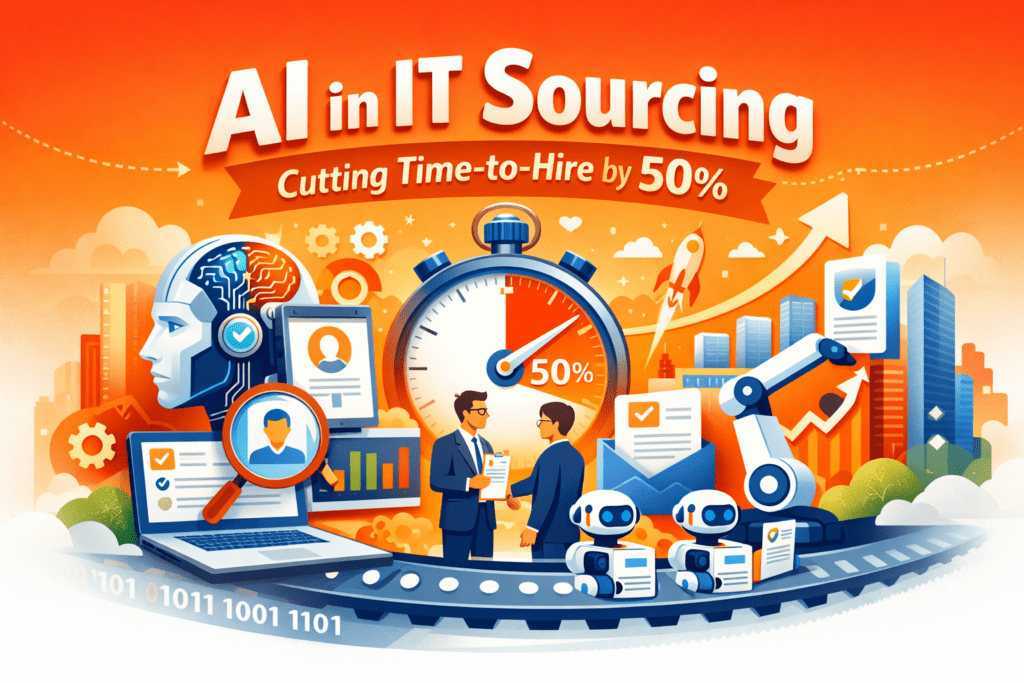
The integration of Artificial Intelligence (AI) and Machine Learning (ML) is fundamentally reshaping the landscape of IT staffing and talent acquisition. Specifically, AI in IT sourcing is dramatically accelerating the recruitment lifecycle, with cutting-edge platforms now consistently delivering a 50% reduction in average time-to-hire. This transformation is achieved by automating time-intensive tasks like candidate screening, semantic matching, and interview scheduling, allowing IT recruiters to shift their focus from administrative work to strategic candidate engagement.
Key Statistics: The AI Recruitment Market Shift
The rapid adoption of AI in staffing is not a forecast it is a current, measurable trend driven by the need to fill highly competitive IT roles faster. These statistics underscore the business imperative for adopting Machine Learning in IT sourcing:
- According to DemandSage, 87% of companies globally are utilizing AI-driven tools in their recruitment processes, signaling a widespread industry shift toward intelligent automation.
- According to a LinkedIn survey, 89% of recruiters agree that using AI decreases their average time-to-hire with some reporting an average reduction of 50%.
- AI recruitment tools can reduce hiring costs by up to 30% per hire in conservative implementations, alongside the significant time savings.
- The global AI in recruitment market was valued at $661.56 million in 2023 and is projected to reach over $1.1 billion by 2030, reflecting sustained, significant investment.
- 72% of recruiters find AI most useful for candidate sourcing, the initial and most time-intensive stage of the IT staffing process.
What is AI in IT Sourcing?
AI in IT sourcing refers to the application of intelligent technologies, primarily Machine Learning and Natural Language Processing (NLP), to automate and enhance the process of identifying, engaging, and qualifying candidates for information technology roles. This moves the process beyond simple keyword matching to contextual and predictive talent identification.
What are the Primary Goals of AI in Staffing?
The primary goals of implementing AI in staffing, particularly for in-demand IT roles, are to:
- Accelerate Time-to-Hire: Drastically reduce the time taken from job posting to offer acceptance, mitigating the risk of losing top talent to faster competitors.
- Improve Quality of Hire: Utilize predictive analytics to match candidates not only to technical skills but also to organizational culture and historical performance data.
- Increase Recruiter Efficiency: Free human recruiters from repetitive, high-volume tasks like screening and scheduling, allowing them to focus on high-touch relationship building.
- Reduce Unconscious Bias: Apply consistent, data-driven evaluation criteria to all candidates, helping to build more diverse and equitable IT teams.
How Machine Learning Drives the 50% Time-to-Hire Reduction
The secret to AI’s speed lies in its ability to manage massive data volumes and automate bottlenecks that traditionally consumed days of human effort. Machine Learning models learn from historical successful hires to make highly accurate predictions and handle administrative tasks with instantaneous efficiency.
Automated Resume Screening and Intelligent Candidate Ranking
How does AI screen candidates faster?
AI-powered resume parsing and screening tools can process thousands of applications in minutes, which drastically reduces the 23 hours per hire traditionally spent on manual review. Instead of relying on exact keyword matches, Machine Learning algorithms use semantic analysis to understand the context and true skill level indicated in a candidate’s profile, ranking them by predictive job fit.
- Intelligent Parsing: Converts unstructured resume data into standardized, searchable information, even from various file formats.
- Contextual Matching: Goes beyond basic keywords to recognize equivalent skills, industry jargon, and conceptual understanding (e.g., matching “Python development” to a role requiring “back-end programming”).
- Time Savings: Organizations consistently report a significant reduction in screening time and improvement in candidate quality by utilizing these AI-driven tools.
Predictive Analytics for Precision IT Sourcing
How does AI improve the quality of candidate sourcing?
Predictive analytics uses historical data, including time-to-fill for past roles, candidate source performance, and the tenure of successful employees to forecast future hiring needs and identify optimal sourcing channels. This allows IT staffing teams to shift from reactive hiring to proactive talent pipeline building.
- Success Likelihood: ML models calculate the probability of a candidate’s success in a specific role and their predicted retention rate based on data patterns.
- Pipeline Forecasting: AI predicts demand for specific IT skills (e.g., cloud security architects, full-stack engineers) before positions open, enabling recruiters to engage passive candidates early.
- Optimized Outreach: Identifies the best candidates from an internal database of passive talent, avoiding the need to start a search from scratch and saving days of sourcing time.
Conversational AI and Automated Scheduling
What role do AI chatbots play in reducing time-to-hire?
AI-powered conversational tools, often in the form of chatbots, take over the high-volume, repetitive, and critical tasks of initial candidate engagement and logistics. By working 24/7, they eliminate delays caused by time zones and manual email correspondence.
- Instant Engagement: Chatbots provide immediate responses to candidate FAQs about a role or company, which dramatically lowers candidate drop-off rates.
- 24/7 Pre-Screening: They conduct initial qualification by asking pre-defined knockout questions, instantly filtering out unqualified applicants and ensuring recruiters only engage with viable leads.
- Interview Scheduling: AI assistants integrate with internal calendars to automatically coordinate interview times, eliminating days of back-and-forth emails. Mastercard reported a reduction in the time it takes to schedule an interview by more than 85% using this automation.
Case Studies: Real-World AI in IT Staffing Success
The benefits of AI in IT staffing are evident in global enterprise operations, where scaling hiring volume while maintaining speed and quality is paramount.
Case Study 1: Unilever
Unilever, receiving approximately 1.8 million applications annually, used an AI-enhanced hiring process that included online assessments and AI-reviewed video responses.
- Challenge: Extremely high application volume and slow manual screening for early-career roles.
- AI Solution: Multi-stage, AI-enhanced screening process for high-volume roles.
- Result: 90% reduction in time to hire for these roles, and over 50,000 recruiter hours saved.
Case Study 2: Leading STEM Staffing Company
A leading global STEM-focused staffing and recruiting firm faced challenges with time-consuming talent searches and complex candidate filtering within their database.
- Challenge: Recruiters spending too much time on keyword-based searches in their CRM.
- AI Solution: Implementation of a cognitive search system utilizing Natural Language Processing (NLP) to find best matches based on a natural language description of the required talent.
- Result: A significant improvement in the efficiency of talent searches, demonstrating the power of NLP to revolutionize candidate retrieval in technical fields.
Key Takeaways for Modern IT Staffing
Modern IT staffing firms and corporate talent acquisition teams that leverage AI are gaining a significant competitive advantage in the war for technical talent. Embracing AI in staffing is no longer optional; it is a core business strategy for agility and efficiency.
- AI doesn’t replace recruiters; it makes them strategic. It automates the “hunt and peck” administrative tasks, allowing recruiters to focus on closing candidates and building relationships.
- The biggest impact is in the initial stages. Resume screening, candidate sourcing, and interview scheduling are the primary bottlenecks that AI successfully eliminates.
- Data quality is critical for AI performance. The effectiveness of any machine learning model is directly tied to the quality and cleanliness of the historical hiring data it is trained on.
- Focus on the candidate experience. AI chatbots and automated communication provide the instant, personalized engagement that today’s in-demand candidates expect, lowering the risk of top talent dropping out.
- Measure and iterate. Continuously track metrics like “time-to-fill” and “quality of hire” to ensure the AI tools are driving measurable business value.
Mitigating Challenges in AI-Driven IT Sourcing
While the benefits are profound, successful implementation of AI in IT sourcing requires careful consideration of potential challenges.
How can algorithmic bias be prevented in AI staffing tools?
Bias prevention is critical for ethical AI use. AI systems are trained on historical data, and if past hiring decisions reflected human bias, the AI can perpetuate it. To mitigate this, companies must use AI solutions designed with transparent algorithms that can be audited, employ blind screening techniques, and continuously validate their model’s output against diversity metrics to ensure fairness. The correction of vector space and data augmentation using Natural Language Processing are cited as effective techniques for mitigating algorithmic bias.
Integration with Existing IT Staffing Systems
A common barrier to AI adoption is the lack of integration. While no specific incompatibility statistic was found in the latest reports, seamless integration with existing Applicant Tracking Systems (ATS) and Customer Relationship Management (CRM) tools is essential to avoid creating new administrative overhead for recruiters.
The Future of IT Staffing: AI as a CoPilot
The shift from manual, time-consuming processes to AI-driven efficiency is permanent. The future of IT staffing involves recruiters working side-by-side with machine learning tools that act as a strategic co-pilot.
AI will move beyond automation to true predictive modeling, calculating the optimal compensation package, predicting team cultural fit, and even forecasting when an engineer might be ready for a new professional challenge within the organization. This allows for unparalleled strategic talent management that is fast, accurate, and highly scalable.
By leveraging the speed and precision of AI to cut time-to-hire by 50% or more, companies can secure the top tech talent necessary for digital transformation and maintain a competitive edge in the fast-paced IT industry.
Conclusion
The adoption of AI in IT sourcing is revolutionizing how companies find and hire technical talent, demonstrably cutting the average time-to-hire and improving the quality of placements. Machine Learning automates the administrative bottlenecks of screening, sourcing, and scheduling, empowering human recruiters to focus on strategic relationship building and closing.
Are you ready to cut your time-to-hire by 50% and secure the best IT talent ahead of the competition? Partner with a leader in technology staffing. Contact VIVA USA today to learn how our AI-powered staffing solutions can transform your talent acquisition strategy, delivering speed, quality, and proven results.