A Practical Roadmap for Implementing AI in Healthcare Staffing
AI in healthcare staffing is defined as the use of machine learning, predictive analytics, and automation tools to source, screen, credential, and schedule clinical and non-clinical talent for hospitals, clinics, and staffing agencies. It helps organizations fill open roles faster, reduce administrative burden, and match qualified candidates to available shifts with greater accuracy and consistency.
Key Takeaways: AI in Healthcare Staffing at a Glance
- AI in healthcare staffing speeds up candidate screening, credential verification, and shift scheduling for hospitals and staffing agencies.
- Staffing Industry Analysts (2026) found that 67% of hiring managers are more inclined to engage staffing firms for AI-related hiring assistance.
- Deloitte (2024) reported that generative AI and automation can cut administrative task time for revenue-cycle staff in half.
- Healthcare workforce automation reduces time-to-fill for nursing and allied health roles.
- The U.S. Bureau of Labor Statistics (2025) projects about 1.9 million healthcare job openings each year through 2034.
- Successful AI healthcare recruitment programs pair automated tools with human recruiters who validate clinical fit.
What Is AI in Healthcare Staffing?
AI in healthcare staffing is the application of artificial intelligence tools, including natural language processing, predictive analytics, and automated workflows, to recruit, credential, and schedule clinicians and support staff. It augments human recruiters rather than replacing them, speeding up repetitive tasks across the hiring lifecycle.
Healthcare organizations face persistent workforce gaps. The U.S. Bureau of Labor Statistics (2025) projects healthcare occupations will add roughly 1.9 million job openings annually through 2034. That volume of hiring is why healthcare systems and staffing firms are turning to AI-driven recruitment platforms.
How Is AI Healthcare Recruitment Different From Traditional Staffing?
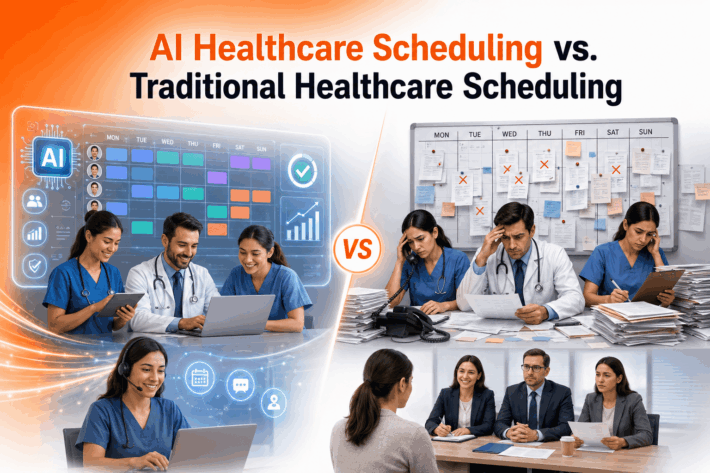
The difference between AI healthcare recruitment and traditional staffing is speed and pattern recognition. Traditional staffing relies on manual resume review and spreadsheet tracking. AI healthcare recruitment uses algorithms to parse resumes, rank candidates, and flag credential gaps within minutes instead of days.
| Factor | Traditional Staffing | AI-Powered Healthcare Staffing |
|---|---|---|
| Resume screening | Manual, one at a time | Automated ranking in minutes |
| Credential verification | Phone calls, faxes, manual lookups | Automated database cross-checks |
| Shift scheduling | Spreadsheets, phone trees | Predictive, demand-based scheduling |
| Time-to-fill | Days to weeks | Hours to days |
| Compliance tracking | Manual audits | Continuous automated monitoring |
What Problems Does Healthcare Workforce Automation Solve?
Healthcare workforce automation solves three recurring problems: slow credentialing, inconsistent shift coverage, and recruiter burnout from repetitive administrative work. Deloitte (2024) found that generative AI and automation can cut the time revenue-cycle staff spend on mundane tasks in half and give bedside nurses 20% more time for direct patient care.
As our earlier analysis on AI and automation in healthcare staffing explained, these tools function as an opportunity for the workforce, not a threat, when they are implemented thoughtfully.
A Step-by-Step Roadmap for Implementing AI in Healthcare Staffing
Implementing AI in healthcare staffing works best as a phased rollout: audit current gaps, pilot one use case, integrate with existing systems, train recruiters, then scale across departments. Skipping the pilot phase tends to cause compliance and adoption problems later.
Here are the top steps to implement AI in healthcare staffing successfully:
- Audit workforce gaps. Identify which roles, such as registered nurses or medical coders, have the longest time-to-fill and highest turnover.
- Select a focused pilot. Start with one function, such as resume screening, instead of deploying AI across every hiring stage at once.
- Integrate with existing systems. Connect AI tools to your applicant tracking system, HRIS, and credentialing databases like Epic or Cerner.
- Train recruiters and managers. Teach hiring teams to interpret AI-generated rankings and flag exceptions for human review.
- Monitor bias and compliance. Audit algorithms for demographic bias and confirm alignment with EEOC and Joint Commission standards.
- Scale and measure ROI. Expand successful pilots to more departments and track time-to-fill, cost-per-hire, and retention.
What Are the First Steps to Adopt AI Healthcare Recruitment Tools?
The first steps to adopt AI healthcare recruitment tools are auditing current hiring bottlenecks, choosing a narrow pilot use case, and confirming the vendor’s platform integrates with existing applicant tracking and credentialing systems. Robert Half (2026) found that 51% of business leaders expect AI tools to drive additional hiring activity in 2026.
How Long Does It Take to Implement AI Recruitment in Healthcare?
Most healthcare organizations complete an initial AI recruitment pilot within 60 to 90 days, covering vendor selection, integration, and recruiter training. Full-scale rollout across multiple facilities typically takes an additional six to twelve months, depending on legacy system complexity.
Benefits and Challenges of AI in Healthcare Staffing
AI in healthcare staffing delivers faster candidate matching, reduced administrative workload, and more consistent credential tracking, but it also introduces challenges around data privacy, algorithmic bias, and the need for human oversight. Weighing both sides helps organizations set realistic expectations before rollout.
Benefits include:
- Faster time-to-fill for hard-to-staff roles like ICU nurses and travel clinicians
- Reduced recruiter workload through automated resume screening
- More consistent license and certification verification
- Predictive scheduling that anticipates seasonal demand spikes, such as flu season surges
Challenges include:
- Risk of algorithmic bias if training data reflects historical hiring gaps
- Integration friction with legacy electronic health record and HR platforms
- Staff resistance without adequate change management and training
- Ongoing need for human review of clinical qualifications and soft skills
What Are the Biggest Challenges of Healthcare Workforce Automation?
The biggest challenges of healthcare workforce automation are data privacy compliance under HIPAA, algorithmic bias in candidate ranking, and integration with legacy hospital IT systems. Organizations that address these three areas early, with clear governance policies, see smoother adoption and fewer compliance issues during audits.
Real-World Example: AI Healthcare Recruitment in Action
A mid-sized regional hospital system facing a 20% vacancy rate among registered nurses piloted an AI-powered applicant tracking tool focused on credential verification and shift-matching. Within one quarter, average time-to-fill for nursing roles dropped noticeably, and recruiters spent less time on manual license checks.
The pilot succeeded because leadership paired the AI healthcare recruitment tool with a dedicated staffing partner who validated clinical fit before extending offers. This hybrid model, technology plus experienced recruiters, reflects the approach staffing firms like VIVA USA use when modernizing healthcare hiring.
Conclusion: The Path Forward for AI in Healthcare Staffing
AI in healthcare staffing is reshaping how hospitals and staffing agencies source, credential, and schedule talent, but success depends on a phased rollout, human oversight, and clear governance. Organizations that pilot narrow use cases, measure results, and pair AI healthcare recruitment tools with experienced staffing partners see the fastest, most sustainable gains.
Ready to modernize your hiring strategy? Contact VIVA USA today to learn how our healthcare staffing experts combine AI-driven tools with hands-on recruiting to fill critical roles faster.