Virtual Healthcare Jobs: The Fastest Growing Remote Careers
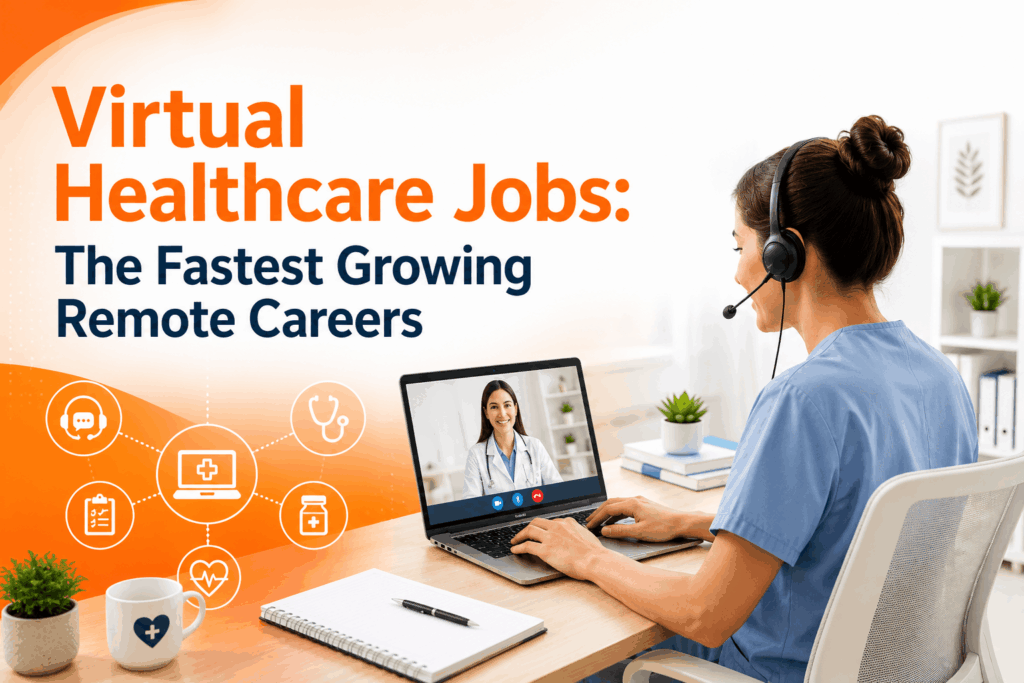
Virtual healthcare jobs are defined as clinical, administrative, or technical healthcare roles performed remotely using telecommunication technology instead of an on-site facility. These positions include telehealth nurses, remote medical coders, virtual care coordinators, and online mental health counselors. Demand for virtual healthcare jobs is rising faster than most other remote career categories in 2025 and 2026.
Key Takeaways: Virtual Healthcare Jobs at a Glance
- Remote employees in healthcare grew by more than 135% between 2019 and 2022, according to Forbes.
- Nursing and Medical & Health both ranked among the top 20 fastest-growing fully remote career categories in 2025, per FlexJobs data cited by Forbes.
- U.S. healthcare occupations are projected to add about 1.9 million job openings each year through 2034, according to the Bureau of Labor Statistics.
- Online doctor consultations worldwide reached over 116 million users in 2024, up from around 57 million in 2019, according to Statista.
- 60% of medical group leaders planned to maintain their current share of remote and hybrid healthcare jobs, while 22% expected to increase them.
What Are Virtual Healthcare Jobs?
Virtual healthcare jobs are defined as healthcare positions performed remotely using video calls, secure messaging, electronic health records, and other digital tools instead of an in-person clinic or hospital setting. These roles span clinical care, administrative support, coding, billing, and mental health services.
The category has expanded well beyond telemedicine physicians. It now includes remote healthcare careers such as virtual nurses, medical billing specialists, utilization review nurses, telehealth coordinators, and remote pharmacists, most of which saw sharply increased remote flexibility since 2020.
What Is the Difference Between Virtual Healthcare Jobs and Telehealth Jobs?
The difference between virtual healthcare jobs and telehealth jobs is scope. Telehealth jobs involve direct patient care delivered remotely, such as video visits with a physician. Virtual healthcare jobs is the broader category, also covering non-clinical careers like coding, billing, and care coordination.
| Category | Patient Contact | Example Roles |
|---|---|---|
| Telehealth Jobs | Direct, video or phone based | Telehealth nurse, virtual physician, online therapist |
| Virtual Healthcare Jobs (broader) | Direct or indirect | Medical coder, care coordinator, utilization reviewer, telehealth nurse |
What Skills Do Virtual Healthcare Jobs Require?
Virtual healthcare jobs require healthcare knowledge plus digital fluency. Employers look for comfort with electronic health record (EHR) systems and HIPAA-compliant communication tools, along with the same licensure or certification required for the equivalent in-person role.
Common requirements include:
- Active state licensure for clinical roles (RN, LPN, NP)
- Experience with EHR platforms like Epic or Cerner
- Strong written and verbal communication for remote patients
- Self-management for unsupervised workdays
- Familiarity with HIPAA privacy requirements
Why Are Remote Healthcare Careers Growing So Fast?
Remote healthcare careers are growing quickly because of persistent staffing shortages, wider payer acceptance of telehealth billing, and employee demand for flexible schedules. According to Forbes (2025), remote employees in healthcare grew by more than 135% between 2019 and 2022, driven largely by the pandemic reshaping how health systems staff non-bedside roles.
How Fast Is the Virtual Healthcare Job Market Growing?
The virtual healthcare job market is growing faster than the overall labor market. According to the U.S. Bureau of Labor Statistics (2025), healthcare occupations are projected to grow much faster than average, with about 1.9 million openings each year through 2034. Much of that growth is remote-eligible: Forbes (2025), citing FlexJobs, reports the top 20 fully remote career categories each grew at least 17% year-over-year, with both Nursing and Medical & Health making that list.
Which Industries Are Driving Remote Healthcare Career Growth?
Telemedicine platforms, insurance payers, revenue cycle companies, and behavioral health providers drive most of this growth, fueled by rising consumer comfort with virtual visits. According to Statista (2025), online doctor consultations worldwide reached over 116 million users in 2024, up from around 57 million in 2019, roughly doubling in five years.
Top Virtual Healthcare Careers Worth Considering
Here are the top virtual healthcare careers currently in demand across telehealth companies, payers, and hospital systems. Each role can be performed from a home office with a secure connection and, in most cases, an active professional license.
- Telehealth Registered Nurse
- Remote Medical Coder or Biller
- Virtual Care Coordinator or Case Manager
- Online Mental Health Counselor or Therapist
- Remote Utilization Review Nurse
- Virtual Pharmacist
- Telehealth Program Manager
- Remote Clinical Documentation Specialist
What Are the Highest-Paying Remote Healthcare Careers?
The highest-paying remote healthcare careers are clinical roles requiring advanced licensure, such as nurse practitioners and virtual pharmacists. According to the Bureau of Labor Statistics (2025), nurse anesthetists, nurse midwives, and nurse practitioners had a median annual pay of $132,050 in May 2024.
Which Virtual Healthcare Jobs Are Best for Beginners?
Entry-level virtual healthcare jobs best suited for beginners include medical billing, scheduling, and customer service roles at telehealth companies. These typically require only a high school diploma or a short certification, making them accessible entry points into remote healthcare careers.
Case in point: A medical assistant transitions into a remote insurance verification role, completes a three-month billing certificate while working, then moves into a fully remote medical coding position within a year, a realistic path into a virtual healthcare career.
How to Land a Virtual Healthcare Job
Landing a virtual healthcare job requires the same core credentials as the in-person equivalent, plus proof you can work independently. Recruiters screen for remote work history, reliable home internet, and comfort with virtual collaboration tools.
Follow these steps to position yourself competitively:
- Confirm your license or certification covers the states where patients are located.
- Highlight any prior remote, hybrid, or multi-site work experience on your resume.
- Get comfortable with major EHR and telehealth platforms like Epic or Cerner.
- Set up a dedicated, HIPAA-compliant home workspace with secure Wi-Fi.
- Apply through healthcare-focused staffing partners that place candidates into virtual healthcare careers.
What Qualifications Do You Need for Remote Healthcare Careers?
Qualifications for remote healthcare careers mirror the qualifications for the same role on-site. Clinical positions require an active license, relevant certifications, and often a year or more of direct patient care experience before a remote assignment.
Non-clinical roles, such as coding or care coordination, typically require a certification (like CPC for coders) or an associate degree, plus strong computer literacy. Employers favor candidates who have already succeeded in a remote or hybrid setting.
Conclusion
Virtual healthcare jobs are one of the fastest growing remote career categories, driven by staffing shortages, rising telehealth adoption, and employer demand for flexible talent. From telehealth nursing to remote medical coding, virtual healthcare careers now span nearly every part of the healthcare system, and growth data from BLS, Forbes, and FlexJobs confirm the trend will continue into 2026.
If your organization is hiring for telehealth nurses, remote coders, virtual care coordinators, or any other remote healthcare careers, VIVA USA’s healthcare staffing team can help you find qualified candidates quickly. Contact VIVA USA today to build your virtual healthcare workforce.