International Healthcare Recruitment 2026: Why Global Talent Is Becoming Essential for U.S. Healthcare
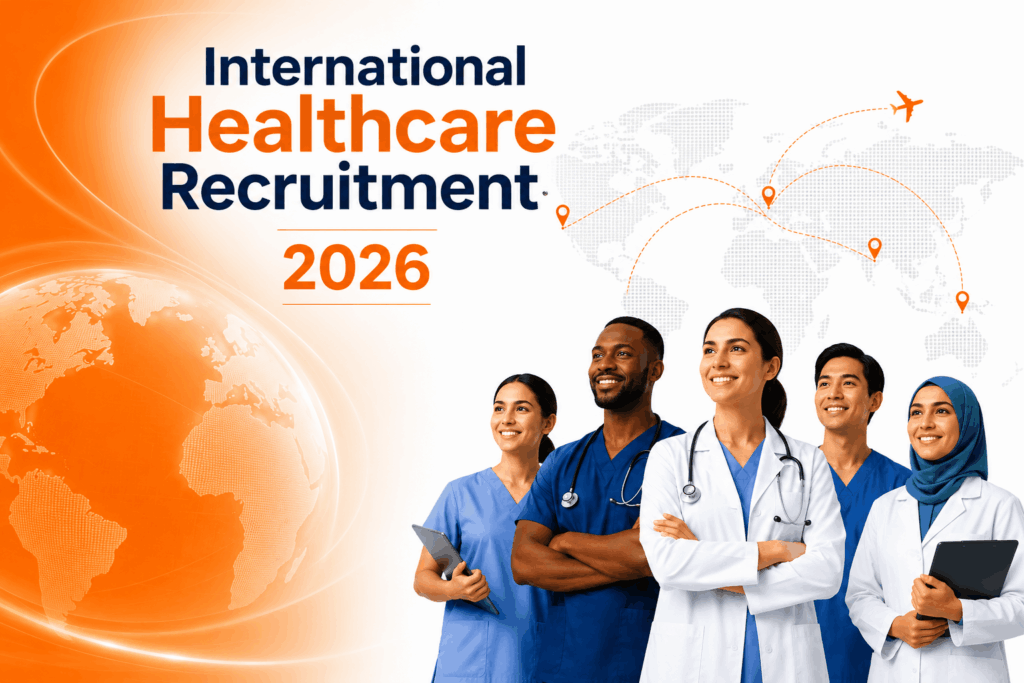
International healthcare recruitment is the process of sourcing, credentialing, and placing nurses, physicians, and allied health professionals from other countries into U.S. healthcare facilities. It exists to close staffing gaps that domestic hiring alone cannot fill, especially in nursing, primary care, and rural or underserved settings.
Key Takeaways
- International healthcare recruitment now supplies a growing share of U.S. nursing and physician staffing amid a nationwide workforce shortage.
- The U.S. could face a shortage of up to 86,000 physicians by 2036, according to the Association of American Medical Colleges.
- More than 100 million Americans live in areas officially designated as primary care shortage areas.
- Global healthcare staffing agencies use structured credentialing, licensure, and visa pathways (such as the H-1B and EB-3) to place foreign healthcare workers in the USA.
- International nurse recruitment USA programs typically take 9 to 18 months from candidate sourcing to bedside placement.
- Hospitals that combine domestic hiring with global healthcare workforce partnerships report shorter vacancy periods for hard-to-fill roles.
What Is International Healthcare Recruitment and Why Does It Matter Now?
International healthcare recruitment is defined as the structured process of identifying, vetting, licensing, and relocating healthcare professionals from abroad to work in U.S. hospitals, clinics, and long-term care facilities. It matters now because domestic training pipelines cannot keep pace with retirements, burnout-driven attrition, and rising patient demand.
The U.S. healthcare workforce shortage USA problem is not a future risk. It is a present operational reality affecting staffing ratios, wait times, and patient outcomes in hospitals across the country today.
How Severe Is the U.S. Healthcare Workforce Shortage?
The shortage spans physicians, nurses, and allied health roles simultaneously, which is unusual compared to prior workforce gaps that were typically concentrated in one discipline. This means facilities cannot solve the problem by shifting staff between departments.
Here are the top factors driving the shortage:
- A wave of retirements among Baby Boomer clinicians.
- Nursing school faculty shortages that cap graduate output.
- Rural and underserved areas struggling to attract domestic talent.
- Rising chronic disease rates increasing overall care demand.
- Post-pandemic burnout accelerating early exits from bedside roles.
According to the Association of American Medical Colleges (2024), the United States could face a shortage of up to 86,000 physicians by 2036, spanning both primary care and specialty fields.
According to the Congressional District Health Dashboard (2024), more than 100 million people in the United States live in areas designated as primary care Health Professional Shortage Areas.
What Roles Are Filled Through International Nurse Recruitment USA Programs?
International nurse recruitment USA programs most commonly fill registered nurse, ICU nurse, operating room nurse, and long-term care nursing roles. Physicians, physical therapists, and medical technologists are also recruited internationally, though nursing remains the largest category by volume.
- Registered Nurses (medical-surgical, ICU, ER, OR)
- Long-term care and skilled nursing facility nurses
- Primary care and specialty physicians
- Physical and occupational therapists
- Medical laboratory technologists
Global Healthcare Staffing: Bridging the Nursing and Physician Gap
Global healthcare staffing is the broader industry function that connects international healthcare workforce supply with U.S. facility demand through licensing support, visa sponsorship, and placement logistics. It complements, rather than replaces, domestic recruitment strategies.
Facilities that rely solely on local hiring often face longer vacancy periods for hard-to-fill specialties. Global healthcare staffing shortens that gap by tapping into a much larger, internationally trained talent pool.
What Is the Difference Between Domestic Staffing and Global Healthcare Staffing?
The difference between domestic staffing and global healthcare staffing is primarily scope and timeline. Domestic staffing draws from a shrinking local labor pool with faster onboarding, while global healthcare staffing accesses a much larger international pool but requires credential verification, licensure exams, and visa processing.
| Factor | Domestic Staffing | Global Healthcare Staffing |
|---|---|---|
| Talent pool size | Limited by local/regional supply | Large, international pool |
| Typical timeline | Weeks to a few months | 9 to 18 months |
| Licensing complexity | State licensure only | State licensure plus credential verification (e.g., CGFNS) and visa processing |
| Best suited for | Short-term or urgent gaps | Long-term, chronic staffing shortages |
| Retention pattern | Variable, market-dependent | Often higher due to long-term visa commitments |
Which Countries Supply the Most Foreign Healthcare Workers in the USA?
The Philippines, India, Nigeria, Canada, and Jamaica are consistently among the top source countries for foreign healthcare workers in the USA, particularly for nursing roles. The Philippines alone has supplied internationally trained nurses to U.S. hospitals for decades due to aligned nursing curricula and English-language training.
International Nurse Recruitment USA: Process, Requirements, and Benefits
International nurse recruitment USA follows a defined multi-step process: credential evaluation, licensure examination (NCLEX-RN), visa screening (VisaScreen certificate), employer sponsorship, and visa issuance. Each step is regulated to ensure patient safety and workforce quality.
What Are the Steps in International Nurse Recruitment USA Programs?
- Candidate sourcing and initial screening
- Credential evaluation through an approved agency such as CGFNS International
- English proficiency testing (if required by state board)
- NCLEX-RN examination and state licensure
- VisaScreen certificate issuance
- Employer sponsorship and visa filing (commonly H-1B or EB-3)
- Relocation, onboarding, and clinical orientation
What Are the Benefits of Hiring Internationally Recruited Nurses?
Internationally recruited nurses often bring specialized clinical experience, strong work ethic driven by long-term visa investment, and lower turnover than short-term staffing solutions. Facilities also gain workforce diversity that can improve care for diverse patient populations.
Example scenario: A mid-sized regional hospital system facing a 22 percent ICU nursing vacancy rate partnered with an international nurse recruitment program to source critical care nurses from the Philippines and India. Within 14 months, the facility filled 85 percent of open ICU positions and reduced reliance on costly short-term travel nurse contracts, according to internal staffing benchmarks commonly reported across similar hospital partnerships.
Healthcare Workforce Shortage USA: What the Data Shows for the Years Ahead
The healthcare workforce shortage USA is projected to worsen before it improves, based on current graduation rates, retirement timelines, and population aging trends. Global healthcare workforce partnerships are increasingly viewed as a structural solution rather than a temporary fix.
- According to the U.S. Bureau of Labor Statistics (2023), the registered nursing workforce is projected to see approximately 193,100 average annual job openings through 2032, driven by growth and workforce exits.
- According to the World Health Organization (2023), the global health workforce faces a projected shortfall of 11 million health workers by 2030, intensifying competition among wealthier nations for internationally trained talent.
- According to the American Association of Colleges of Nursing (2023), U.S. nursing schools have turned away tens of thousands of qualified applicants in recent years due to faculty shortages, constraining the domestic nursing pipeline.
Will International Healthcare Recruitment Continue Growing?
International healthcare recruitment is expected to keep growing as domestic nursing school capacity remains constrained and physician retirements accelerate. Facilities that build long-term global healthcare staffing partnerships now are better positioned to stabilize staffing than those relying only on reactive, short-term hiring.
Conclusion
International healthcare recruitment has moved from a supplemental strategy to a core workforce solution for U.S. hospitals facing sustained nursing and physician shortages. Global healthcare staffing expands the available talent pool, while international nurse recruitment USA programs provide a structured, compliant pathway to bring in qualified foreign healthcare workers in the USA. As the healthcare workforce shortage USA continues into the next decade, facilities that build proactive global partnerships will be better positioned to maintain safe staffing levels.
If your organization is facing persistent staffing gaps, VIVA USA’s healthcare staffing team can help you build a compliant, long-term international healthcare recruitment strategy. Contact VIVA USA today to discuss your workforce needs.