From Manual Screening to AI Matchmaking: The Evolution of Talent Acquisition
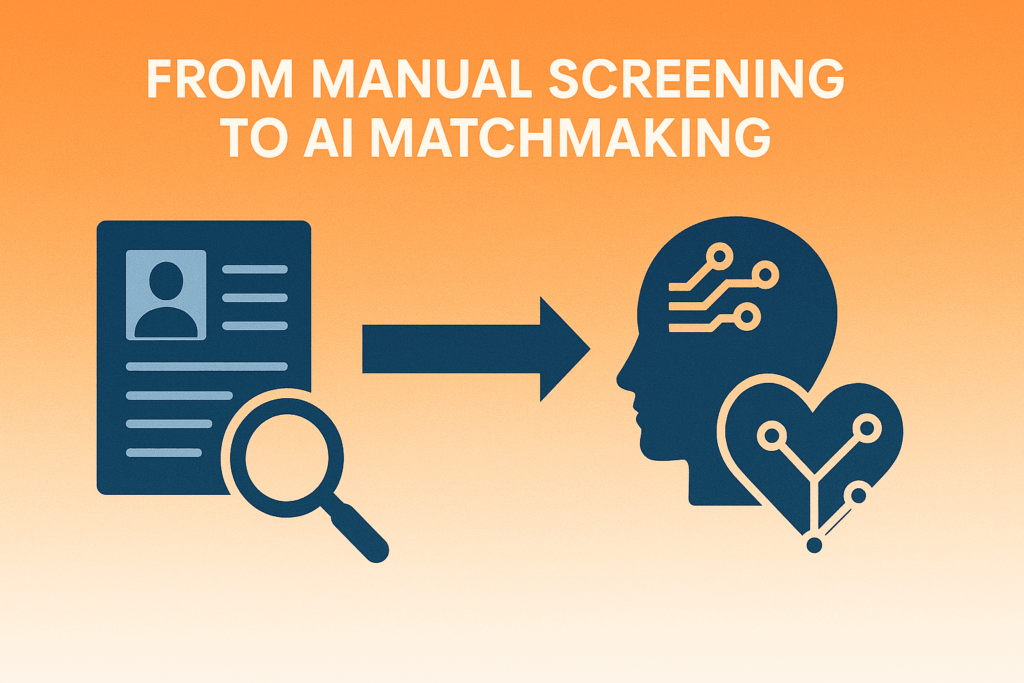
Talent acquisition is shifting from slow manual screening to fast and intelligent AI matchmaking that connects the right talent with the right role. This change is especially important for companies that rely on offshore staffing and high volume hiring where speed and accuracy matter most.
What Is Manual Screening in Talent Acquisition?
Manual screening is the traditional process where recruiters read resumes, review cover letters, and compare candidate profiles against job requirements. It relies on human judgment to determine which applicants should move forward.
Why manual screening is still used
- It allows full human control over candidate evaluation.
- Recruiters are familiar with the method and trust their experience.
- It works well for low volume or highly specialized roles.
Key limitations of manual screening
- It requires significant time and effort.
- It introduces variability and unconscious bias.
- It does not scale well for global or offshore hiring.
- It slows down the hiring process and harms the candidate experience.
Why Companies Are Moving Toward AI Matchmaking
AI matchmaking uses artificial intelligence, machine learning, and structured data to automatically screen, score, and match candidates. It can review thousands of profiles in minutes and provide ranking insights that help recruiters focus on the most promising candidates.
What AI matchmaking delivers
- Instant parsing of resumes into structured skills and experience.
- Accurate candidate to job matching based on predefined criteria.
- Automated interview scheduling and communication.
- Scalability for global talent acquisition, including offshore staffing.
Market growth and rising adoption
- The global AI in talent acquisition market is expected to grow from 1.13 billion USD in 2024 to 1.35 billion USD in 2025 with a CAGR of 18.9 percent. (The Business Research Company, 2024)
- 62.5 percent of HR leaders use AI in hiring, primarily for resume screening and candidate matching. (Fit Small Business, 2024)
- 75 percent of staffing firms report using AI in some part of their process.
AI is no longer optional. It is now a core requirement for competitive hiring and effective offshore team scaling.
Manual Screening vs AI Matchmaking Comparison
| Feature | Manual Screening | AI Matchmaking |
|---|---|---|
| Speed | Slow and highly manual | Fast and automated with quick shortlisting |
| Scalability | Hard to scale when applicant numbers rise | Handles large volumes and global talent effectively |
| Consistency and Bias | Reviews can vary between recruiters | More consistent and less prone to unconscious bias |
| Candidate Experience | Slow updates and long wait times | Faster response times and automated updates |
| Offshore Staffing Support | Time zones and cultural factors require additional effort | Built to evaluate global candidates efficiently |
| Cost Efficiency | High recruiter workload | Lower cost per hire with faster screening |
| Recruiter Focus Shift | Administrative tasks consume time | Recruiters can spend more time building relationships |
Real World Examples and Use Cases
Example 1: High volume offshore staffing
An MSP managing talent across multiple countries received thousands of applications each month. Manual screening created week long delays and top candidates were lost. After adopting an AI matchmaking system, the team reduced screening time by nearly 70 percent. Fill rates improved and recruiters were able to focus on candidate engagement rather than clerical work.
Example 2: Contingent staffing with global sourcing
A staffing provider supporting IT and engineering contractors worldwide integrated AI into its sourcing model. AI parsed profiles from different countries, matched skills to project needs, and produced ranked shortlists automatically. This improved time to fill and strengthened the reliability of offshore talent pipelines for large enterprise clients.
Example 3: Time lost to manual screening
Recruiters using traditional workflows often spend 20 or more hours per role reading resumes and managing screening. One industry report noted that manual screening can take up nearly a full workweek for busy HR teams.
These examples show that AI matchmaking does not replace recruiters. Instead, it lets them focus on strategic decision making and more meaningful interactions with top talent.
How AI Matchmaking Supports Offshore Staffing
Offshore staffing brings unique challenges related to time zone differences, cultural alignment, and varying levels of candidate readiness. AI helps overcome these challenges in several ways.
- Global talent visibility: AI can scan and categorize candidates across regions quickly.
- Faster vetting: When offshore teams require immediate deployment, AI identifies the best fit in minutes.
- Compliance and standardization: AI supports consistent evaluation that reduces legal risk.
- Better workforce planning: AI provides data insights that help companies scale offshore teams efficiently.
- Improved candidate experience: Faster responses and automated updates strengthen employer brand.
Key Trends That Are Shaping the Evolution
- Talent shortages and pressure to hire faster: 60 percent of companies reported an increase in time to hire in 2024.
- Staffing industry expansion: The global staffing industry was valued at 626 billion USD in 2024.
- High AI adoption in recruitment: 62 percent of hiring teams use AI and nearly 90 percent report improved efficiency.
These trends create ideal conditions for the shift from manual screening to AI matchmaking, especially for companies that depend on offshore and contingent talent models.
Best Practices for Moving From Manual Screening to AI Matchmaking
- Conduct a process audit to identify bottlenecks and performance gaps.
- Define clear matching criteria including skills, experience, location, availability, and cultural fit.
- Select an AI tool that integrates with your ATS and supports global workflows.
- Start with high volume roles to demonstrate quick wins and measure impact.
- Train recruiters and hiring managers to maximize the benefits of automation.
- Track performance metrics such as time to shortlist, cost per hire, and quality of hire.
- Expand AI across offshore staffing functions such as sourcing, screening, onboarding, and compliance.
Key Takeaways
- Manual screening is slow and difficult to scale, especially in offshore staffing environments.
- AI matchmaking speeds up screening, improves consistency, and enhances global talent matching.
- The staffing and talent acquisition industries are rapidly adopting AI solutions.
- Companies that shift early gain a major advantage in efficiency, candidate experience, and global reach.
- AI allows recruiters to spend more time building relationships and less time reading resumes.
Conclusion
The evolution from manual screening to AI matchmaking represents a strategic upgrade for any growing organisation. Companies that rely on contingent staffing or offshore talent can benefit significantly from faster screening, improved accuracy, and better global scalability.
If your organization wants to modernize its hiring workflow and strengthen offshore staffing capabilities, contact Neuhire to learn how AI matchmaking and global workforce solutions can accelerate your time to hire and enhance your talent quality.