AI-Driven Workflow Orchestration: A Strategic Solution to Healthcare Staffing Shortages
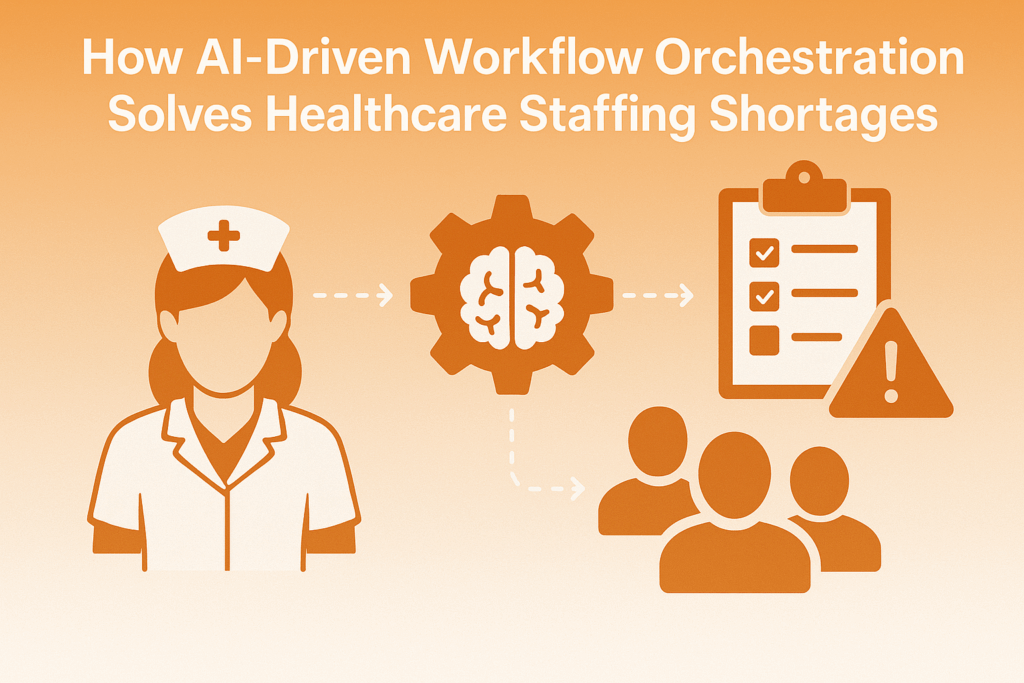
AI-driven workflow orchestration uses intelligent systems to automate and coordinate clinical and operational processes across healthcare organizations. It helps mitigate staffing shortages by optimizing schedules, reducing administrative work, and allowing medical professionals to focus more on patient care. In essence, it increases capacity without increasing headcount.
Understanding the Healthcare Staffing Crisis
Healthcare organizations continue to face significant workforce challenges. High turnover rates, burnout, and administrative burdens are pushing professionals out of the industry faster than new workers can be trained.
- According to the Bureau of Labor Statistics, the United States is projected to add over 1.9 million new healthcare jobs by 2031, many of which are already difficult to fill.
- The American Association of Colleges of Nursing reports that nursing schools turned away over 66,000 qualified applicants in 2023 due to faculty shortages.
- The National Library of Medicine projects a shortage of up to 124,180 physicians by 2027.
- Burnout is at an all-time high, with over 60% of clinicians reporting symptoms of emotional exhaustion and disengagement.
- A 2024 Statista survey revealed that 20 percent of U.S. healthcare workers reported serious intentions to leave the profession within the next two years.
The result is a growing mismatch between patient demand and available workforce capacity. Traditional staffing solutions, such as overtime and temporary hires, provide short-term relief but are not sustainable. AI-driven workflow orchestration provides a longer-term solution by optimizing how work is distributed and executed.
What Is AI-Driven Workflow Orchestration?
AI-driven workflow orchestration is the automated coordination of tasks, data, and human actions across healthcare systems. It applies predictive analytics and machine learning to ensure the right tasks reach the right people at the right time. This approach improves efficiency, reduces manual errors, and helps healthcare organizations operate with fewer resource constraints.
According to Staffing Industry Analysts, 43% of internal employees at both traditional and platform-based staffing firms in North America reported using AI within the past year.
How AI Orchestration Works in Healthcare Operations
AI orchestration integrates data from various systems such as Electronic Health Records (EHR), scheduling tools, and patient management systems. It uses that data to automate and prioritize workflows across clinical, administrative, and operational processes.
Examples of AI Orchestration in Practice
1. Staff Scheduling and Shift Optimization
The system analyzes demand forecasts, staff availability, and skill sets to create optimized schedules. If patient volumes rise unexpectedly, the algorithm reallocates shifts automatically to ensure coverage.
2. Clinical Documentation Assistance
AI can capture and categorize clinical notes, reducing time spent on paperwork. Physicians and nurses regain valuable hours that can be redirected to patient interaction.
3. Patient Intake and Referrals
Automated routing of forms, approvals, and insurance verifications reduces bottlenecks. This helps organizations handle more patients with the same number of staff.
4. Capacity Management
Predictive models analyze data from hospital departments to forecast needs for operating rooms, imaging slots, or bed space. This allows staff and resources to be allocated efficiently.
5. Communication and Escalation
AI-driven notifications ensure that critical alerts, follow-ups, and tasks reach the right team members promptly, reducing delays in care coordination.
The Benefits of AI Workflow Orchestration for Staffing Shortages
1. Improved Efficiency
Automated coordination reduces repetitive administrative work and eliminates redundant manual steps, allowing staff to focus on higher-value tasks.
2. Enhanced Staff Productivity
By streamlining scheduling, task management, and documentation, AI orchestration enables teams to serve more patients without additional staffing.
3. Reduced Burnout
With less time spent on manual coordination, healthcare workers experience lower cognitive and emotional strain, which improves job satisfaction and retention.
4. Consistent Patient Care
Orchestration ensures continuity of care by managing transitions smoothly between departments and maintaining visibility over the entire care process.
5. Better Financial Outcomes
Improved efficiency and reduced overtime translate into measurable cost savings.
Key Challenges and Considerations
While AI orchestration offers clear advantages, healthcare executives should address several challenges during implementation:
1. Integration Complexity
Many healthcare organizations operate multiple legacy systems. Integration requires careful planning and testing to ensure seamless data flow.
2. Data Governance and Privacy
Compliance with HIPAA and other regulations must be maintained. Strong data security and access controls are essential.
3. Bias and Fairness in Algorithms
Orchestration systems must be regularly reviewed to avoid reinforcing existing disparities in task assignments or care priorities.
4. Change Management and Adoption
Staff members need to trust and understand AI systems. Training, transparency, and communication are critical to successful adoption.
5. Ongoing Maintenance
Once deployed, orchestration models must be updated regularly to adapt to new workflows, technologies, and organizational goals.
Steps for Executives to Implement AI Workflow Orchestration
Phase 1: Identify Priority Workflows
Map existing processes to locate inefficiencies and labor bottlenecks. Focus first on high-volume or repetitive workflows such as scheduling or documentation.
Phase 2: Pilot Implementation
Run a small-scale pilot to test integration, gather feedback, and measure key performance indicators such as time savings and staff satisfaction.
Phase 3: Integrate Across Systems
Expand orchestration to other departments. Ensure compatibility with EHR, HR, and financial systems.
Phase 4: Establish Governance and Oversight
Create data governance frameworks and review committees to monitor AI performance, compliance, and fairness.
Phase 5: Measure and Scale
Use measurable outcomes such as reduced wait times, lower turnover, and improved throughput to justify scaling across the enterprise.
The Future of AI Orchestration in Healthcare
The convergence of artificial intelligence, predictive analytics, and automation represents a transformative shift in how healthcare work is managed. As the technology matures, orchestration will extend beyond administrative efficiency to clinical decision support, predictive staffing, and personalized care pathways.
According to Forbes (2025), more than 60% of healthcare CIOs plan to expand their investment in AI workflow orchestration within the next two years. The same report predicts that hospitals using orchestration tools will operate with 10% fewer staff shortages compared to those relying solely on manual systems.
Key Takeaways
- AI-driven workflow orchestration automates and coordinates healthcare tasks across systems and roles.
- It addresses staffing shortages by improving efficiency, reducing administrative burden, and optimizing staff utilization.
- The technology enhances patient care, staff well-being, and financial performance simultaneously.
- Implementation requires careful integration, governance, and staff engagement to ensure long-term success.
- Healthcare organizations that adopt orchestration now will be better prepared for future workforce disruptions.
Conclusion
Staffing shortages will remain one of the healthcare industry’s most critical challenges in the coming decade. Hiring alone cannot solve the problem. AI-driven workflow orchestration provides a practical, scalable, and strategic solution that allows organizations to do more with existing resources.
As healthcare organizations navigate unprecedented staffing shortages, the path forward lies in strategic, data-driven innovation. VIVA USA Inc. specializes in healthcare staffing solutions that combine deep industry expertise with advanced technology to help hospitals, clinics, and health systems build resilient, efficient, and high-performing teams.
Through our custom AI-enabled workflow portals, VIVA helps healthcare organizations automate repetitive administrative tasks, optimize scheduling, and orchestrate workforce management across departments. These intelligent systems integrate seamlessly with existing platforms to improve coordination, enhance visibility, and deliver measurable results in patient care and operational efficiency.
If your organization is seeking to strengthen workforce capacity and modernize its staffing operations, reach out to VIVA today. Our experts can design a tailored healthcare staffing strategy supported by AI-driven workflow orchestration, empowering your teams to deliver better care with greater efficiency.
Contact VIVA USA Inc. to learn how our solutions can help your healthcare organization achieve staffing stability and operational excellence.