What Healthcare Leaders Look for in a Staffing Partner
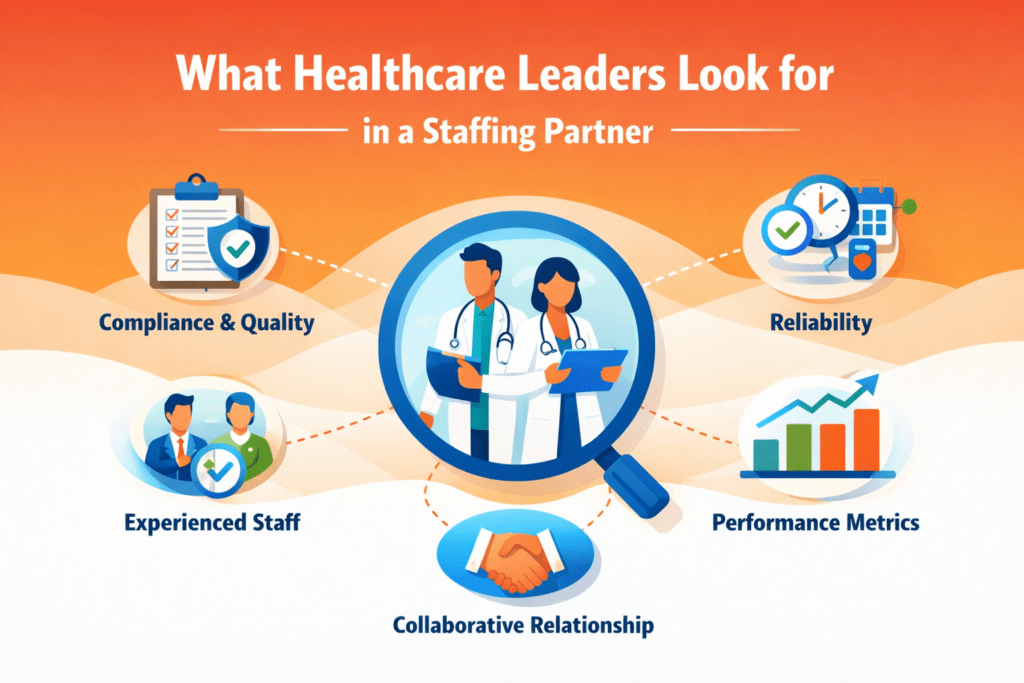
Healthcare leaders look for a healthcare staffing partner that offers rigorous candidate vetting, deep industry expertise, and advanced technology integration. A successful healthcare staffing partnership focuses on reducing burnout through flexible scheduling and optimizing costs via clinical labor analytics. By 2025, the primary criteria for selecting healthcare staffing solutions include the ability to provide high-quality talent and real-time compliance tracking to ensure patient safety and operational efficiency.
Key Takeaways: Evaluating Your Healthcare Staffing Solutions
If you are short on time, here are the essential factors healthcare executives prioritize when selecting a partner:
- Quality and Vetting: Clinical competency assessments that go beyond basic license verification.
- Specialized Expertise: A partner who understands niche roles like ICU, OR, or Emergency Medicine.
- Technological Maturity: Use of AI for predictive staffing and automated credentialing.
- Cost Management: Clear ROI analysis and strategies to reduce reliance on expensive travel contracts.
- Operational Flexibility: Support for per diem, locum tenens, and gig-style scheduling.
The 2025 Healthcare Staffing Landscape: Why the Right Partner Matters
The healthcare industry is facing a transformative period. According to a report by Hallmark Health Care Solutions (January 2025), 89% of healthcare leaders feel intense pressure to cut staffing costs while managing a workforce where 67% of clinicians cite burnout as a critical issue. These pressures make the selection of a healthcare staffing partner a strategic decision rather than a simple procurement task.
Healthcare leaders no longer want just a vendor to fill shifts. They seek a partner that can help them navigate the vicious cycle of turnover and soaring labor costs. By 2025, the demand for flexible work has become universal. Research from Hallmark indicates that 98% of healthcare executives are now exploring gig-style scheduling tools to bridge staffing gaps.
1. Rigorous Vetting and Clinical Competency
What is the most important quality in a healthcare staffing partner?
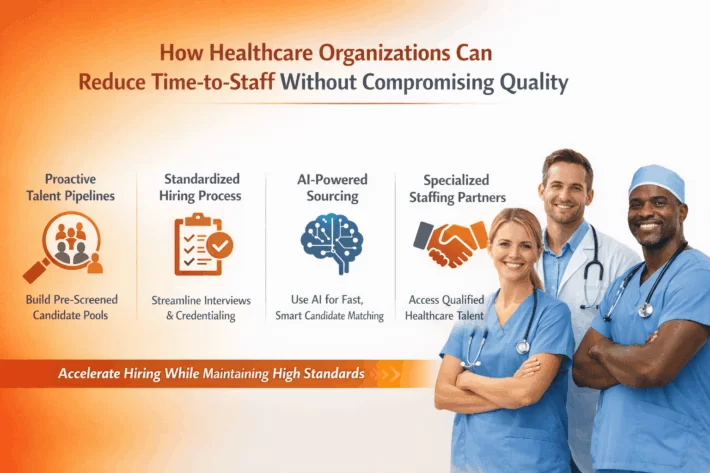
The most important quality is a partner’s ability to ensure patient safety through rigorous, multi-layered candidate vetting. Leaders look for agencies that perform clinical competency assessments tailored to specific specialties, verify references from previous employers, and maintain real-time compliance with Joint Commission and CMS standards to mitigate risk.
A primary concern for C-suite leaders is the quality of care. It is not enough to simply check if a nurse has an active license. A high-tier healthcare staffing partnership includes:
- Specialty-Specific Testing: Ensuring an ER nurse actually understands the latest trauma protocols.
- Behavioral Interviewing: Assessing how a contingent worker fits into a specific hospital’s culture.
- Automated Compliance: Systems that alert both the agency and the facility before a certification expires.
2. Strategic Cost Optimization and Transparency
How do healthcare staffing solutions help manage hospital budgets?
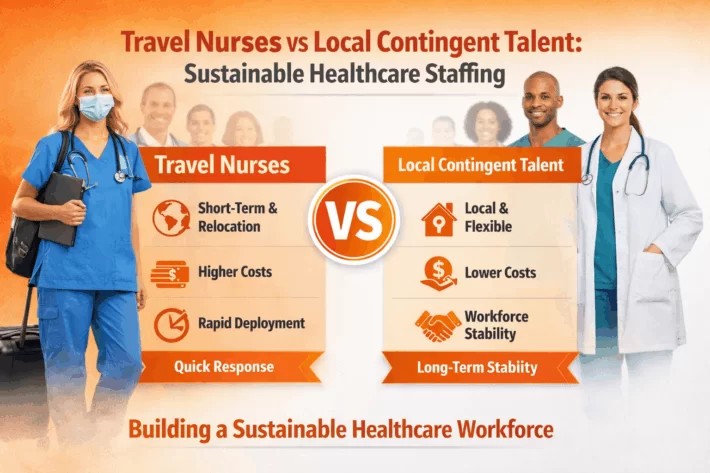
Healthcare staffing solutions manage budgets by utilizing data-driven workforce planning to reduce the need for high-cost crisis contracts. Partners provide transparent pricing structures and ROI analysis, helping facilities transition from expensive travel nursing models to more sustainable local float pools and per diem staffing strategies.
According to Staffing Industry Analysts (SIA) (September 2025), U.S. healthcare staffing revenue is projected to stabilize at $39.4 billion in 2025. While this signals a normalization from pandemic peaks, labor costs remain significantly high. Leaders look for partners who actively work to lower these premiums by sourcing local talent or providing Managed Service Provider (MSP) programs that offer better visibility into spend.
3. Technology Integration and AI Capabilities
What role does technology play in a healthcare staffing partnership?
In a modern healthcare staffing partnership, technology serves as the backbone for efficiency. Leaders look for partners using AI-powered matching algorithms, mobile apps for instant shift coverage, and Vendor Management Systems (VMS) that integrate with existing hospital HRIS platforms to provide real-time visibility into labor utilization and spending.
According to a Deloitte (January 2025) survey, 70% of C-suite executives said that improving operational efficiencies and productivity gains will be top priorities for their organizations this year. Furthermore, many organizations are now deploying agentic AI to automate administrative tasks like credentialing and scheduling, which previously burdened hospital staff.
Table: Traditional Staffing vs. Modern Tech-Driven Partnerships
| Feature | Traditional Vendor | Modern Staffing Partner |
|---|---|---|
| Shift Filling | Manual phone calls/emails | Real-time mobile app matching |
| Credentialing | Paper-based or manual PDF | AI-enabled automated verification |
| Data Usage | Reactive reporting | Predictive analytics for future needs |
| Visibility | Siloed information | Integrated VMS/MSP dashboards |
4. Solving the Clinician Burnout Crisis
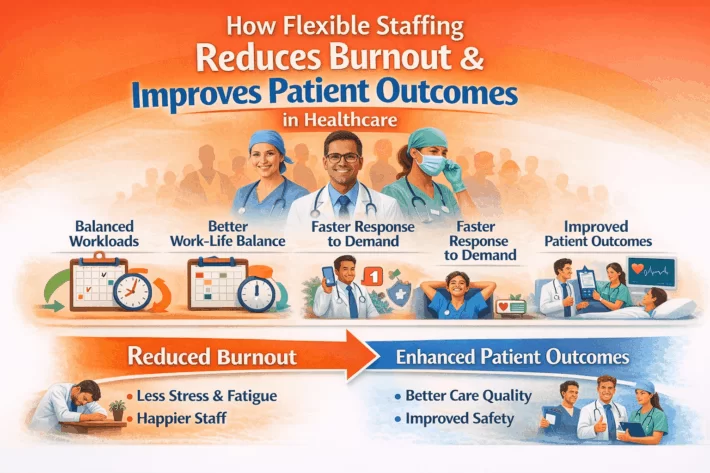
The nursing shortage is no longer just about numbers; it is about engagement. TNAA (August 2025) reports that the 2022 National Nursing Workforce Survey predicted that more than one-quarter of nurses will leave the profession or retire by 2027.
Healthcare leaders look for partners who can help them implement:
- Gig-Style Scheduling: Allowing staff to choose shifts that fit their lives, which 78% of leaders say is vital for morale.
- Advanced Practice Providers (APPs): Utilizing Nurse Practitioners and Physician Associates to fill gaps; BLS data shows PAs are seeing a 28% growth rate through 2032.
- Internal Float Pools: Building a flexible, in-house workforce that reduces reliance on external agencies.
5. Cultural Alignment and Social Responsibility
Healthcare professionals are becoming more selective about where they work. As noted by CoreMedical Group (January 2025), clinicians want to work with agencies and facilities whose values align with their own, whether that involves sustainability, ethics, or social impact. Leaders look for a healthcare staffing partner that can market the hospital’s culture effectively to attract the best talent.
A partner that understands your facility’s mission is more likely to provide the right fit rather than just a warm body. This alignment directly correlates to patient satisfaction. As reported by Tribal Health, a focus on culture and wellbeing has led to 25% stronger job satisfaction among nurses.
Quick Facts: Healthcare Staffing Trends 2025
- Locum Tenens Growth: Revenue in this segment is projected to reach $9.6 billion in 2025 as it becomes a core strategy for continuity of care.
- AI Transformation: 95% of healthcare executives believe generative AI will transform the industry, with a focus on reducing administrative burdens.
- Workforce Stability: 80% of facilities expect to maintain or increase their use of locum tenens to combat burnout and maintain services.
- The Cost Cycle: Reliance on travel and contract nurses can increase labor costs by 20% to 30% per shift, driving leaders toward more integrated staffing models.
Conclusion: Building a Resilient Workforce Strategy
Choosing a healthcare staffing partner is one of the most consequential decisions a healthcare leader can make. By focusing on quality vetting, transparent costs, technological integration, and a commitment to reducing clinician burnout, you can build a resilient workforce that thrives even in a challenging labor market. The right healthcare staffing solutions do more than just fill gaps; they provide the strategic support necessary to improve patient outcomes and stabilize your bottom line.
Partner with VIVA USA for Leading Healthcare Staffing Solutions. At VIVA USA, we understand the complexities of modern healthcare leadership. We provide tailored staffing strategies that prioritize clinical excellence and operational efficiency.