Time-to-Fill vs. Time-to-Start in Healthcare Hiring: What’s the Difference?
In healthcare hiring, time-to-fill and time-to-start measure different stages of the recruitment process. Time-to-fill tracks how long it takes to hire a candidate after opening a role, while time-to-start measures how long it takes for that hired candidate to actually begin working. Understanding the difference helps healthcare organizations reduce staffing gaps, improve patient care continuity, and streamline healthcare staffing strategies.
What Is Time-to-Fill in Healthcare?
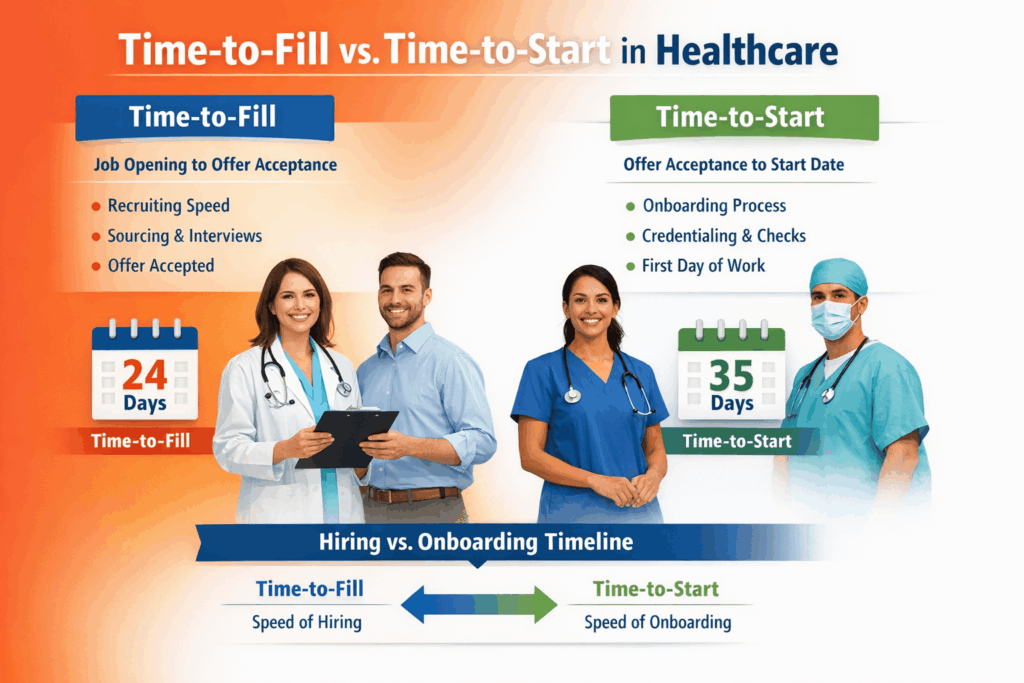
Time-to-fill in healthcare refers to the number of days between when a job position is opened and when a candidate accepts the offer. It measures the efficiency of the recruiting process and reflects how quickly healthcare organizations can attract and secure qualified talent.
Healthcare organizations track time-to-fill to evaluate recruitment performance and identify bottlenecks in hiring workflows.
Example of Time-to-Fill in Healthcare Hiring
- A hospital posts a job opening for a registered nurse on June 1.
- Interviews occur between June 10 and June 20.
- The candidate accepts the job offer on June 25.
Time-to-fill: 24 days.
This metric focuses strictly on recruitment speed, not when the employee actually begins work.
What Is Time-to-Start in Healthcare?
Time-to-start in healthcare refers to the number of days between when a candidate accepts a job offer and when they officially start their role. This metric accounts for onboarding processes such as credentialing, licensing verification, background checks, and notice periods.
Healthcare roles often have longer time-to-start periods due to strict compliance and credentialing requirements.
Example of Time-to-Start
Continuing the previous example:
- Candidate accepts the job offer on June 25.
- Credentialing and background checks take 30 days.
- The employee starts work on July 30.
Time-to-start: 35 days.
In healthcare, this period can often be longer than the recruitment stage itself, especially for clinical roles.
Key Differences Between Time-to-Fill and Time-to-Start in Healthcare
| Metric | Definition | What It Measures | Key Factors |
|---|---|---|---|
| Time-to-Fill | Days from job opening to offer acceptance | Recruiting efficiency | Sourcing, interviews, and candidate availability |
| Time-to-Start | Days from offer acceptance to start date | Onboarding and compliance processes | Credentialing, licensing, relocation |
| Goal | Faster recruitment | Faster onboarding | Streamlined hiring workflow |
Quick summary:
- Time-to-fill = hiring speed
- Time-to-start = onboarding speed
Both metrics are essential for managing healthcare staffing shortages.
Healthcare Hiring Statistics You Should Know
Here are several recent statistics highlighting the challenges healthcare organizations face when filling positions:
- Average healthcare time-to-fill: The average time to fill healthcare roles is about 49 days, compared with roughly 36 days across industries.
- RN recruitment timelines: Recruiting a single registered nurse takes around three months on average.
- Healthcare hiring difficulty: 89% of healthcare managers report difficulty finding skilled candidates.
- Healthcare job demand: Job openings in the healthcare sector increased 48% from 2019 to 2023.
- Workforce shortages: More than 75 million Americans live in primary care shortage areas.
These numbers highlight why healthcare leaders closely monitor time-to-fill and time-to-start metrics.
Why Time-to-Fill Matters in Healthcare Staffing
Time-to-fill directly affects hospital operations and patient outcomes.
1. Reduces Staffing Shortages
When healthcare roles remain open too long, remaining staff must cover additional shifts. This often leads to burnout and reduced patient care quality.
2. Controls Labor Costs
Extended vacancies increase reliance on expensive contract or travel staff.
3. Maintains Patient Care Continuity
Faster hiring ensures hospitals maintain safe staffing ratios and minimize service disruptions.
4. Improves Recruitment Efficiency
Tracking time-to-fill helps recruiters identify slow hiring stages such as:
- Delayed job approvals
- Inefficient interview scheduling
- Limited candidate pipelines
Why Time-to-Start Is Often Longer in Healthcare Hiring
Even after hiring decisions are made, healthcare professionals cannot immediately begin work.
Several compliance factors extend time-to-start.
1. Credential Verification
Hospitals must verify medical licenses, certifications, and clinical experience.
2. Background Checks
Healthcare organizations conduct extensive background screenings and reference checks.
3. Regulatory Compliance
Many roles require compliance with federal and state healthcare regulations.
4. Candidate Notice Periods
Experienced clinicians often need to complete a 30–90 day notice period with their current employer.
Because of these requirements, time-to-start for healthcare professionals may range from several weeks to months.
Strategies to Reduce Time-to-Fill in Healthcare
Healthcare organizations can significantly improve recruitment efficiency using the following strategies.
1. Build Talent Pipelines
Maintain databases of pre-qualified candidates such as:
- Nurses
- Allied health professionals
- Medical technologists
- Administrative healthcare staff
2. Use Healthcare Staffing Partners
Specialized staffing firms already maintain pools of credentialed candidates, reducing sourcing time.
3. Implement AI-Powered Recruiting
Automated sourcing tools can identify qualified healthcare professionals faster.
4. Simplify Interview Processes
Healthcare employers should avoid unnecessary interview rounds that slow hiring decisions.
5. Adopt Contingent Staffing Models
Flexible hiring options such as:
- Staff augmentation
- MSP staffing programs
- Temporary clinical staffing
allow organizations to quickly fill urgent positions.
Strategies to Reduce Time-to-Start
Reducing time-to-start often requires improving onboarding and compliance processes.
1. Streamline Credentialing
Use digital credential verification platforms to speed up verification.
2. Begin Background Checks Early
Initiating screenings during late interview stages can reduce onboarding delays.
3. Pre-Onboard Candidates
Healthcare organizations can start onboarding documentation before the official start date.
4. Coordinate Licensing Across States
For travel nurses and telehealth providers, multi-state licensing can reduce future delays.
Real-World Example: Reducing Healthcare Hiring Delays
Consider a mid-sized hospital experiencing critical nursing shortages.
Before optimization:
- Time-to-fill: 60 days
- Time-to-start: 45 days
- Total time to deploy a nurse: 105 days
After process improvements:
- Implemented healthcare staffing agency partnership
- Introduced digital credentialing systems
- Simplified interview processes
Results:
- Time-to-fill reduced to 30 days
- Time-to-start reduced to 25 days
- Total hiring timeline cut nearly in half
This improvement allowed the hospital to stabilize staffing levels and reduce overtime costs.
Key Takeaways: Time-to-Fill vs. Time-to-Start in Healthcare Hiring
- Time-to-fill measures recruiting speed from job posting to offer acceptance.
- Time-to-start measures onboarding time from offer acceptance to first day of work.
- Healthcare roles often have longer timelines due to credentialing and compliance.
- The average healthcare time-to-fill is around 49 days.
- Registered nurse hiring can take up to three months due to staffing shortages.
- Improving hiring workflows can dramatically reduce staffing delays.
Conclusion
Understanding the difference between time-to-fill and time-to-start in healthcare hiring is critical for hospitals, clinics, and healthcare systems facing ongoing workforce shortages. By optimizing both recruitment and onboarding processes, healthcare organizations can reduce hiring delays, maintain staffing levels, and ensure consistent patient care.
If your organization is struggling to fill healthcare roles quickly, partnering with an experienced healthcare staffing provider can dramatically improve hiring timelines.
Need Help Hiring Healthcare Talent Faster?
VIVA USA Inc. provides flexible healthcare staffing solutions including contingent staffing, staff augmentation, and MSP programs designed to reduce hiring timelines and improve workforce scalability.