Improving Compliance and Visibility Across Healthcare Staffing Vendors
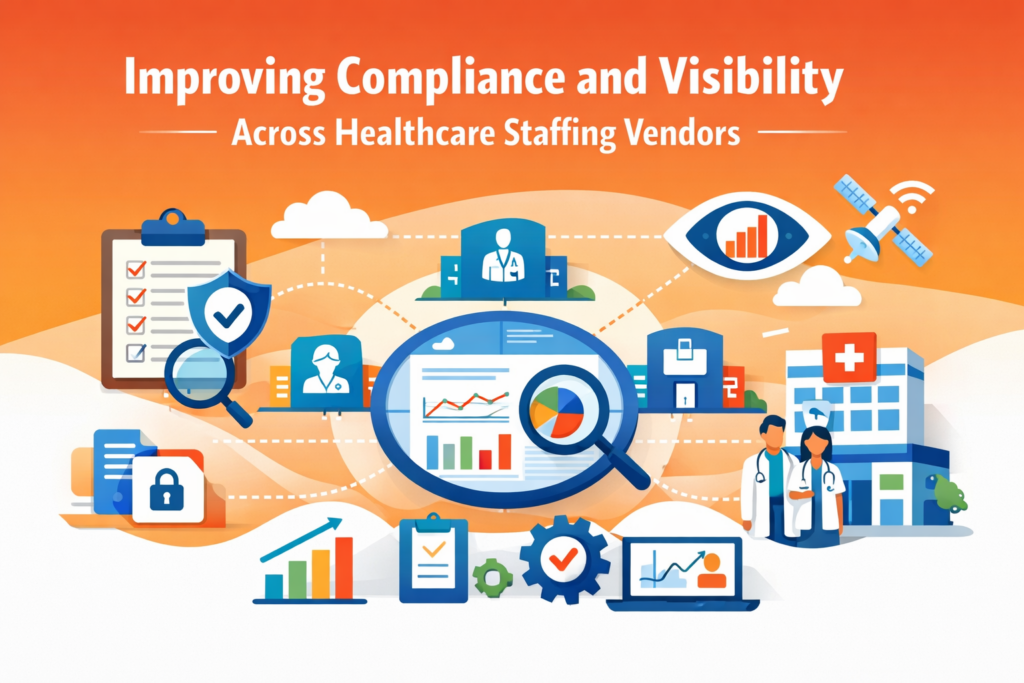
Efficiently managing healthcare staffing requires a unified strategy to mitigate risks and control costs. To improve compliance and visibility across healthcare staffing vendors, organizations must implement centralized Vendor Management Systems (VMS) that automate credentialing, provide real-time labor spend analytics, and standardize clinical quality audits across all third-party suppliers.
Quick Facts: Healthcare Staffing Efficiency
- Centralization is Critical: Moving from decentralized manual processes to a unified VMS reduces administrative overhead by up to 85%.
- Real-Time Data Access: High visibility into vendor performance allows for proactive budgeting and eliminates hidden markups.
- Automated Credentialing: AI-powered compliance tools ensure that 100% of temporary staff meet regulatory and facility-specific standards before stepping onto the floor.
- Cost Control: Organizations utilizing managed service providers (MSP) or VMS platforms can save millions by reducing reliance on high-cost emergency agencies.
The Rising Importance of Healthcare Staffing Compliance
Healthcare staffing compliance refers to the process of ensuring that every contract worker meets the legal, clinical, and regulatory requirements necessary to provide patient care. In an era of increasing nursing shortages and high turnover, maintaining these standards is more challenging yet more vital than ever.
According to Deloitte, 2025, approximately 90% of healthcare C-suite executives expect the use of digital technologies to accelerate this year, with a primary focus on improving administrative and clinical efficiencies. This shift is driven by the need to replace manual, error-prone workflows with automated systems that guarantee compliance at scale.
Furthermore, IBM, 2025 reports that data breaches involving a non-compliance factor cost organizations an average of $4.88 million globally. For healthcare facilities, the stakes are even higher, as non-compliance can lead to patient safety risks, loss of accreditation, and severe legal penalties.
Why Manual Compliance Tracking Fails
Many hospitals still rely on fragmented spreadsheets and phone calls to manage dozens of staffing agencies. This lack of a “single source of truth” creates dangerous gaps in visibility. Without a centralized system, it is nearly impossible to verify that every travel nurse or locum tenens physician has up-to-date licenses, background checks, and immunizations across various vendors.
Enhancing Healthcare Staffing Visibility Through Technology
What is healthcare staffing visibility? It is the ability for health system leaders to see real-time data regarding their entire contingent workforce, including current headcounts, credential status, and total spend across all staffing vendors.
Achieving this visibility requires moving beyond vendor-locked systems. A vendor-neutral VMS allows a facility to engage with a wide pool of agencies while funneling all data into one dashboard. This transparency enables leaders to identify which vendors consistently provide high-quality candidates and which ones are driving up costs through excessive bill rates.
The Financial Impact of Transparency
According to the 2025 NSI National Health Care Retention & RN Staffing Report, the average cost of turnover for a single bedside Registered Nurse (RN) has risen to $61,110. As hospitals lean on contract labor to fill these gaps, the lack of visibility into vendor markups can lead to significant budget leakage.
Know Your Customer notes that companies utilizing automated compliance and governance technology save an average of $1.45 million in compliance-related costs. By integrating these tools into their staffing strategy, healthcare organizations can ensure they are paying fair market rates while maintaining the highest standards of care.
Best Practices for Healthcare Staffing Vendor Management
Effective healthcare staffing vendor management involves building a structured ecosystem where vendors are held accountable through data-driven performance metrics.
- Standardize Your Onboarding: Create a uniform set of requirements for all vendors. This ensures that whether you hire from a national agency or a local boutique firm, the quality of talent remains consistent.
- Utilize Tiered Distribution: Use your VMS to broadcast open shifts to your best-performing (Tier 1) vendors first. This rewards high-quality partners and drives better fill rates.
- Audit Regularly and Automatically: Instead of annual manual audits, use technology that provides “continuous compliance.” These systems flag expiring credentials automatically, preventing unauthorized staff from working shifts.
- Analyze Spend by Unit and Specialty: Visibility should not just be at the top level. You need to know which specific departments are most dependent on agency staff to address the root causes of turnover.
Case Study: Reducing Administrative Burden
A major multi-state hospital system recently implemented a unified healthcare shift management solution to address staffing gaps. Before the rollout, managers spent hours on the phone coordinating with different agencies. After implementing a centralized, mobile-first VMS, the organization reported a 93% self-scheduling rate and an 85% reduction in administrative workload for department managers.
Detailed Strategies for Visibility and Control
To achieve total visibility, healthcare leaders must look beyond the bill rate. Comprehensive visibility encompasses clinical outcomes, attendance reliability, and vendor responsiveness.
Implementing Real-Time Analytics
Modern healthcare staffing platforms provide real-time dashboards that track key performance indicators (KPIs). These include:
- Fill Rate: The percentage of shift requests successfully filled by a vendor.
- Credential Completion Rate: How quickly and accurately a vendor provides necessary documentation.
- Turnover Rate: The frequency with which contract workers leave before their assignment ends.
By tracking these metrics, facilities can move toward a “Value-Based Staffing” model where high-performing vendors are prioritized. This transparency discourages vendors from submitting unqualified candidates just to meet a deadline.
Leveraging Managed Service Providers (MSP)
A Managed Service Provider (MSP) acts as an intermediary between the healthcare facility and its dozens of staffing vendors. The MSP manages the VMS technology, handles vendor communications, and ensures that all compliance documentation is verified before an invoice is paid. This adds an extra layer of visibility by consolidating all invoicing into a single weekly statement, eliminating the need for accounts payable to track hundreds of separate transactions.
Conclusion
Improving compliance and visibility across healthcare staffing vendors is no longer just an HR initiative; it is a financial and clinical necessity. By leveraging modern VMS technology and standardized management practices, healthcare organizations can protect their patients, their staff, and their bottom line.
Summary of Key Benefits:
- 17% reduction in overtime costs through better resource sharing.
- 23% decrease in agency expenses via improved vendor competition.
- 100% audit readiness with automated credential tracking.
Take the Next Step with VIVA USA
Are you ready to transform your staffing operations and achieve total visibility over your contingent workforce? VIVA USA provides industry-leading staffing solutions designed to simplify compliance and maximize efficiency for healthcare providers. Contact us today to learn how our vendor management strategies can reduce your administrative burden and improve your facility’s bottom line.
Help Center
Frequently asked questions
Quick answers to questions you may have. Can't find what you're looking for? Check out our full documentation.