How Healthcare Organizations Can Improve Time-to-Staff Without Compromising Quality

Healthcare organizations can reduce time-to-fill without lowering hiring standards by combining workforce planning, AI-powered sourcing, structured screening, and specialized healthcare staffing partners. The key is standardizing processes, leveraging data benchmarks, and building proactive talent pipelines. When executed strategically, faster healthcare hiring improves patient outcomes, reduces burnout, and protects revenue.
Healthcare staffing shortages are not new. However, rising patient volumes, clinician burnout, and competition for specialized talent have made reducing time to fill a top priority for hospitals, clinics, and health systems nationwide.
Why Reducing Time-to-Fill in Healthcare Staffing Matters
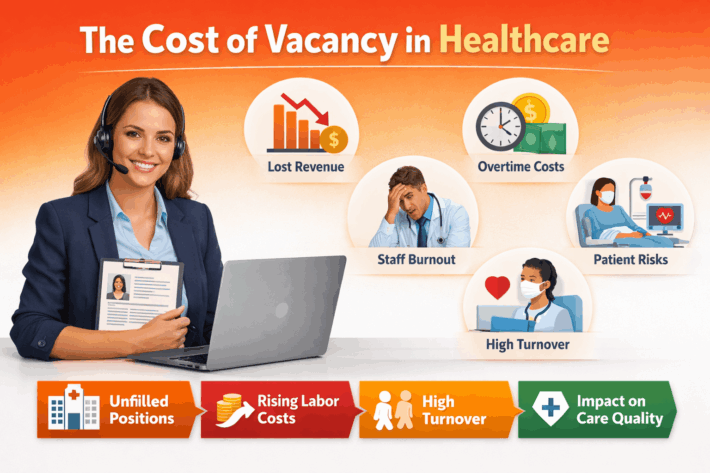
Time-to-fill in healthcare staffing refers to the number of days between job requisition approval and candidate acceptance. In clinical environments, prolonged vacancies increase overtime costs, strain care teams, and directly impact patient care quality.
Recent Healthcare Hiring Statistics You Should Know
- According to National Library Of Medicine, 2024, hospitals face a projected shortage of up to 124,000 physicians by 2033, increasing pressure on recruitment speed.
- According to Deloitte, 2023, 57% of healthcare executives identified workforce challenges as their top operational risk.
- The average cost of employee turnover can range from 50% to 200% of annual salary depending on role complexity.
- According to Statista, 2023, healthcare ranked among the top industries experiencing labor shortages in the United States.
- According to VIVA USA, 2024, average time-to-fill for medical positions can vary widely depending on specialty, facility type, and geographic demand.
These figures highlight a simple reality: healthcare hiring must be faster and smarter.
What Is the Average Time-to-Fill for Healthcare Positions?
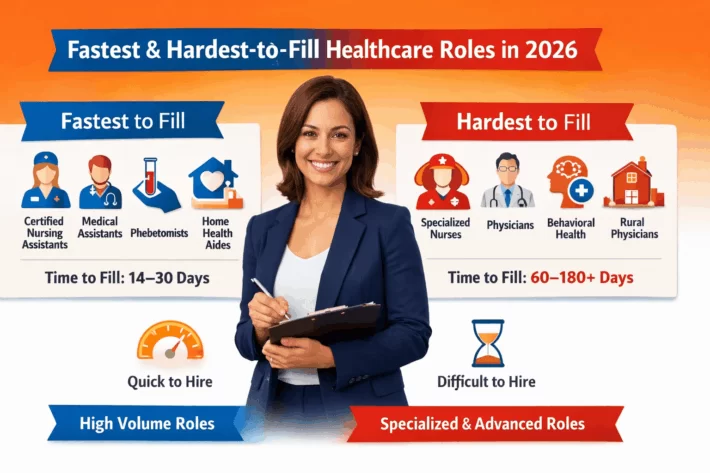
The average time-to-fill for healthcare positions ranges from 30 to 90 days, depending on role specialization, location, and credentialing requirements. Highly specialized physicians and advanced practice roles often exceed 90 days, while support staff may average 30 to 45 days.
For a detailed breakdown by role and specialty, review VIVA USA’s benchmark guide:
https://viva-it.com/insights/average-time-to-fill-for-medical-positions-benchmarks-you-should-know/
Understanding benchmarks allows organizations to identify inefficiencies and set realistic hiring goals.
Common Reasons Healthcare Organizations Struggle to Reduce Time to Fill
1. Credentialing and Compliance Delays
Healthcare hiring requires license verification, background checks, board certifications, and immunization documentation. Manual verification processes can add weeks.
2. Limited Talent Pools
Specialized nurses, physicians, and technicians are in high demand nationwide. Geographic constraints further narrow candidate availability.
3. Inefficient Interview Processes
Multiple approval layers and delayed feedback extend hiring timelines unnecessarily.
4. Reactive Hiring Instead of Workforce Planning
Organizations often recruit only after vacancies occur rather than maintaining proactive pipelines.
How to Reduce Time-to-Staff Without Compromising Quality
1. Build a Proactive Healthcare Talent Pipeline
A proactive pipeline reduces time-to-fill by maintaining a pool of pre-vetted healthcare professionals ready for deployment. This eliminates sourcing delays when roles open.
Best practices include:
- Maintaining relationships with passive candidates
- Hosting clinical networking events
- Leveraging alumni and referral programs
- Partnering with specialized healthcare staffing providers
Proactive recruitment ensures quality is preserved because screening occurs before urgent demand arises.
2. Standardize the Healthcare Hiring Process
Standardizing interviews, scorecards, and credentialing checklists reduces delays and maintains consistent quality standards.
Implement:
- Structured interview templates
- Defined evaluation criteria
- Clear approval timelines
- Centralized credential documentation systems
When decision-making frameworks are predefined, hiring managers avoid inconsistent or subjective evaluations.
3. Leverage AI-Powered Sourcing and Screening
AI-driven applicant tracking systems can:
- Match candidates to job descriptions faster
- Identify transferable clinical skills
- Predict retention likelihood
- Automate resume screening
This accelerates early-stage screening while preserving quality through data-backed evaluations.
Healthcare organizations investing in digital workforce tools reported improved operational efficiency.
4. Partner with a Specialized Healthcare Staffing Firm
Healthcare staffing partners reduce time-to-fill by providing access to pre-qualified talent networks and credential-ready professionals.
For example, VIVA USA’s contingent staffing model allows healthcare organizations to:
- Access IT, healthcare, and clinical professionals
- Scale quickly during patient surges
- Integrate with MSP or VMS programs
- Deploy temporary or project-based clinicians
This approach maintains compliance standards while significantly accelerating hiring timelines.
Balancing Speed and Quality in Healthcare Hiring
Reducing time to fill does not mean lowering standards. Instead, it means optimizing each stage of the recruitment lifecycle.
A Comparison: Fast vs Strategic Hiring
| Hiring Approach | Speed | Quality Control | Long-Term Impact |
|---|---|---|---|
| Reactive Hiring | Slow to moderate | Inconsistent | Higher turnover |
| Rushed Hiring | Fast | Low | Compliance risks |
| Strategic Staffing Model | Fast and structured | High | Improved retention |
The goal is structured acceleration, not shortcuts.
Case Example: Reducing Time-to-Staff in a Regional Hospital System
A regional hospital faced 60-day average hiring timelines for specialized nurses. By implementing:
- Pre-screened talent pools
- Streamlined credential tracking
- Dedicated staffing partnerships
They reduced average time-to-fill to 38 days within six months while maintaining compliance and quality standards.
This reduced overtime costs and improved nurse retention rates.
Quick Facts About Healthcare Staffing and Time-to-Fill
- Healthcare time-to-fill averages 30 to 90 days depending on role
- Workforce shortages remain a top operational risk for healthcare leaders
- Turnover costs can reach 200% of salary for specialized roles
- Structured hiring reduces bias and improves candidate quality
- Staffing partnerships accelerate deployment without sacrificing compliance
Long-Tail Strategies to Improve Healthcare Hiring Efficiency
Improve Physician and Nurse Recruitment Speed
- Use specialty-focused recruiters
- Offer relocation assistance
- Provide flexible scheduling options
- Maintain competitive compensation benchmarking
Reduce Credentialing Delays in Healthcare Staffing
- Digitize license verification
- Partner with credentialing specialists
- Pre-collect documentation during pipeline stage
Improve Candidate Experience to Reduce Drop-Off
Poor candidate experience significantly impacts employer brand and acceptance rates.
Healthcare candidates often juggle multiple offers. Transparent communication and quick feedback reduce offer declines.
How Workforce Planning Supports Faster Healthcare Hiring
Workforce planning includes:
- Predictive patient volume analysis
- Seasonal staffing forecasts
- Succession planning
- Internal mobility programs
Hospitals that forecast demand six to twelve months in advance can reduce emergency recruitment costs significantly.
According to the U.S. Bureau of Labor Statistics, 2024, healthcare occupations are projected to grow faster than average for all occupations through 2032.
Growth projections make proactive staffing essential.
Technology Tools That Reduce Healthcare Time-to-Fill
- Applicant Tracking Systems
- Automated Credentialing Platforms
- AI Resume Matching Tools
- Digital Onboarding Systems
- Workforce Analytics Dashboards
Technology ensures speed does not compromise compliance documentation or skill verification.
Key Takeaways: How to Improve Time-to-Staff Without Lowering Standards
- Use data benchmarks to set realistic hiring timelines
- Build proactive pipelines for high-demand healthcare roles
- Standardize interview and evaluation criteria
- Digitize credentialing processes
- Leverage AI for screening and matching
- Partner with experienced healthcare staffing providers
Reducing time-to-fill in healthcare is achievable when speed is driven by structure, not shortcuts.
Conclusion: Smarter Healthcare Staffing Starts with Strategy
Healthcare organizations cannot afford prolonged vacancies or rushed hires. By combining workforce planning, AI-enabled sourcing, structured screening, and specialized staffing partnerships, hospitals can reduce time to fill while maintaining clinical excellence.
If your organization is looking to accelerate healthcare hiring without compromising quality, VIVA USA offers flexible contingent staffing solutions tailored to healthcare environments. Contact VIVA USA today to streamline your healthcare staffing strategy and reduce time-to-staff with confidence.