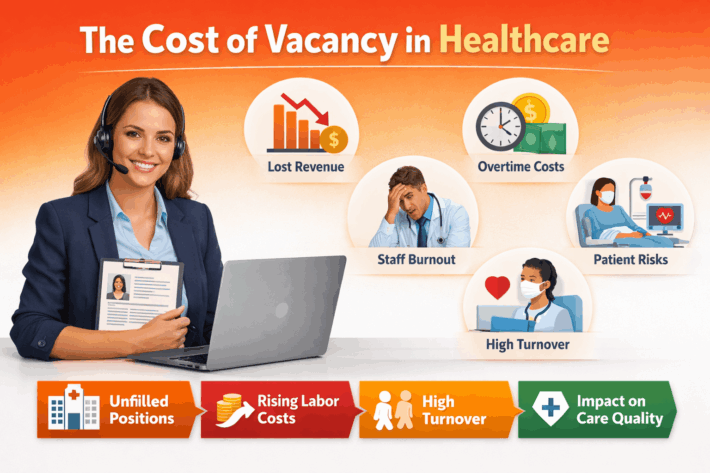
Fastest-to-Fill vs. Hardest-to-Fill Healthcare Roles in 2026: Time-to-Fill Benchmarks and Staffing Insights

In 2026, the fastest-to-fill healthcare roles are typically high-volume positions such as certified nursing assistants and medical assistants, while the hardest-to-fill roles include specialized nurses, physicians, and advanced practice providers. The difference in time to fill healthcare roles is driven by talent shortages, credentialing requirements, and geographic demand.
Healthcare staffing teams are under pressure to reduce vacancy days without sacrificing quality. Understanding which healthcare roles are fastest and hardest to fill helps organizations forecast hiring timelines, control labor costs, and strengthen workforce planning.
What Is “Time to Fill” in Healthcare Staffing?
Time to fill healthcare roles is the number of calendar days between opening a requisition and a candidate accepting the offer. It measures recruitment efficiency and directly impacts patient care continuity, overtime costs, and burnout rates.
In healthcare staffing, time to fill is influenced by:
- Licensing and credentialing requirements
- Specialty-level experience
- Location and facility type
- Competition from travel and contract roles
- Compensation and shift flexibility
Reducing time to fill is a top priority for hospitals, health systems, and government healthcare agencies in 2026.
Healthcare Labor Market in 2026: Key Statistics
Recent data highlights why some healthcare roles are significantly harder to fill than others.
1. Nurse Shortage Projection
According to the U.S. Health Resources and Services Administration, 2023 Workforce Projections, the United States is projected to face shortages in several nursing specialties through 2036.
2. Physician Shortage Forecast
According to the Association of American Medical Colleges, 2024 report, the U.S. could face a physician shortage of up to 86,000 physicians by 2036.
3. Healthcare Job Growth
According to the U.S. Bureau of Labor Statistics, 2024 Employment Projections, healthcare occupations are projected to grow much faster than average, adding about 1.9 million jobs annually through 2032.
4. Healthcare Turnover Rates
According to Webhr, 2024, the average hospital RN turnover rate remains above 20 percent.
These statistics explain why time to fill healthcare roles varies widely across specialties.
Fastest-to-Fill Healthcare Roles in 2026
What Are the Fastest-to-Fill Healthcare Roles?
The fastest-to-fill healthcare roles in 2026 are typically entry-level or high-supply positions with standardized skill requirements and broader talent pools. These roles often have shorter credentialing timelines and less specialization.
1. Certified Nursing Assistants (CNAs)
- Large candidate pools
- Short training cycles
- High demand but consistent supply
Average time to fill: 14 to 25 days in competitive markets.
CNAs remain critical for long-term care, rehabilitation centers, and hospitals. While turnover is high, the volume of available candidates keeps time to fill relatively short compared to specialized nursing roles.
2. Medical Assistants
- Outpatient clinic demand
- Short certification programs
- Broad geographic availability
Average time to fill: 15 to 30 days.
Medical assistants are among the fastest-growing healthcare roles according to BLS. Their versatility in administrative and clinical tasks makes them easier to recruit across large metro markets.
3. Phlebotomists
- Limited licensing barriers in many states
- High training output from vocational schools
Average time to fill: 10 to 20 days.
Phlebotomy roles are often filled quickly through local talent pipelines and staffing partnerships.
4. Home Health Aides
- Strong demand due to aging population
- Flexible hiring models
Average time to fill: 14 to 28 days.
Although turnover is high, agencies often maintain active candidate pools, reducing recruitment lead time.
Hardest-to-Fill Healthcare Roles in 2026
What Are the Hardest-to-Fill Healthcare Roles?
The hardest-to-fill healthcare roles in 2026 are specialized, advanced-practice, or physician-level positions that require extensive education, certifications, and experience. These roles often exceed 60 to 120 days in time to fill.
1. Registered Nurses in Specialty Units
Specialties such as:
- ICU
- Emergency Department
- Labor and Delivery
- Operating Room
Average time to fill: 60 to 90 days.
High burnout rates and competitive travel nurse contracts increase vacancy durations. Facilities in rural or underserved areas often experience even longer delays.
2. Nurse Practitioners and Physician Assistants
Average time to fill: 75 to 120 days.
Advanced practice providers require board certification, state licensure, and collaborative agreements in some states. Geographic limitations further constrain supply.
3. Behavioral Health Professionals
Includes:
- Psychiatrists
- Licensed Clinical Social Workers
- Mental health nurse practitioners
Average time to fill: 90 to 150 days.
Mental health demand continues to surge post-pandemic. Limited residency slots and educational pipelines slow workforce expansion.
4. Physicians in Rural Areas
Primary care and specialty physicians in rural regions face:
- Limited candidate mobility
- Long credentialing processes
- Hospital privileging delays
Average time to fill: 120 to 180 days or more.
Comparison Table: Fastest vs. Hardest-to-Fill Healthcare Roles
| Factor | Prolonged Vacancy | Strategic Healthcare Staffing |
|---|---|---|
| Revenue Impact | Lost patient volume | Maintained throughput |
| Labor Costs | High overtime and agency rates | Predictable staffing costs |
| Staff Morale | Burnout and turnover | Stable workload |
| Patient Outcomes | Increased risk | Improved quality metrics |
| Compliance Risk | Higher | Lower |
This comparison highlights why healthcare staffing strategies must vary by role type.
Why Time to Fill Healthcare Roles Is Increasing in 2026
1. Aging Population
The U.S. Census Bureau projects that adults aged 65 and older will out number children by 2034.
An aging population increases demand for complex and chronic care services, intensifying hiring competition.
2. Burnout and Turnover
Persistent burnout continues to drive experienced clinicians out of bedside care. High RN turnover directly increases vacancy rates and time to fill.
3. Credentialing Delays
Hospital privileging and background checks can add 30 to 90 days to physician hiring cycles.
4. Travel and Contract Competition
Travel nurse agencies offer premium pay, reducing local full-time candidate availability.
Strategies to Reduce Time to Fill in Healthcare Staffing
Healthcare organizations that reduce time to fill use proactive and data-driven strategies.
1. Build Talent Pipelines Before Demand Peaks
- Maintain active candidate databases
- Partner with staffing agencies
- Engage passive candidates
2. Streamline Credentialing
- Pre-verify licenses
- Use digital onboarding platforms
- Conduct parallel background checks
3. Offer Flexible Hiring Models
- Per diem
- Contract-to-hire
- Managed Service Provider models
Flexible staffing options attract broader candidate pools.
4. Leverage AI-Powered Sourcing
AI tools can match clinicians faster by analyzing certifications, availability, and location preferences. This reduces manual screening time and accelerates interviews.
Quick Facts: Fastest vs. Hardest Healthcare Roles
- Fastest-to-fill roles average under 30 days.
- Hardest-to-fill roles can exceed 120 days.
- Specialty nursing and behavioral health remain the most competitive areas.
- Rural healthcare roles take longer to fill than urban positions.
- Credentialing delays significantly impact physician hiring timelines.
Case Example: Reducing Time to Fill for ICU Nurses
A regional hospital network experiencing 85-day average time to fill for ICU nurses implemented:
- Dedicated specialty nurse recruiters
- Signing bonuses tied to retention
- Streamlined credentialing
Within six months, time to fill decreased to 58 days. Vacancy costs dropped, and overtime expenses declined significantly.
This demonstrates how targeted healthcare staffing strategies improve operational efficiency.
The Future of Healthcare Roles in 2026 and Beyond
Healthcare workforce demand will continue to rise due to:
- Population aging
- Chronic disease prevalence
- Expanded access to care
- Mental health service demand
Organizations that treat time to fill healthcare roles as a strategic KPI will gain a competitive advantage.
Fastest-to-fill roles will remain essential for operational continuity. Hardest-to-fill roles will require proactive workforce planning, strong employer branding, and specialized recruitment expertise.
Conclusion: Closing the Healthcare Staffing Gap in 2026
In 2026, the gap between fastest-to-fill and hardest-to-fill healthcare roles is widening. Entry-level clinical support roles may be filled in weeks, while specialized nurses, behavioral health providers, and physicians can take months. Reducing time to fill healthcare roles requires data-driven sourcing, flexible hiring models, and strong staffing partnerships. If your organization is struggling to fill critical healthcare roles quickly and efficiently, contact VIVA USA to explore scalable healthcare staffing solutions designed to reduce vacancy days and improve workforce performance.