10 Healthcare Recruitment Metrics Every HR Leader Should Track in 2026
Healthcare recruitment metrics help HR leaders measure how efficiently their organizations attract, hire, and retain healthcare professionals. Tracking the right data points, such as time-to-fill, cost-per-hire, vacancy rates, and candidate quality allows hospitals and healthcare organizations to improve hiring speed, reduce staffing shortages, and strengthen workforce stability in a highly competitive healthcare hiring market.
Why Healthcare Recruitment Metrics Matter for Healthcare Staffing
Healthcare recruitment metrics provide measurable insights into hiring performance. They help HR teams identify bottlenecks in healthcare hiring, improve talent acquisition strategies, and reduce workforce shortages.
The healthcare industry is facing increasing demand for skilled professionals. According to Staffing Industry Analysts, citing U.S. Bureau of Labor Statistics data, healthcare job openings rose 48% from 1.2 million in 2019 to 1.8 million in 2023, highlighting the growing demand for healthcare talent.
Additional recent data illustrates the urgency:
- The average Registered Nurse vacancy rate in U.S. hospitals is 9.9%, creating significant pressure on healthcare hiring teams.
- The average time to fill a medical/surgical RN role ranges from 80 to 109 days, with an average of 94 days.
- The average cost of RN turnover is $56,300 per nurse, costing hospitals between $3.9 million and $5.8 million annually.
These figures show why healthcare HR leaders must monitor recruitment metrics closely to maintain patient care quality and operational stability.
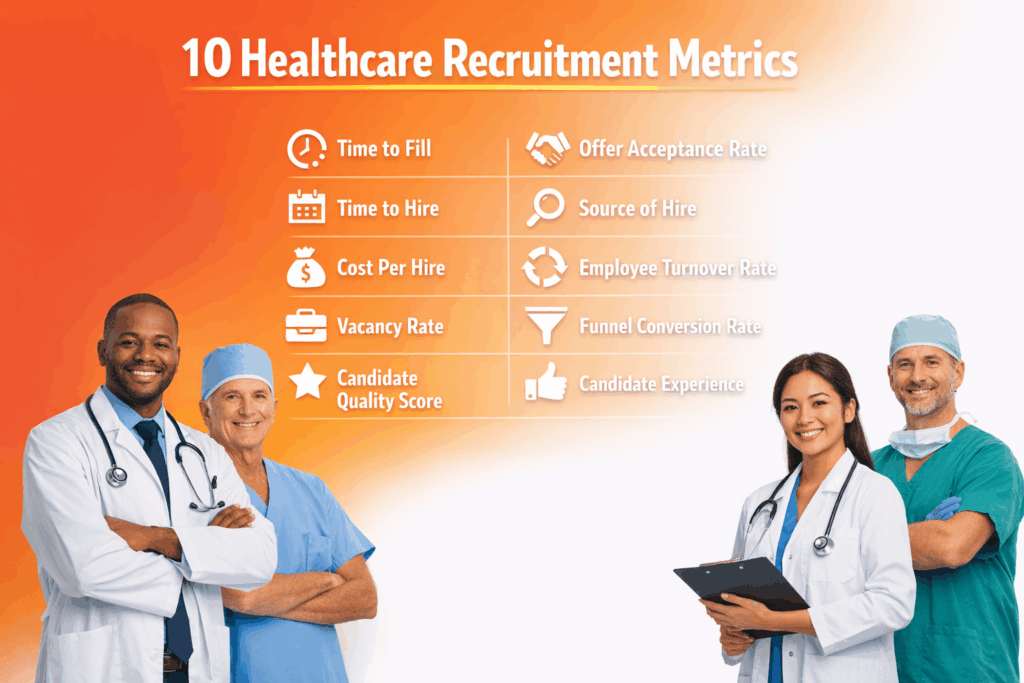
10 Healthcare Recruitment Metrics Every HR Leader Should Track
Below are the most important healthcare recruitment metrics used by hospitals, healthcare systems, and staffing organizations to improve hiring performance.
1. Time to Fill in Healthcare Hiring
Time to fill measures the number of days between opening a healthcare position and the candidate accepting the job offer. It reflects how quickly an organization can close critical workforce gaps.
In healthcare staffing, this metric is especially important because delays can impact patient care, staff workloads, and operational efficiency.
How to calculate time to fill
Time to Fill = Date candidate accepts offer – Date job was posted
Why it matters
- Identifies slow recruitment processes
- Helps forecast workforce shortages
- Improves healthcare workforce planning
Example
If a hospital takes 90 days to hire a registered nurse but competitors fill similar roles in 60 days, recruitment leaders should evaluate sourcing strategies, hiring workflows, and candidate experience.
2. Time to Hire in Healthcare Recruitment
Time to hire measures the number of days between the candidate entering the recruitment pipeline and accepting the offer.
While time to fill measures the entire process, time to hire focuses on recruiter efficiency.
Why HR leaders track this metric
- Evaluates screening and interview efficiency
- Identifies delays in decision-making
- Improves candidate experience in healthcare hiring
Example
If the average time to hire for nurse practitioners is 20 days but physicians take 45 days, HR leaders can adjust interview stages or decision timelines.
3. Cost per Hire in Healthcare Staffing
Cost per hire measures the total recruitment cost required to fill a healthcare position.
This metric includes internal and external recruiting costs.
Typical cost components
- Job advertising
- Recruitment agency fees
- HR team salaries
- Recruitment software
- Candidate travel and onboarding costs
Formula
Cost per Hire = Total recruitment cost / Number of hires
Why it matters
Healthcare organizations often spend heavily on recruitment agencies and travel nurses. Tracking this metric helps reduce hiring costs without compromising candidate quality.
4. Healthcare Vacancy Rate
Vacancy rate measures the percentage of open healthcare positions compared to the total number of positions in an organization.
Formula
Vacancy Rate = (Open positions / Total positions) × 100
Why it matters
High vacancy rates can lead to:
- Staff burnout
- Increased overtime costs
- Lower patient satisfaction
- Higher turnover rates
Hospitals with high vacancy rates often rely on temporary healthcare staffing solutions to maintain care standards.
5. Candidate Quality Score
Candidate quality measures how well newly hired healthcare professionals perform after joining the organization.
Key indicators
- Performance reviews
- Retention rates
- Clinical competency scores
- Manager feedback
Why it matters
Hiring quickly is important, but hiring the right candidate is even more critical in healthcare recruitment.
A high candidate quality score ensures:
- Better patient outcomes
- Reduced turnover
- Higher team productivity
6. Offer Acceptance Rate
Offer acceptance rate measures the percentage of job offers accepted by candidates.
Formula
Offer Acceptance Rate = (Accepted offers / Total offers made) × 100
Why it matters in healthcare hiring
Healthcare candidates often receive multiple offers. A low acceptance rate may indicate:
- Noncompetitive compensation
- Poor employer branding
- Slow recruitment processes
HR leaders can improve this metric by offering faster decisions, better compensation packages, and improved candidate engagement.
7. Source of Hire in Healthcare Recruitment
The source of hire identifies where successful healthcare candidates come from.
Common recruitment sources
- Healthcare staffing agencies
- Job boards
- Employee referrals
- Professional networks
- Medical schools and universities
Why this metric matters
Tracking hiring sources helps HR teams invest more in the channels that deliver high quality healthcare candidates.
For example:
| Source | Benefit |
|---|---|
| Employee referrals | Higher retention |
| Staffing agencies | Faster hiring |
| Job boards | Larger talent pools |
8. Healthcare Employee Turnover Rate
Turnover rate measures the percentage of healthcare employees who leave an organization within a specific period.
Formula
Turnover Rate = (Number of employees who left / Average total employees) × 100
Why HR leaders track this
Healthcare turnover directly affects recruitment demand. High turnover increases hiring costs and disrupts patient care continuity.
Long term care facilities experience some of the highest turnover levels. According to DailyPay, nursing homes report an average nursing staff turnover rate of 53.3%.
Monitoring turnover allows healthcare organizations to improve retention strategies.
9. Recruitment Funnel Conversion Rate
Recruitment funnel metrics measure how candidates move through each stage of the hiring process.
Typical stages include:
- Job application
- Screening
- Interview
- Offer
- Hire
Why it matters
This metric helps HR leaders identify where candidates drop off during healthcare hiring.
For example:
| Stage | Conversion Issue |
|---|---|
| Application to interview | Poor job descriptions |
| Interview to offer | Weak candidate evaluation |
| Offer to hire | Noncompetitive compensation |
Optimizing the funnel improves hiring efficiency and candidate experience.
10. Candidate Experience Score
Candidate experience measures how applicants perceive the recruitment process.
Healthcare candidates value transparent communication and fast decision making.
Common measurement methods
- Candidate surveys
- Net Promoter Score (NPS)
- Interview feedback forms
Benefits
- Improves employer brand
- Increases offer acceptance rates
- Attracts high quality healthcare professionals
How HR Leaders Can Improve Healthcare Hiring Metrics
Healthcare recruitment metrics are only useful when organizations actively use them to improve hiring strategies.
1. Use data-driven recruitment strategies
Healthcare HR teams should analyze hiring data regularly to identify trends such as high turnover departments or slow recruitment pipelines.
2. Partner with healthcare staffing specialists
External healthcare staffing partners can help organizations reduce time to fill and access specialized talent pools.
3. Improve employer branding
Healthcare professionals often prioritize:
- Work-life balance
- Professional development
- Competitive compensation
- Flexible schedules
Highlighting these benefits can improve candidate engagement.
4. Invest in recruitment technology
Modern healthcare recruitment tools such as ATS platforms, AI sourcing, and workforce analytics improve hiring speed and candidate matching.
5. Focus on retention strategies
Recruitment metrics are closely linked to retention metrics. Hospitals that reduce burnout, improve staffing ratios, and provide career growth opportunities typically experience lower turnover.
Conclusion
Healthcare recruitment metrics are essential for HR leaders navigating the growing talent shortage in the healthcare industry. By tracking metrics such as time-to-fill, cost-per-hire, vacancy rates, and candidate quality, organizations can improve hiring efficiency, reduce workforce shortages, and maintain high-quality patient care.
Healthcare hiring challenges are increasing, but data-driven recruitment strategies can help organizations stay competitive.
Looking to strengthen your healthcare staffing strategy?
VIVA USA provides scalable healthcare staffing solutions, helping healthcare organizations access qualified professionals quickly and efficiently. Contact VIVA USA today to learn how our contingent staffing solutions can support your healthcare recruitment goals.