The New Reality of Healthcare Work in 2026: Burnout and the Rise of AI
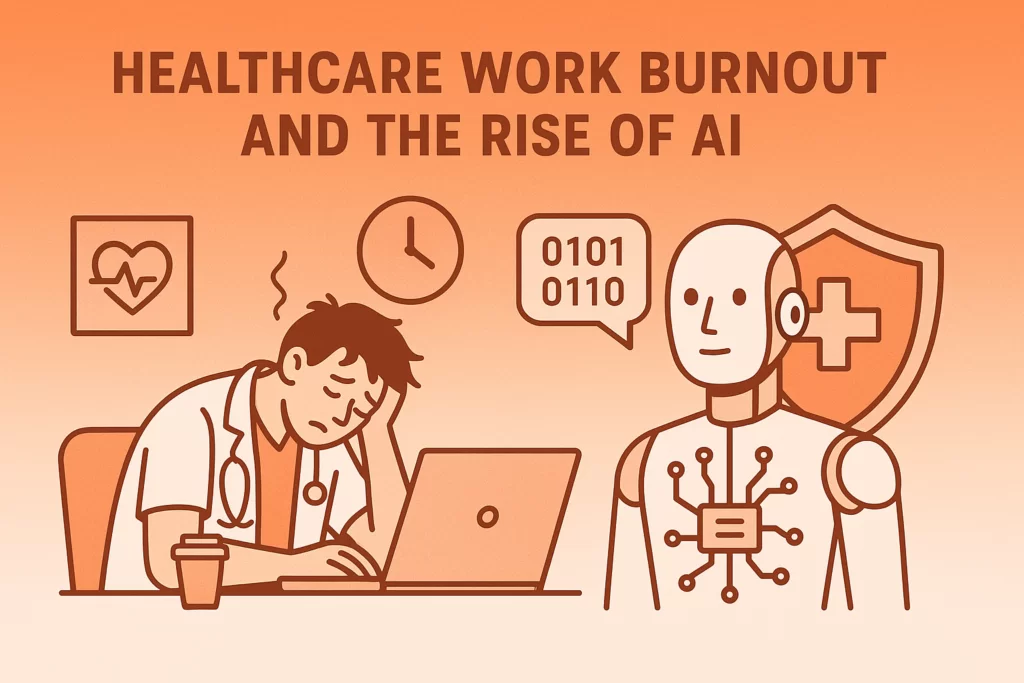
The landscape of healthcare work in 2026 is defined by a critical paradox: escalating clinical burnout alongside the rapid adoption of Artificial Intelligence (AI). Effective healthcare staffing hinges on mitigating administrative overload and leveraging predictive AI tools for better workflow orchestration, transforming high-stress roles into sustainable careers.
This blog post explores the pressing burnout crisis and the powerful emergence of AI as a necessary strategic partner, fundamentally reshaping healthcare staffing trends and ensuring quality patient care in the coming years. Organizations that strategically integrate technology will secure a competitive edge in attracting and retaining the essential healthcare workforce.
The Crisis Point of Healthcare Staffing: Why Burnout Defines 2026
The severity of burnout among clinical staff has transitioned from a professional concern to a systemic threat, directly impacting patient outcomes and the stability of global health systems. Factors such as persistent staffing shortages, increased administrative demands, and the emotional toll of prolonged stress continue to drive clinicians away from the bedside. Addressing this core issue is the single most critical challenge defining healthcare work in 2026.
What is driving healthcare worker burnout in 2026?
Healthcare worker burnout in 2026 is primarily driven by unsustainable workloads, excessive documentation requirements, and insufficient staffing ratios that lead to mandatory overtime. These systemic pressures erode professional autonomy and job satisfaction, resulting in emotional exhaustion and high rates of attrition among experienced providers and nurses. This exhaustion is now a key risk factor for patient safety and organizational stability.
The data confirms the critical nature of the issue. According to the CDC Vital Signs Report (published November 2023), nearly half of health workers reported often feeling burned out in 2022. This surge demonstrates the deep impact of prolonged crisis conditions on the workforce.
According to the CDC Vital Signs Report, published November 2023, 46% of US health workers reported often feeling burned out in 2022, a significant increase from 32% in 2018.
For nursing staff, the situation remains especially dire. According to the fourth annual survey conducted by Cross Country Healthcare and Florida Atlantic University, burnout and stress continue to persist at alarming levels. These immense psychological burdens necessitate immediate, comprehensive interventions beyond traditional wellness programs.
Based on the “Beyond the Bedside: The State of Nursing in 2025” report from Cross Country Healthcare and FAU, published April 29, 2025, 65% of nurses report high levels of stress and burnout.
Financial and Operational Impact of High Turnover
Burnout feeds directly into high staff turnover, creating a debilitating cycle of understaffing and increased workload for those who remain. High turnover is not merely a human resources problem; it is a staggering financial liability, with the average cost of replacing a single registered nurse reaching over $60,000.
The instability is clearly reflected in staffing metrics across the country. According to the NSI National Health Care Retention & RN Staffing Report, while turnover rates have subsided slightly from pandemic peaks, they remain elevated and concerning for hospital finances.
According to the 2025 NSI National Health Care Retention & RN Staffing Report, the national average hospital RN turnover rate stood at 16.4% in 2024.
The constant need to replace staff detracts from strategic investment in care quality. Instead of focusing resources on innovation or facility upgrades, hospitals are forced to spend millions annually simply maintaining baseline staffing levels. This unsustainable model is why healthcare staffing trends are pivoting sharply toward technological solutions that promise stability and operational efficiency.
Healthcare Staffing Trends 2026: The AI Revolution
Artificial intelligence is rapidly shifting from a futuristic concept to an indispensable operational tool in healthcare, particularly in addressing the twin challenges of burnout and labor shortages. The successful implementation of AI in healthcare work in 2026 is focused not on replacing clinicians, but on eliminating the administrative and scheduling headaches that fuel dissatisfaction. This collaboration between human expertise and machine efficiency is the defining trend for the mid-decade.
How is AI reducing administrative burden for nurses?
AI is reducing administrative burden for nurses by automating time-consuming, repetitive tasks such as charting, prior authorizations, and scheduling optimization. Using Natural Language Processing (NLP) and ambient intelligence, AI tools can transcribe physician-patient conversations directly into the Electronic Health Record (EHR), freeing up clinical staff to focus on direct patient interaction. This shift restores valuable time to bedside care and reduces cognitive fatigue.
This technological delegation represents a massive opportunity to return time to patient care. Clinicians frequently report spending between 35% and 50% of their day on documentation and administrative tasks rather than patient-facing duties. This non-clinical workload is a primary driver of burnout.
By targeting these inefficiencies, AI offers tangible time savings. Deloitte’s research highlights the significant potential for leveraging technology to give nurses back their time, which directly addresses one of the core drivers of burnout.
Research published in Deloitte Insights (May 2024) found that available technologies, including AI, could potentially free up to 20% of time for bedside nurses by automating key administrative tasks.
The Shift to Predictive and Proactive Workforce Management
One of the most disruptive healthcare staffing trends involves the use of AI for predictive modeling. Traditional staffing relies on historical data and manual scheduling, which often leads to poor resource allocation, resulting in both over- and under-staffing. Understaffing directly causes burnout, while overstaffing wastes precious financial resources.
What is Predictive Staffing in healthcare?
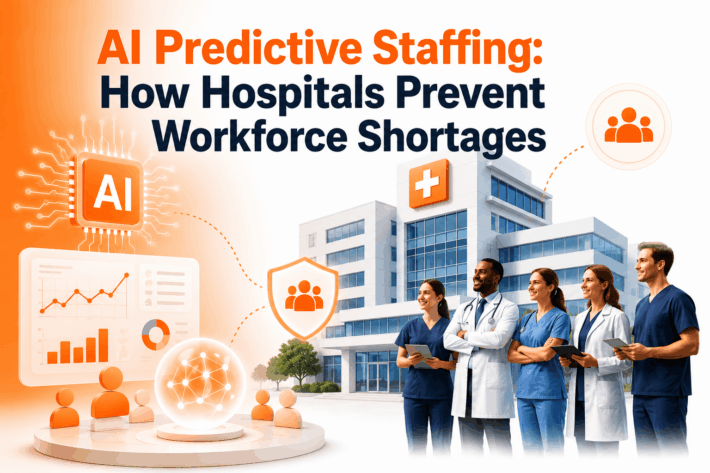
Predictive Staffing in healthcare is an AI-driven approach that uses machine learning to analyze real-time and historical data including patient census, admission rates, staff utilization, and seasonal illness trends to accurately forecast staffing needs days or weeks in advance. This allows organizations to proactively adjust schedules and allocate resources, minimizing unexpected shortages and reducing the need for costly, reactive crisis staffing.
Implementing AI-driven workflow orchestration is a strategic solution to healthcare staffing shortages, enabling hospitals to move away from reactive scheduling. AI platforms can monitor workloads in real time, identifying high-risk units or staff members exhibiting early signs of fatigue based on shift length or frequency of late clock-outs. These systems provide managers with proactive alerts, allowing for timely intervention and schedule adjustments before minor stress turns into career-ending burnout. Read more about this approach here: AI-driven workflow orchestration: a strategic solution to healthcare staffing shortages.
Through advanced algorithms, AI helps match talent not just based on licensure, but on a more nuanced profile that includes availability, skill set, and even behavioral analysis for better team cohesion. This leads to higher retention rates and a more stable working environment, which are critical outcomes in the pursuit of sustainable healthcare staffing.
Navigating the New Reality: Integration and Upskilling
The integration of AI is not a choice but a necessary evolutionary step for healthcare organizations aiming for long-term survival and success. The challenge lies in ensuring this technology is implemented thoughtfully, with a focus on empowering the existing workforce rather than alienating them. Healthcare work in 2026 demands a hybrid skill set: clinical excellence combined with digital fluency.
Executive Outlook: Rapid Adoption of Generative AI
Healthcare leaders have recognized the necessity of this digital transformation. The industry’s adoption rate for generative AI has accelerated dramatically as executives seek tangible operational gains. Generative AI holds particular promise for automating complex clerical work like draft clinical notes, initial insurance claims processing, and personalized patient communication summaries.
McKinsey’s ongoing research into AI trends clearly shows the commitment of the industry to embracing this technology. The vast majority of leaders are past the exploration stage and moving into implementation.
A McKinsey Health Institute survey conducted in Q4 2024 found that 85% of healthcare leaders from payers, health systems, and technology groups were exploring or had already adopted gen AI capabilities.
The initial success stories often focus on the back office, streamlining revenue cycle management and administrative tasks to yield immediate financial returns. This approach frees up capital that can then be reinvested into frontline clinical staffing, better compensation, and training programs for AI integration.
The Ethical and Human Component of AI Integration
While the technical capabilities of AI are impressive, successful integration hinges on human factors like trust, training, and ethical governance. There is a legitimate concern among clinicians about “deskilling” the possibility of losing critical diagnostic and decision-making abilities due to over-reliance on AI systems. Organizations must adopt a transparent approach.
To maintain trust, health systems must ensure that AI serves as a powerful co-pilot, not a replacement. Training must focus on teaching clinicians how to audit, interpret, and validate AI output, ensuring they maintain final authority and professional responsibility for all decisions. The goal is augmentation, where AI handles the routine, allowing the human provider to focus on complex decision-making, empathy, and complex communication. This ensures that AI and automation in healthcare staffing are truly an opportunity, not a threat. You can learn more about managing this transition here: AI and automation in healthcare staffing: threat or opportunity?.
Organizations must also establish clear ethical frameworks regarding patient data privacy and algorithmic bias. As AI assumes greater responsibility, the human touch in patient care must be consciously prioritized to prevent the erosion of the essential healthcare worker-patient relationship.
Strategic Partnerships for Future-Proof Staffing
The transition to an AI-augmented environment requires specialized expertise that many health systems lack internally. Successfully navigating the complex intersection of clinical workflow, data science, and talent acquisition necessitates strategic partnerships. Expert staffing solutions providers are increasingly stepping into this role, offering customized, technology-enabled workforce strategies.
These partnerships leverage advanced analytics to assess existing workforce skills gaps and design targeted training programs to upskill staff in using new AI tools. They also utilize technology to conduct sophisticated forecasting and source candidates who are already digitally fluent and adaptable to new models of care delivery. By partnering with firms focused on innovative human capital strategies, health systems can ensure they meet current demands while preparing for the future of healthcare work in 2026 and beyond.
Key Takeaways for Healthcare Staffing Leaders
- Burnout is a Business Crisis: High attrition rates, such as the 16.4% RN turnover in 2024 (NSI Nursing Solutions), are financially unsustainable and require systemic, technological solutions, not just wellness programs.
- AI is the Key to Time Recovery: AI and automation can liberate significant time for clinicians, with estimates from Deloitte suggesting up to 20% of nurse time can be freed from administrative tasks.
- Adoption is Rapid: A vast majority of leaders (85% in Q4 2024, McKinsey) are already experimenting with or deploying generative AI to address workforce and financial challenges.
- Future Staffing is Predictive: The leading trend is shifting from reactive staffing to predictive workforce management, which uses AI to forecast needs and optimize scheduling, reducing both under- and over-staffing.
- Urgent Intervention is Needed: The CDC reports that 46% of US health workers were burned out in 2022, underscoring the critical need for immediate workplace improvements supported by technology.
Conclusion: Securing the Future of Healthcare Work
The new reality of healthcare work in 2026 is defined by volatility, but also by profound opportunity. While the ongoing crisis of burnout and staff shortage continues to challenge the industry, the rise of AI provides the most powerful tool yet to restore sustainability and purpose to clinical roles. By automating administrative burdens and enabling truly predictive healthcare staffing trends, AI allows clinicians to re-engage with the human elements of care that drew them to the profession. Health systems that proactively implement these integrated, intelligent workforce solutions will stabilize their operations and build a resilient, future-ready clinical team.
Ready to transform your workforce management model and combat burnout with intelligent solutions? Contact VIVA USA today to discuss strategic, AI-driven workflow orchestration and customized staffing solutions designed to address the challenges of the new healthcare reality.