Skip to content
Certified Woman & Minority Owned
Important Notice for Form 1095-C
VIVA USA Inc.
  • Services
    • Contingent Staffing
      • IT Staffing
      • Healthcare Staffing
      • Government Staffing
    • Neuhire – Offshore Staffing
    • Permanent Staffing
    • Recruitment Outsourcing Solutions
    • Software Project Consulting
    • Data Cleansing & Enrichment
    • Payroll Services
  • Solutions
    • STARS – Supplier Success Portal
      • Data Scrubbing & Enrichment
      • Supplier Registration
      • Tier 2 Spend Reporting
      • Tier 1 Spend Analytics
      • External Supplier Locator
      • Economic Impact Analysis
      • Benchmarking Report
      • Business Card Scanner
      • Engagement & Outreach Center
      • ESG Reporting
      • Supplier Success Consulting
      • Certification Portals
      • Compliance Portals
    • Custom Workflow Portals (SaaS)
    • Global Capability Center
  • Careers
    • Careers
    • Career Benefits
  • About Us
    • Who We Are
    • Awards & Recognition
    • Partnerships & Certifications
    • Contract Vehicles
    • Quality Practice
    • Past Performance
  • Insights
    • Blog
    • Case Studies
  • Contact Us
Contact
Insights

Who’s Leaving Healthcare? A Look at Workforce Attrition Trends
July 31, 2025 Rajkumar R Comments Off on Who’s Leaving Healthcare? A Look at Workforce Attrition Trends
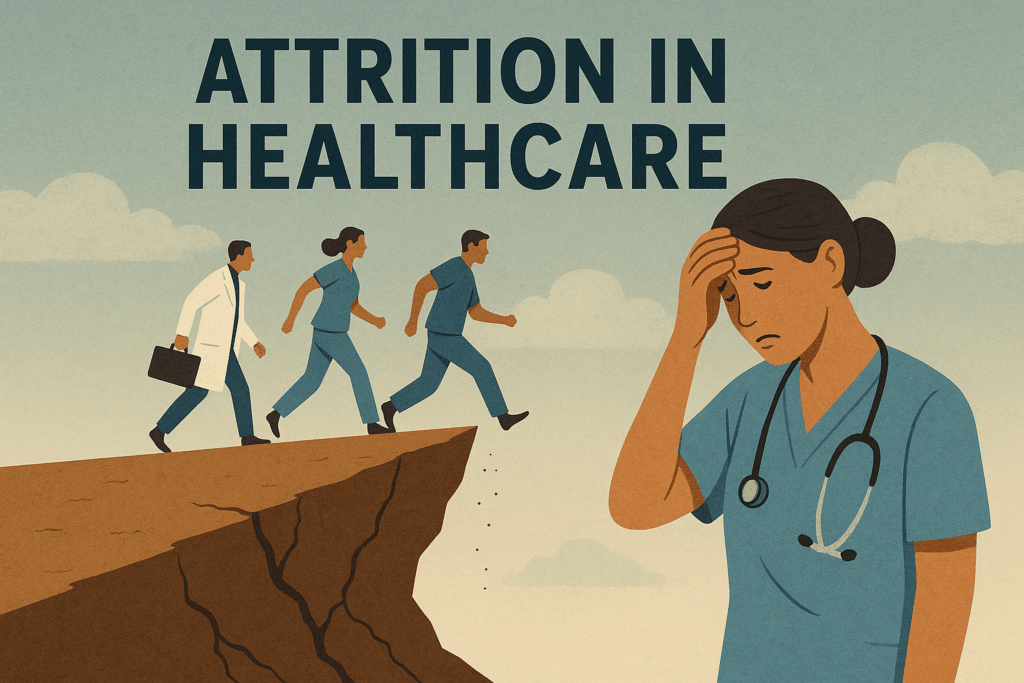
Attrition in healthcare industry

As the U.S. healthcare system continues to evolve post-pandemic, one issue remains at the forefront: workforce attrition. The “Great Resignation” hit healthcare harder than most industries, with high burnout rates, early retirements, and career shifts among healthcare professionals. In 2025, workforce attrition remains a defining challenge with serious implications for patient care, staffing strategies, and financial health. 

This article explores who is leaving healthcare, why they’re leaving, and what healthcare systems can do to reverse the trend and fill critical staffing gaps.

The Scope of the Problem

According to a 2024 Statista survey, 20% of U.S. healthcare workers reported serious intentions to leave the profession within the next two years. Another KFF survey revealed that close to 30% of nurses are considering leaving the profession 

The Bureau of Labor Statistics (BLS) projects that the U.S. will need to fill more than 1.9 million healthcare jobs annually through 2031, primarily due to retirements, role changes, and voluntary exits. Healthcare already comprises one of the largest employment sectors in the U.S., and the demand continues to grow.

 Key groups leaving the workforce: 

  • Experienced nurses, especially RNs with 10+ years of experience, are retiring early or switching to non-clinical roles. 
  • Physicians over 55 are increasingly choosing early retirement due to stress, liability, and work-life imbalance. 
  • Younger professionals are pivoting to tech, insurance, or education sectors seeking better flexibility and compensation. 

Top 4 Reasons for Attrition in the Healthcare Industry

Healthcare attrition is driven by multiple overlapping causes that vary by role, age, and facility type. Here are the primary reasons professionals are leaving the sector: 
 

1. Burnout 

Burnout is the number one factor. Staff are overworked, under-resourced, and emotionally drained. The emotional toll of managing life-or-death situations, coupled with long hours and limited recovery time, is unsustainable for many. 
 

2. Inadequate Compensation 

Many professionals, particularly in entry-level or rural roles, feel that their pay does not reflect the physical and emotional demands of the job. Inflation and stagnant wages further compound the issue. 
 

3. Safety Concerns 

Healthcare workers face increasing safety threats, including workplace violence, exposure to contagious diseases, and mental stress from high-acuity care settings. 
 

4. Administrative Burden 

EHR systems and documentation protocols often require as much or more time than direct patient care. This added bureaucracy leads to frustration, disengagement, and departure.
 

Demographic Breakdown

Understanding who is leaving healthcare helps target solutions more precisely. 

  • Age: Professionals over age 55 are retiring earlier than expected, creating sudden experience gaps. 
  • Gender: Women, who make up more than 75% of the healthcare workforce, are disproportionately affected due to caregiver responsibilities at home. 
  • Geography: Attrition is especially severe in rural and underserved areas where replacements are harder to find, and workloads are higher.

Impact on Healthcare Systems

The consequences of attrition are far-reaching, affecting the entire ecosystem: 

  • Increased labor costs: Hospitals must rely on travel nurses, temp workers, and overtime to fill gaps—at significant cost. 
  • Declining patient satisfaction: Understaffed facilities often lead to longer wait times, errors, and reduced patient communication. 
  • Reduced care continuity: Constant turnover disrupts team-based care models and hinders long-term patient-provider relationships. 
  • Higher recruitment and onboarding expenses: Replacing a healthcare worker can cost tens of thousands of dollars in sourcing, training, and administrative effort.
     

The attrition cycle also fuels burnout among remaining staff, creating a self-perpetuating staffing crisis.

Top 6 Strategies to Address Attrition in the Healthcare Industry

To slow or reverse attrition, healthcare systems need to tackle its root causes with targeted, sustainable interventions.

1. Workforce Wellness Initiatives

Establish mental health support programs that include on-site counseling, peer support groups, wellness stipends, and burnout assessments. Normalize seeking help and implement trauma-informed leadership practices. 
 

2. Compensation Adjustments 

Conduct regional pay equity reviews to ensure competitive wages and create transparent career ladders. Offer retention bonuses for high-need departments and provide differentials for night, weekend, or high-risk shifts. 
 

3. Reduce Administrative Burden 

Leverage automation and AI-based scribe tools to reduce manual data entry. Train staff on efficient EHR use and streamline reporting requirements to allow more time for patient interaction. 
 

4. Career Development and Mentorship 

Invest in internal promotion pathways, mentorship programs, and leadership tracks. Support continuing education, offer loan repayment assistance, and build a culture of lifelong learning. 
 

5. Flexible Work Models 

Embrace hybrid and remote work where feasible, especially in administrative, telemedicine, and mental health services. Enable self-scheduling and flexible shift arrangements to retain talent with family or educational obligations. 
 

6. Strengthen Safety Protocols 

Implement zero-tolerance workplace violence policies, install panic buttons and surveillance systems, and conduct regular de-escalation training. 
 

Top 6 Ways to Fill the Existing Gaps in the Healthcare Industry

Even with retention efforts, large gaps remain. Here’s how to bridge them quickly and strategically:

1. Accelerate Pipeline Programs

Develop partnerships with nursing schools, allied health programs, and technical colleges. Offer tuition reimbursement and apprenticeships to draw in students early and secure future talent.

2. Use International Talent

Establish legal and credentialing frameworks to support foreign-trained nurses, physicians, and allied professionals. Expand visa programs and collaborate with international staffing agencies.

3. Expand Telehealth Staffing

Invest in virtual care platforms that allow providers to operate across state lines. Use telemedicine to reduce patient loads at physical sites and retain clinicians who prefer remote roles.

4. Tap Into Retired and Semi-Retired Professionals

Create flexible, part-time, or advisory roles for retired clinicians. Many are willing to return under less strenuous conditions, providing mentorship and stability.

5. Utilize Managed Service Providers (MSPs)

Engage with specialized healthcare staffing firms that offer rapid, vetted talent pools. MSPs reduce time-to-fill and offer flexibility during seasonal surges or crises.

6. Re-skill and Redeploy Internal Talent

Encourage administrative staff to retrain into clinical or tech support roles. Offer fast-track programs for medical assistants, coders, or health IT positions.

Conclusion: Building a Sustainable Workforce

Healthcare workforce attrition is not just a numbers issue—it’s a systemic challenge that touches recruitment, culture, care quality, and financial performance. In 2025, addressing it requires more than reactive hiring. Healthcare leaders must create sustainable, inclusive work environments that inspire long-term loyalty.

To move forward, healthcare organizations should:

  • Invest in workforce well-being as a strategic priority, not just an HR function.
  • Build educational and hiring partnerships to secure talent pipelines.
  • Modernize staffing models using remote care, digital platforms, and AI tools.
  • Engage employees with flexible options, meaningful growth, and transparent communication.
  • By tackling attrition with both empathy and innovation, healthcare systems can retain top talent, improve patient outcomes, and future-proof their workforce.

Cut down hiring delays and simplify healthcare staffing with VIVA USA Inc. Our AI-powered tools, credentialed talent networks, and scalable MSP models are built to get you the right people fast. Contact us now to learn more.

  • Healthcare Staffing
Rajkumar R

Post navigation

Previous
Next

Recent posts

  • healthcare-staffing
    How Healthcare Organizations Can Improve Time-to-Staff Without Compromising Quality
  • fastest-hardest-to-fill-healthcare-roles
    Fastest-to-Fill vs. Hardest-to-Fill Healthcare Roles in 2026: Time-to-Fill Benchmarks and Staffing Insights
  • cost-of-vacancy-healthcare
    Cost of Vacancy in Healthcare: Why Slow Hiring Hurts More Than You Think

View All

Related Post

US Healthcare Staffing CrisisSolving the U.S. Healthcare Staffing Crisis: Key Problems and Practical Solutions Contingent Staffing ModelsThe Rise of Flexible and Contingent Healthcare Staffing Models retain-healthcare-workersBeyond Pay: What Truly Drives Healthcare Professional Retention?

Related Post

contingent-it-healthcare-engineering
Insights

The Rise of Contingent Staffing in IT, Healthcare, and Engineering

September 3, 2025 Rajkumar R Comments Off on The Rise of Contingent Staffing in IT, Healthcare, and Engineering

Contingent staffing—using freelancers, contract workers, temporary and gig-style resources is growing rapidly in sectors like IT, healthcare, and engineering due to skills shortages, demand volatility, and cost pressures.

global-healthcare-crisis
Insights

Nurse Staffing Companies: Addressing the Global Healthcare Workforce Crisis

August 27, 2025 Rajkumar R Comments Off on Nurse Staffing Companies: Addressing the Global Healthcare Workforce Crisis

Nurse staffing firms are key players in mitigating the worldwide shortage of healthcare professionals by matching supply to need, deploying flexible staffing models, and helping institutions cover surges and shortages.

retain-healthcare-workers
Insights

Beyond Pay: What Truly Drives Healthcare Professional Retention?

August 13, 2025 Rajkumar R Comments Off on Beyond Pay: What Truly Drives Healthcare Professional Retention?

While financial compensation is important, healthcare professionals often prioritize respect, professional growth, meaningful work, and work-life balance when deciding whether to stay with an organization.

VIVA USA Inc.
Services
  • Contingent Staffing
  • Offshore Staffing
  • Permanent Staffing
  • RPO (Recruitment Process Outsourcing)
  • Software Project Consulting
  • Data Cleansing
  • Payroll Services/EOR
Solutions
  • STARS - Supplier Success Portal
  • Custom Workflow Portal (SaaS)
  • Global Capability Center (GCC)
Others
  • STARS - Supplier Success
  • Neuhire
  • Savvysoft Technologies
About Us
  • Who We Are
  • Awards & Recognition
  • Partnerships & Certifications
  • Career Benefits
  • Careers
  • Contract Vehicles
  • Insights

2025 © Copyright, VIVA USA Inc. All Rights Reserved.

  • Terms and Conditions
  • Privacy Policy
  • AI Usage Policy