The Rise of Contingent Staffing in IT, Healthcare, and Engineering
Introduction
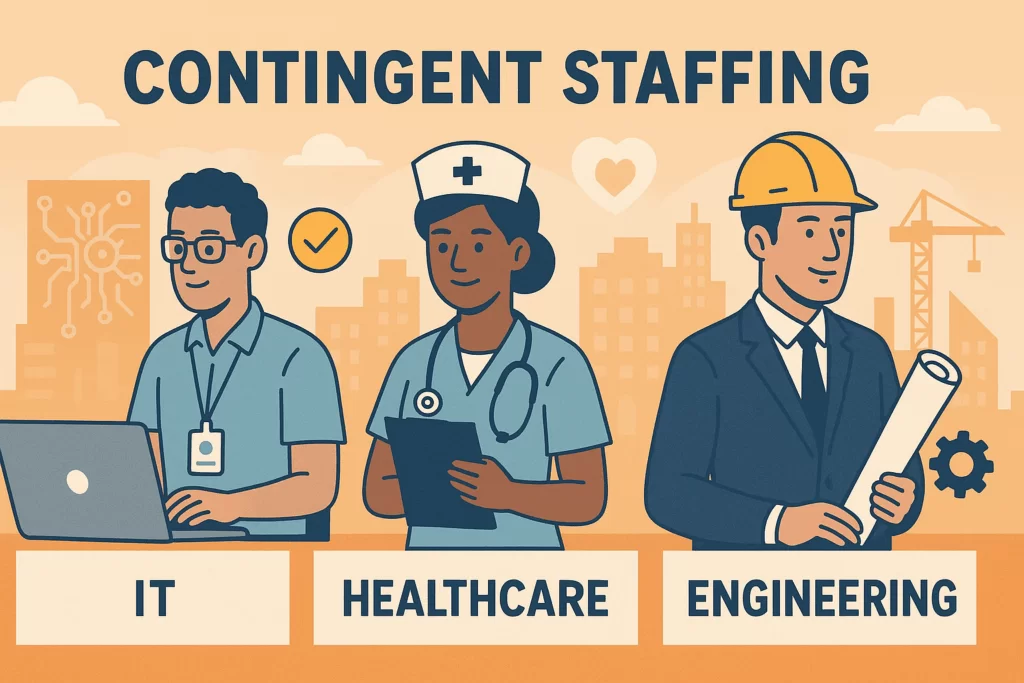
Contingent staffing, hiring non-permanent talent as needed, is reshaping workforce strategies in IT, healthcare, and engineering. Organizations embrace contingent hiring and contract staffing services because they offer unmatched flexibility, access to niche skills, and cost efficiency. These models enable businesses to respond quickly to shifting project demands and talent gaps.
Understanding Contingent Staffing, Contingent Hiring, and Contract Staffing Services
Contingent staffing refers to hiring professionals on a temporary, contract, or freelance basis instead of full-time employment. Contingent hiring and contract staffing services allow organizations to scale their workforce up or down, bringing in specialized expertise for defined durations.
Unlike permanent hiring, contingent staffing supports agility, rapid deployment, and tailored solutions for short- or medium-term projects. These models are especially valuable in industries where speed, adaptability, and specialized knowledge are critical.
Recent Statistics Highlighting the Shift Toward Contingent Staffing
- NexusCW (2025) projects that over 40% of the global workforce will be contingent by 2025. This demonstrates how businesses increasingly rely on flexible labor models. (nexuscw.com)
- A 2024 Deloitte report found that 41% of companies expect to increase their use of contingent workers, reflecting a shift toward flexibility. (conexisvmssoftware.com)
- The same study revealed that contingent workers currently make up 30–40% of the U.S. labor market, with projections to reach 50% by 2050.
- Staffing Industry Analysts (SIA, 2024) reported that while overall spend on temporary labor dipped 4% year over year, engineering and locum tenens staffing showed growth, with 2% and 10% revenue increases, respectively. (staffingindustry.com)
- Forbes, 2022, citing SIA data, reported 33 million contingent workers in the U.S. in 2021, representing nearly $1.7 trillion in total spend. (forbes.com).
Why Contingent Staffing Matters in IT, Healthcare, and Engineering
What is contingent staffing in IT?
Contingent staffing in IT involves hiring contract or freelance professionals, such as developers, cloud engineers, or cybersecurity experts, for project-based or specialized tasks without long-term commitments.
Why it is gaining traction:
- Rapid innovation cycles demand flexible staffing that can scale up or down quickly.
- Niche skills such as artificial intelligence, telehealth platforms, and cybersecurity are easier to access through contract staffing services.
- IT companies benefit from reduced payroll overhead while maintaining access to top talent.
What is contingent staffing in healthcare?
Healthcare contingent staffing includes roles like locum tenens physicians, per diem nurses, and travel clinicians. These professionals are hired on flexible contracts to meet urgent or seasonal patient care needs.
Why it is on the rise:
- Persistent staffing shortages and high burnout rates have made flexible hiring a necessity.
- Models such as per diem nursing and locum tenens contracts provide continuity of care while reducing staff fatigue.
- AI-powered scheduling and matching platforms help organizations fill roles more efficiently, improving patient care outcomes.
What is contingent staffing in engineering?
Engineering contract staffing involves engaging specialists such as civil engineers, project leads, or quality assurance experts for defined project timelines or niche technical requirements.
Why it is increasingly adopted:
- Demand for engineering skills remains high despite economic uncertainty. Digital engineering, renewable energy, and infrastructure projects require specialized expertise.
- Employers are shifting from transactional staffing toward strategic partnerships that ensure project success while managing workforce costs.
- Contingent hiring provides the flexibility to meet project peaks without carrying long-term payroll burdens.
Comparison Table: Contingent vs. Permanent Staffing
| Aspect | Contingent (Contract) Staffing | Permanent Staffing |
|---|---|---|
| Employment Duration | Short-term, project-based | Long-term, ongoing |
| Flexibility | High, scalable staffing aligned to workload peaks | Low, dependent on fixed headcount cycles |
| Cost Structure | Pay per assignment, fewer overhead costs | Salaries, benefits, and training expenses |
| Access to Specialists | High, niche talent available quickly | Limited, depends on internal workforce |
| Hiring Speed | Fast, roles filled in days or weeks | Slower, involves lengthy recruitment cycles |
| Strategic Use | Tactical, solves immediate project needs | Strategic, builds culture and continuity |
| Risk Management | Lower, no long-term obligations | Higher, includes severance and turnover risks |
Quick Facts • Key Takeaways
- By 2025, 40% of the global workforce will be contingent.
- 41% of companies plan to increase contingent hiring.
- Contingent workers already make up 30–40% of the U.S. labor market, projected to reach 50% by 2050.
- Healthcare contingent staffing generated $1.7 trillion in spend with 33 million contingent workers in the U.S. as of 2021.
- Engineering and locum tenens staffing showed positive revenue growth in 2024, even when other contingent categories declined.
Strategic Benefits of Contingent Staffing by Sector
Contingent Staffing In IT:
- Ability to deploy skilled professionals quickly for high-priority projects.
- Cost savings by avoiding long-term commitments for temporary needs.
- Access to niche expertise such as AI, cybersecurity, and cloud architecture.
Contingent Staffing In Healthcare:
- Maintains continuity of patient care during staffing shortages.
- Provides relief from burnout through per diem and locum models.
- Improves scheduling efficiency with AI-enabled staffing tools.
Contingent Staffing In Engineering:
- Bridges gaps in technical expertise during critical project phases.
- Reduces long-term overhead while ensuring compliance and quality.
- Supports innovation in areas such as green energy and infrastructure.
Real-World Example
A large healthcare provider faced simultaneous challenges: a rise in telehealth demand, a shortage of nurses, and infrastructure upgrades for digital platforms. Through contingent hiring:
- IT contractors were deployed to expand telehealth systems.
- Locum tenens nurses ensured patient care continuity.
- Engineering contractors managed upgrades for hospital infrastructure.
This mix of contract staffing services allowed the organization to stay agile, maintain care quality, and control costs.
How to Navigate Contingent Hiring Effectively
1. Define Objectives
Clarify whether the need is short-term project support, interim coverage, or niche technical skills.
2. Choose the Right Model
Options include freelance contracts, per diem staffing, travel assignments, or project-based hires.
3. Use Technology Tools
AI-driven platforms streamline credentialing, scheduling, and candidate matching.
4. Ensure Compliance
Partner with providers who understand labor laws and regulations in your industry.
5. Measure Outcomes
Track cost savings, hiring speed, and performance metrics to assess ROI.
Conclusion
Contingent staffing, whether through contract staffing services, contingent hiring, or flexible workforce models, is no longer an optional strategy. It is now essential across IT, healthcare, and engineering because it delivers agility, access to top talent, and cost efficiency. With projections showing contingent work could reach 40% of the global workforce by 2025, businesses that embrace these strategies will be best positioned to thrive.
Is your organization ready to benefit from contingent staffing? Contact VIVA USA today to explore customized contract staffing services designed for IT, healthcare, and engineering. Let us help you build a flexible, skilled, and scalable workforce for the future.