Navigating the Onboarding Process at a Staffing Agency: A Comprehensive Guide
If you have worked with a staffing agency before, you already know how the system functions. But if you are new to the world of staffing, recruitment, or employment agencies, you might be wondering what to expect when you are hired by one.
One of the most important parts of your journey with a staffing agency is the onboarding process. Onboarding is not just about signing forms and completing paperwork. It is the process that prepares you to start working with both your staffing agency and its end-client.
Unlike traditional full-time employment, onboarding with a staffing agency involves two layers of compliance. You must meet the agency’s requirements as your direct employer and the specific requirements of the client company where you will perform your job.
This guide provides a comprehensive overview of each stage of the onboarding process so you can understand what to expect and how to navigate it smoothly.
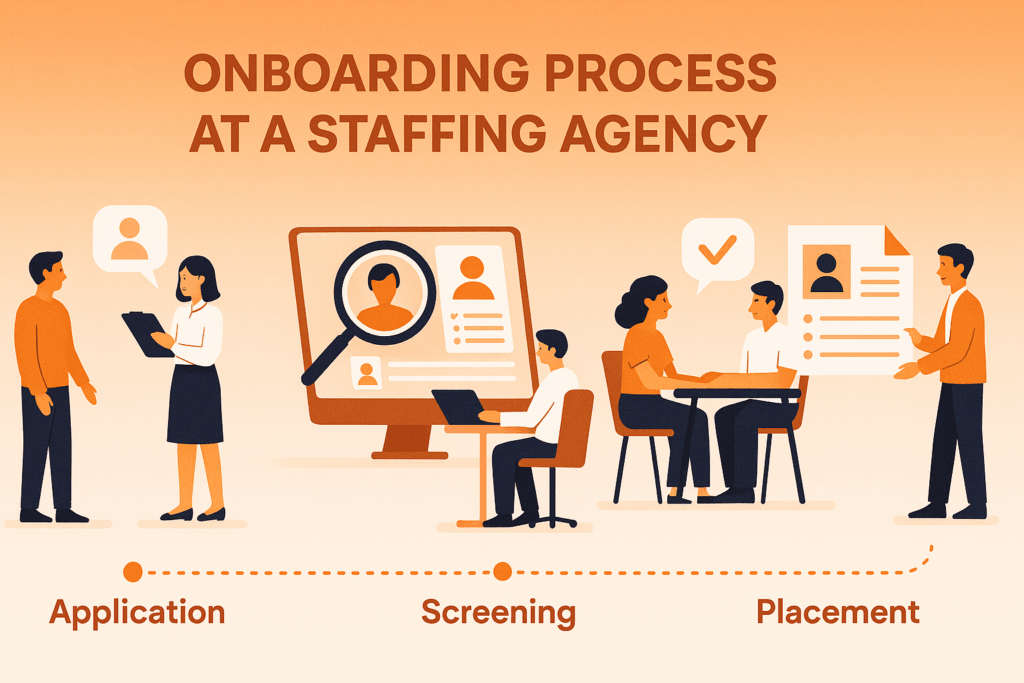
Onboarding Process at a Staffing Agency
1. Introduction to Your Assignment and Client
Once you accept a job offer from a staffing agency, the onboarding process usually begins with an introductory meeting. This meeting can be conducted by your recruiter, account manager, or a member of the HR team.
During this session, you will learn the details of your upcoming assignment, including your job responsibilities, work location, reporting structure, and client expectations. The agency will also share company policies that apply to you as their employee, as well as guidance on who to contact if you have questions about payroll, scheduling, or HR matters.
The goal of this step is to ensure you clearly understand your relationship with both parties. You are an employee of the staffing agency but will perform work for the end-client. Knowing this distinction early helps prevent confusion later.
2. Background Verification and Drug Screening
Before you begin working, the agency will typically conduct a background check and drug screening. These screenings are standard across most staffing agencies, but the exact requirements depend on the nature of your assignment and the client’s policies.
For example, a software developer assigned to an insurance company may undergo a detailed background check focused on data security, while a forklift operator working at a warehouse may be required to complete drug and safety screenings.
These steps ensure that both you and the client maintain a safe, compliant, and trustworthy work environment. Completing these checks promptly also helps you start your assignment faster.
3. Federal and State-Mandated Paperwork
Every employee in the United States must complete certain federal and state forms during onboarding, regardless of where they work. These include:
- Form I-9 (Employment Eligibility Verification): Verifies your identity and authorization to work in the U.S. You will need valid identification such as a driver’s license, passport, or Employment Authorization Document (EAD).
- Form W-4 (Employee’s Withholding Certificate): Determines how much federal income tax your employer should withhold from your paycheck.
- State withholding forms: Required if you live in a state with income tax.
Make sure your identification documents are current and will not expire during your contract. Completing these forms accurately avoids payroll delays and compliance issues later.
4. Employment Agreements and Employee Handbooks
After the mandatory forms, you will receive your employment agreement. This document outlines your responsibilities, pay rate, work schedule, and terms of employment. It may also contain important policies about confidentiality, attendance, and code of conduct.
Because staffing agencies do not directly oversee your day-to-day work at the client’s site, they use this agreement to clarify expectations and legal protections. You should read this document carefully and ask questions if anything is unclear.
In addition, most agencies provide an employee handbook. This handbook contains valuable information about your rights, benefits, workplace conduct, and procedures for resolving issues. Keep this document easily accessible. It will serve as a reference for how to handle challenges such as reporting absences, addressing harassment, or requesting leave.
5. Health Insurance, 401(k), and Other Benefits
Your eligibility for benefits depends largely on the length and type of your contract.
If you are hired for a short-term assignment (for example, one month), you may not qualify for benefits like health insurance or a 401(k) plan. However, if you are placed on a longer contract (for example, six months or more), you are more likely to receive benefits options.
Typical benefits may include:
- Medical, dental, and vision insurance
- Retirement savings plans (401(k))
- Paid time off (depending on agency policy)
- Holiday pay
- Employee assistance programs
Always review the benefits package carefully. Each staffing agency has its own eligibility criteria and waiting periods, so confirm your coverage start date and any employee contribution requirements before signing up.
6. Client-Specific Paperwork
Depending on the client you will work for, you may be asked to complete additional documentation. These requirements vary by industry, role, and the client’s internal policies.
For example:
- A software developer may need to sign a data privacy agreement or a non-disclosure agreement (NDA) to protect sensitive information.
- A forklift driver may need to acknowledge workplace safety policies, dress codes, or equipment handling procedures.
Other common client-specific forms include:
- Code of Conduct or Ethics policy acknowledgments
- Data security or information protection policies
- Health and safety compliance forms
- Conflict of interest declarations
Even though these forms come from the client, it is critical to complete them through your staffing agency. Failing to do so could delay your start date or even disqualify you from the assignment.
7. Training and Orientation
Some staffing agencies provide training programs during onboarding. Training can include:
- A general orientation on agency policies and workplace expectations
- Client-specific training, such as cybersecurity awareness or safety procedures
- Role-specific training related to your job duties
- State-mandated training programs, such as anti-harassment or workplace discrimination training
Not all assignments require training, but when it is provided, take advantage of it. Training not only prepares you for your first day on the job but also helps you integrate more easily into your client’s workplace culture.
8. Digital Onboarding Systems
In today’s digital workplace, many staffing agencies use online HR Information Systems (HRIS) or electronic signature platforms to streamline onboarding. Through these systems, you can complete your forms, review policies, and sign documents electronically.
These platforms make the process faster and more convenient for both you and the agency. However, if you prefer completing paperwork in person or on paper, most agencies can accommodate that request. The goal is to make onboarding efficient and accessible to everyone, regardless of their comfort level with technology.
9. Balancing the Pros and Cons of the Onboarding Experience
The onboarding process at a staffing agency offers unique benefits and challenges. On the positive side, you gain exposure to a variety of policies, documents, and compliance procedures that expand your understanding of how businesses operate. This experience can be valuable if you pursue leadership or HR roles in the future.
However, the process can also feel overwhelming, especially if you are completing paperwork for both the agency and the client. Take your time, ask questions, and remember that accuracy and thoroughness during onboarding will help you avoid confusion later.
10. Understanding Your Employment Relationship
Perhaps the most important takeaway from the entire onboarding experience is understanding who your true employer is.
As a staffing agency employee, your employer is the staffing agency, not the client company where you are assigned to work. While the client supervises your daily activities, your paycheck, benefits, and HR support come from the agency.
If you have issues related to payroll, benefits, time-off requests, or workplace conflicts, you should always contact your recruiter, account manager, or HR representative at the agency. The client company typically cannot resolve those issues directly because your employment contract is with the staffing agency.
Conclusion
Understanding the onboarding process at a staffing agency helps you start your assignment with confidence and clarity. While the steps may seem detailed, each one serves an important purpose. They ensure compliance, protect your rights, and prepare you for success in your role.
Remember, the onboarding process is more than a formality. It is your opportunity to build a strong relationship with your staffing agency, understand your benefits and obligations, and establish open communication channels with your recruiter or HR team.
By approaching onboarding with patience and attention to detail, you not only set yourself up for a smooth start but also demonstrate professionalism to both your agency and its clients.
The staffing agency is your employer, advocate, and resource. From the first form you sign to your first day on assignment, your agency has your back and that partnership is what makes staffing work.