H-1B Fee Impact on IT Hiring: How US Employers Fill IT Roles Without New Visa Petitions
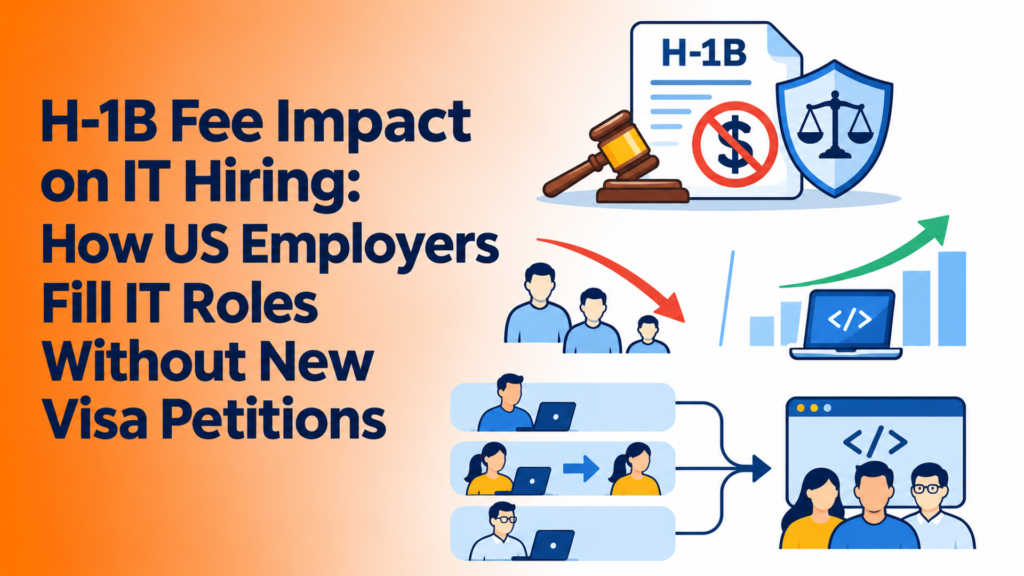
The H-1B fee impact on IT hiring is the shift in cost, speed and risk that US employers face when a new H-1B petition for a worker abroad carries a $100,000 payment. In November 2026, federal court orders bar USCIS from collecting that fee, but a 2027 extension and a separate proposed fee keep the risk alive, so many IT leaders now fill roles with domestic contractors, contract-to-hire and permanent hires instead.
Key Takeaways
- A September 2025 presidential proclamation added a $100,000 payment to certain new H-1B petitions filed on or after September 21, 2025.
- A September 18, 2026 proclamation extended the $100,000 H-1B fee through September 21, 2027, but federal court orders currently block USCIS from collecting it.
- Extensions of stay, most changes of status inside the United States and petitions for workers already holding valid H-1B visas were exempt from the fee.
- H-1B weighted selection now gives a Level IV wage offer four entries in the lottery and a Level I offer only one entry.
- The most cost-effective H-1B alternatives for employers are domestic IT contractors, contract-to-hire and direct hire, with an owned Global Capability Center for long-term capacity.
H-1B Fee Impact on IT Hiring: Where the $100,000 Fee Stands in November 2026
The $100,000 H-1B fee is legally in force on paper but blocked in practice. A September 18, 2026 proclamation extended it through September 21, 2027, yet two federal district courts have vacated or blocked the agency policies that collect it. As of November 2026, employers filing new H-1B petitions do not have to include the payment.
The fee began with a proclamation that took effect on September 21, 2025. In June 2026, the US District Court for the District of Massachusetts vacated the fee policy, and the First Circuit declined to pause that ruling in July 2026. Fragomen reported that USCIS remains barred from collecting the fee even after the 2026 extension.
The picture is still moving. A second court in the Northern District of California blocked the policies under both proclamations on September 30, 2026, and the government has appealed. DHS has also proposed a separate $103,265 fee on cap-subject petitions, which is not yet in effect. A November 2026 legal update lists the open appeals in detail.
Who Has to Pay the $100,000 H-1B Fee and Who Is Exempt?
The fee applied mainly to new petitions for workers outside the United States who needed consular processing. These groups were exempt or largely exempt:
- Extensions of stay for current H-1B workers, including routine renewals with the same employer.
- Most changes of status inside the United States, such as an F-1 graduate moving to H-1B.
- Petitions filed for workers who already hold a valid H-1B visa.
- Petitions filed before 12:01 a.m. Eastern on September 21, 2025.
How H-1B Weighted Selection Changes the Odds
H-1B weighted selection is defined as a lottery that gives more entries to higher wage offers. Under the FY2027 rules, a Level IV offer receives four entries, Level III three entries and Level I only one, as Adams and Reese explains. Entry-level IT roles now face lower odds even when the fee is not collected.
How the H-1B Fee Impact on IT Hiring Shows Up in the Data
The H-1B fee impact on IT hiring is clearest in falling registrations from the largest IT services firms. Demand for US tech talent keeps growing at the same time, which means fewer visa-based hires are chasing more open roles. That gap is pushing employers toward domestic talent pipelines and flexible staffing.
According to Staffing Industry Analysts (2026), FY2027 H-1B registrations fell 95% at TCS and 91% at Infosys, while Cognizant’s dropped to zero.
According to Staffing Industry Analysts (2026), USCIS reported a 38.5% decrease in properly submitted FY2027 H-1B registrations after the selection process changed.
According to CompTIA (2026), US net tech employment is projected to grow 1.9% in 2026 to about 9.8 million workers.
According to the US Bureau of Labor Statistics (2026), about 280,000 openings are projected each year in computer and information technology occupations, with a median annual wage of $109,470 in May 2025.
Skills pressure adds to the squeeze. According to CompTIA (2026), more than 275,000 active US job postings in January 2026 referenced AI skills. Our guide to the most in-demand IT roles in 2026 covers where that demand is concentrated.
H-1B Alternatives for Employers: Cost-Effective Ways to Reduce the H-1B Fee Impact on IT Hiring
Here are the top ways to fill hard-to-hire IT roles without a new visa petition: hire domestic IT contractors through a staffing partner, use contract-to-hire to test fit before converting, recruit permanent employees for core roles, transfer or extend existing H-1B workers who are exempt, and build an owned Global Capability Center for long-term capacity.
- Domestic IT contractors: fastest start for cloud, data, cybersecurity and AI projects with a defined scope.
- Contract-to-hire: a trial period, often three to six months, before a permanent offer.
- Direct hire: permanent recruitment for architects, engineering managers and other core roles.
- Existing H-1B talent: hiring workers who already hold valid H-1B status, since those petitions were exempt.
- Owned capability center: an enterprise-owned center for sustained engineering and operations work.
How Do Domestic IT Contractors and Contract-to-Hire Compare on Cost and Speed?
The difference between domestic IT contractors and contract-to-hire is commitment. A contractor covers a project and leaves, while contract-to-hire converts a proven performer into a full-time employee. The table compares the main options.
| Model | Typical speed to start | Cost structure | Best fit |
|---|---|---|---|
| Domestic IT contractors | Days to weeks | Hourly bill rate, no benefits or visa costs | Projects, surges, niche skills |
| Contract-to-hire | Days to weeks | Hourly rate, then salary plus any conversion fee | Roles where fit must be proven |
| Direct hire | Several weeks | One-time placement fee plus salary | Long-term core roles |
| New H-1B petition from abroad | Months, tied to the lottery cycle | Filing and legal costs plus a possible $100,000 fee | Rare skills with no domestic supply |
For a deeper look at rates and models, read IT staff augmentation costs and how to choose a partner and temporary staffing vs. permanent hiring.
When Does an Owned Global Capability Center Make Sense?
An owned Global Capability Center makes sense when an enterprise needs a stable team of 50 or more engineers for three years or longer. The company owns the center, its processes and its intellectual property, which suits product engineering, QA automation, analytics and IT operations rather than one-off projects.
A Global Capability Center is a long-term operating decision, not a quick hiring fix. CIOs should weigh governance, setup time and leadership capacity before choosing it over domestic staffing.
Illustrative Example: Pricing the H-1B Fee Impact on IT Hiring for One Role
This illustrative estimate shows why many employers now favor domestic options. If the $100,000 fee were reinstated, spreading it over a three-year initial H-1B period adds about $33,333 per year, or roughly $16 per hour at 2,080 working hours a year, before filing fees, legal costs or salary.
Assumptions: one new petition for a worker abroad, a three-year initial period and full-time hours. If the worker left after 18 months, the effective cost would double to about $32 per hour of service delivered. A domestic contractor carries no such sunk cost, and a contract-to-hire arrangement lets the employer confirm fit before taking on permanent salary and benefits.
Consider a regional health insurer that needs four Azure data engineers for a 12-month migration. Rather than wait for the March lottery, it brings in domestic contractors within weeks and converts the two strongest to employees. VIVA’s banking data architecture case study shows how experienced data talent supports this kind of transformation.
Planning for the H-1B Fee Impact on IT Hiring in 2027: Steps for HR and Procurement
HR and procurement should treat the H-1B fee impact on IT hiring as a standing risk for 2027, not a closed issue. Build budgets that do not depend on new visa petitions, pre-approve contract and contract-to-hire options with staffing partners, and track court rulings and the proposed DHS fee rule each quarter.
- Audit your current H-1B workforce: list extension dates, since extensions and transfers of existing holders were exempt.
- Reclassify open roles: mark which roles can be filled by domestic IT contractors, contract-to-hire or direct hire.
- Update rate cards: negotiate contract and conversion terms with your staffing vendors before Q1 2027 budgets close.
- Model the worst case: price any remaining visa-dependent roles with the $100,000 fee included.
- Review quarterly: assign counsel to report on the First, Ninth and D.C. Circuit appeals and any final DHS rule.
How VIVA USA Helps Reduce the H-1B Fee Impact on IT Hiring
VIVA USA reduces the H-1B fee impact on IT hiring by filling roles with domestic IT talent through contract, contract-to-hire and direct placement models. With more than 25 years in IT recruiting, VIVA sources cloud, data, cybersecurity, AI and ERP professionals, including candidates with security clearances for government work.
VIVA’s IT staffing services draw on a database of more than one million pre-vetted candidates and fill many IT roles within 48 to 72 hours. For long-term hires, VIVA’s permanent staffing team handles direct hire and executive search.
Conclusion: Managing the H-1B Fee Impact on IT Hiring
The H-1B fee impact on IT hiring is real even while courts block collection. First, the $100,000 fee is extended to 2027 but currently not collected. Second, weighted selection and falling registrations make new petitions less reliable. Third, domestic IT contractors, contract-to-hire and direct hire fill roles faster and with less risk. Contact VIVA USA to build an IT hiring plan for 2027.
FAQ
FAQ: H-1B Fee Impact on IT Hiring
These answers cover the $100,000 H-1B fee, who is exempt, weighted selection and the most practical H-1B alternatives for US employers filling IT roles.