How Do Customized Workflow Solutions Improve Operational Productivity?
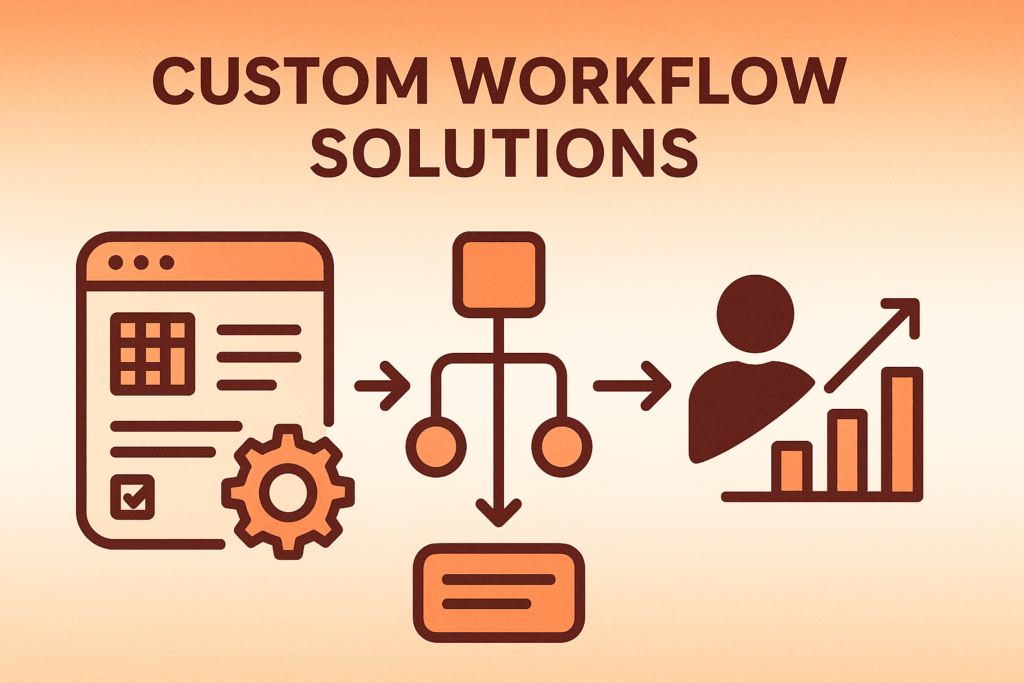
A well-designed customized workflow solution helps organizations streamline work, eliminate bottlenecks, and free teams to focus on value-adding tasks. The right system adapts to your processes, reduces manual intervention, and provides real-time visibility into business operations. In short, workflow automation for businesses transforms operations from manual and error-prone to agile, consistent, and scalable.
Customized workflow solutions improve operational productivity by automating repetitive tasks, enforcing standardized steps, and enabling visibility across teams. These solutions are built to match unique organizational processes, which means fewer errors, faster throughput, and greater efficiency compared to off-the-shelf automation tools.
Why Workflow Automation for Businesses Matters
What Is a Customized Workflow Solution?
A custom workflow management software is a platform designed to handle an organization’s specific sequence of tasks, approvals, and decision-making logic. Instead of imposing a one-size-fits-all template, custom solutions adapt to a company’s existing processes, integrate with core systems, and evolve as requirements change.
Generic workflow tools often require businesses to modify their operations to fit the tool. Customized solutions, on the other hand, mold the automation around the business itself, creating a smoother and more productive environment.
Key Benefits of Workflow Automation
- Reduced manual effort: Automation handles repetitive processes such as notifications, data entry, routing, and approvals.
- Fewer errors and rework: Validation rules and standardized logic minimize costly mistakes.
- Faster throughput: Automated workflows eliminate delays caused by manual handoffs.
- Better visibility and reporting: Dashboards provide insights into where work is delayed and how processes can be optimized.
- Greater scalability and agility: Customized workflows adapt to new regulations, changing business models, or market demands.
These factors together drive substantial improvements in operational performance.
Supporting Statistics: The Impact of Workflow Automation
- The global workflow automation market was valued at USD 20.3 billion in 2023 and is expected to grow at a CAGR of 10.1% between 2024 and 2032. (Global Market Insights, 2023)
- In 2025, businesses using automation reported saving 500+ hours per year in finance alone, with ROI between 30–200% in year one. (BigSur AI, 2025)
- A survey found that 94% of companies still complete repetitive tasks manually, while 66% of those adopting automation experienced productivity gains. (Kissflow, 2024)
- Workflow automation reduces email volume by up to 60%, improving team communication and efficiency. (Gitnux, 2024)
- Demand for automation is increasing across industries, with 73% of CFOs planning to increase automation investment to improve operational resilience. (Deloitte, 2023)
How Customized Workflow Solutions Drive Productivity
Tailored Workflow Logic for Domain-Specific Needs
Customized workflows capture business-specific rules such as compliance steps, exception handling, and role-based routing. This ensures every process runs as intended without human interpretation.
A customized workflow solution encodes business-specific logic, including approvals, exceptions, and conditional rules. This eliminates manual guesswork, accelerates handoffs, and enforces consistency, leading to faster and more accurate operations.
For example, in procurement, a company may set approval thresholds that vary by supplier category. A custom workflow ensures these rules are enforced automatically without additional checks.
Seamless Integration with Core Systems
Custom workflow solutions connect directly with CRM, ERP, HR, and financial platforms, ensuring smooth data exchange and reducing duplication.
- Sales teams benefit when closed deals in CRM automatically generate invoice drafts in accounting software.
- HR departments can integrate onboarding workflows with payroll and IT systems, creating a seamless experience for new hires.
This eliminates manual updates and prevents errors caused by siloed systems.
Dynamic Routing, Escalations, and Exception Handling
Custom workflows allow advanced conditional logic and automated escalation.
- If an approval is delayed, the workflow automatically routes the task to a senior manager.
- If data is incomplete, the system reroutes the task back to the originator for correction.
This ensures tasks keep moving, preventing bottlenecks and maintaining operational momentum.
Visibility, Monitoring, and Analytics
Custom workflows provide leadership with a clear view of operations:
- Cycle time analysis: Identify where delays occur.
- Exception tracking: Spot recurring issues that need process redesign.
- Workload distribution: Understand resource allocation and balance team responsibilities.
With these insights, organizations can refine workflows continuously, ensuring productivity keeps improving.
Scalability and Long-Term Adaptability
Unlike rigid off-the-shelf solutions, custom workflows grow with the business.
- New approval stages, compliance requirements, or integration endpoints can be added over time.
- Different regions or business units can operate slightly different versions of the same workflow.
- Continuous improvement cycles ensure automation remains aligned with evolving strategies.
This adaptability is critical for organizations in fast-changing industries such as healthcare, IT, and finance.
Comparison: Custom vs Generic Workflow Tools
| Aspect | Generic Tool | Customized Workflow Solution |
|---|---|---|
| Process Alignment | Requires business to adapt | Aligns with existing workflows |
| Flexibility | Limited configurations | Highly flexible |
| Integration | Basic APIs or connectors | Deep, enterprise-level integration |
| Routing Logic | Simple, linear flows | Complex, conditional, dynamic |
| Scalability | May struggle at enterprise scale | Designed for growth and complexity |
| Long-Term ROI | Diminishes with growth | Expands with evolving needs |
Real World Examples
- Corporate Expense Management: A financial services firm used AI-enabled workflow automation for expense reporting, reducing processing time by 80% while improving compliance accuracy.
- HR Onboarding Automation: A global tech company automated onboarding tasks such as account setup, training enrollments, and payroll registration. Cycle time dropped from 14 days to 4 days.
- Healthcare Records Management: A hospital automated patient intake and record transfers. Staff reclaimed hundreds of hours per month, allowing more time for patient care.
Quick Facts and Key Takeaways
- Customized workflow solutions adapt to unique business needs instead of forcing changes.
- Workflow automation reduces repetitive tasks, improves accuracy, and speeds up cycle times.
- Integration with existing systems ensures smooth data flow and eliminates silos.
- Custom workflow management software supports dynamic routing, escalations, and exception handling.
- Automation can save 500+ hours annually in finance teams and deliver ROI up to 200% in the first year.
- The global automation market is growing at over 10% CAGR, reflecting strong business demand.
Best Practices for Implementing Custom Workflow Automation
- Start with process mapping: Document current workflows before automation.
- Prioritize high-impact workflows: Begin with simple, high-volume processes such as approvals or onboarding.
- Measure success with KPIs: Track cycle time, error reduction, and throughput.
- Ensure governance: Apply version control, rollback options, and structured change management.
- Adopt incremental rollout: Pilot in one department and expand gradually.
- Maintain continuous improvement: Use feedback loops and analytics to refine workflows over time.
- Involve end-users: Design workflows with user input to increase adoption and satisfaction.
Conclusion
Customized workflow solutions are powerful tools for improving operational productivity. By automating repetitive tasks, enforcing consistent business rules, providing real-time visibility, and scaling with organizational needs, these solutions deliver measurable benefits such as higher efficiency, reduced errors, and substantial ROI.
If you want to implement workflow automation for your business, build custom workflow management software, or explore the full range of workflow automation benefits, contact Viva today. Our team specializes in developing custom workflow portals that adapt to your unique processes and help you achieve long-term operational success.